

On this page
Questions like "find the point on the curve nearest to (0, 5)" appear in NCERT Class 12 maths and in JEE Main. There are two methods, and they lead to the same answer: use the normal through the point, or minimise the squared distance with calculus.
Why is the shortest distance always along the normal?
Picture a circle centred on your point P, growing until it first touches the curve. There the circle and curve share a tangent, and a radius is perpendicular to its tangent. So the shortest segment meets the curve at a right angle: it lies along the normal.
The UBC Math Exam Resources guide states the rule directly: the point on a curve closest to A is the point at which the normal line passes through A. For a straight line ax + by + c = 0, the distance is the perpendicular segment, of length |ax₀ + by₀ + c| / √(a² + b²) (Wikipedia). If the normal slope −1/(dy/dx) feels shaky, revise equations of tangents and normals first.
How do you find the shortest distance from a point to a parabola?
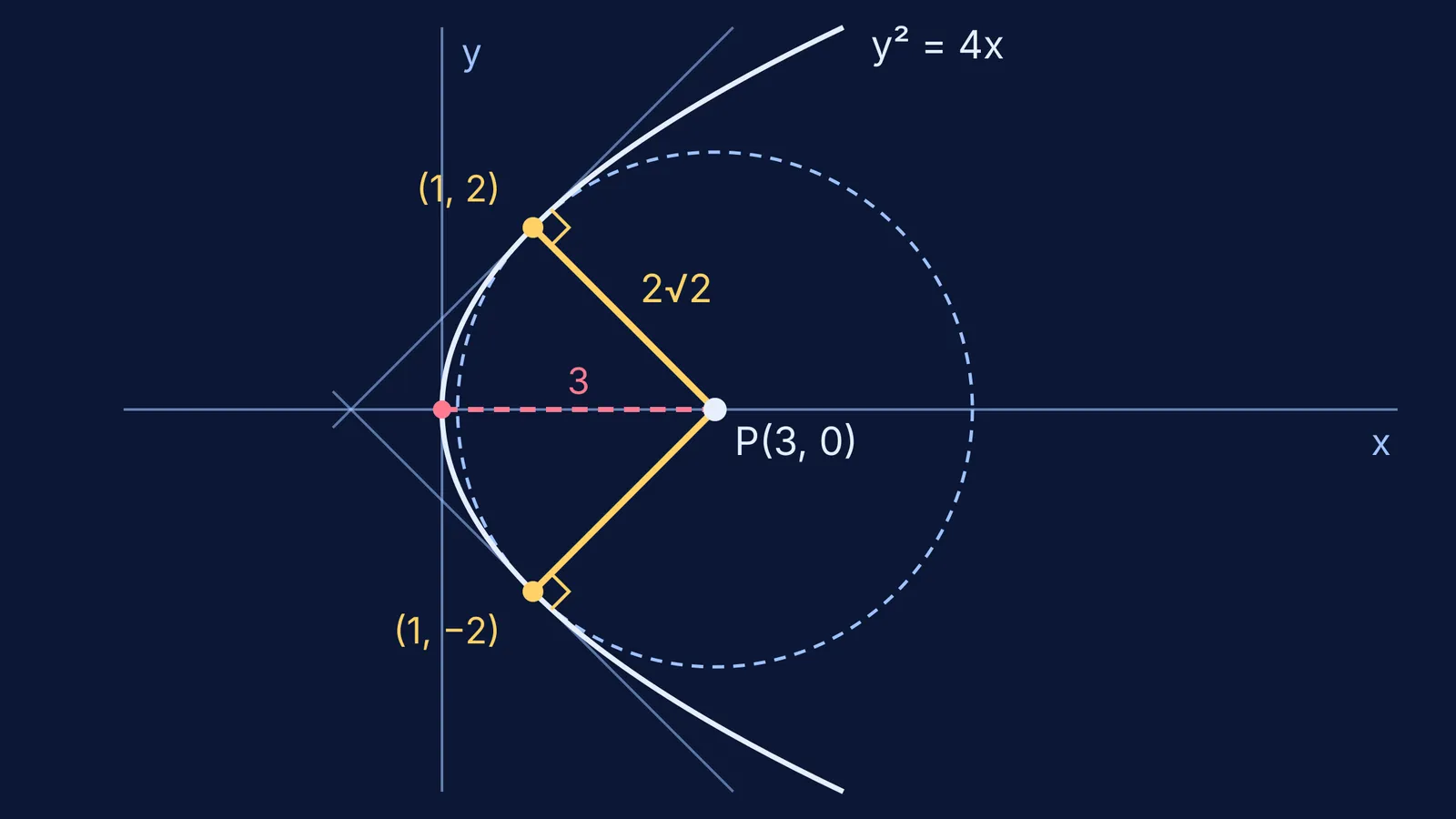
Take y² = 4x and the point P(3, 0).
Method 1, the normal. Write a general point as (t², 2t). The tangent slope there is 1/t, so the normal slope is −t, and the normal is y = −tx + 2t + t³. Make it pass through (3, 0): 0 = −3t + 2t + t³, so t³ − t = 0 and t = 0, 1 or −1. Candidates: (0, 0) at distance 3, and (1, ±2) at distance √(4 + 4) = 2√2, about 2.83. The shortest distance is 2√2. The vertex passed the normal test but lost the comparison, so always compare candidates.
Method 2, calculus. On the curve, D² = (x − 3)² + 4x = x² − 2x + 9. Its derivative 2x − 2 is zero at x = 1, where D² = 8 and D = 2√2.
Which point on x² = 2y is nearest to (0, 5)?
This NCERT Class 12 question (labelled Ex 6.3, Q27 on Teachoo) asks for the point on x² = 2y nearest to (0, 5), and lists (0, 0) as one of the options (worked solution on Teachoo/category/Ex-6.5)). With x² = 2y, D² = 2y + (y − 5)². The derivative 2 + 2(y − 5) is zero at y = 4, giving (±2√2, 4) and D = 3. The vertex is 5 away: that option is the trap.
The pattern behind it: for x² = 4ay and a point (0, c), the same working gives y = c − 2a, which only works when c > 2a. Lower than that, the vertex is nearest. For x² = 2y, a = 1/2, so the switch is at c = 1.
How do you find the shortest distance from a point to a circle?
Every normal to a circle passes through its centre C, so the shortest distance is |PC − r| and the longest is PC + r.
Example: x² + y² − 6x − 8y + 21 = 0 has centre (3, 4) and r = 2. From the origin, PC = 5, so the shortest distance is 3 and the longest 7. The nearest point is three-fifths of the way to the centre: (9/5, 12/5).
What is the shortest distance between a line and a curve?
If the line misses the curve, the nearest point is where the curve's tangent is parallel to the line.
JEE Main on 2 September 2020 (Shift 1) asked for the point P on y = x² + 7x + 2 nearest to the line y = 3x − 3 and the normal there (question and solution on Cracku). First check they do not meet: x² + 4x + 5 = 0 has a negative discriminant. Then 2x + 7 = 3 gives x = −2 and P(−2, −8). The distance is |3(−2) − (−8) − 3| / √10 = 1/√10, and the normal at P is x + 3y + 26 = 0, the listed answer. More conic normals are in parabola focal chords, tangents and normals.
A five-step checklist for any point-to-curve question:
If the point lies on the curve, or the line meets it, the distance is 0.
Choose one variable: parametric form, or substitute the curve into D².
Write the normal-through-P condition or D² in that variable.
Solve and list every candidate, including the vertex or endpoints.
Keep the smallest, and check the segment is perpendicular to the tangent at the nearest point.
Step 4 is where marks go: a stationary point is not always a minimum, as covered in maxima and minima applications. To practise until it is automatic, the Fermi Problem Library has worked problems with a step-by-step solver that explains the reasoning rather than printing an answer. If normals or parametric forms are the gap, start from the lesson in the Fermi Concept Library.
Try this yourself: find the shortest distance from (5, 0) to y² = 4x. You should get 4, at the points (3, ±2√3).


