

On this page
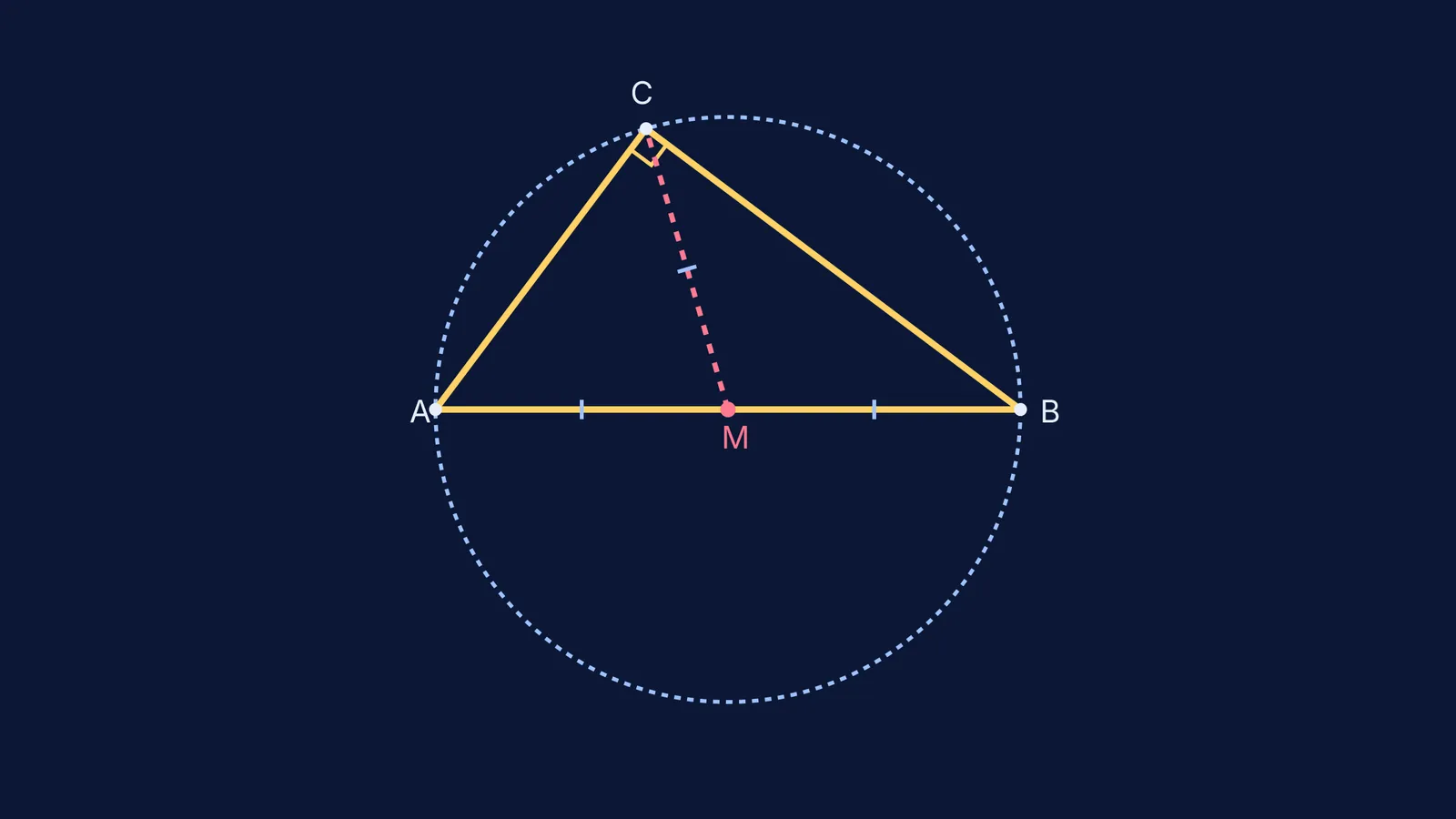
In geometry, a right-angled triangle has a special property: the midpoint of its longest side, the hypotenuse, is perfectly equidistant from all three of its vertices.
This simple fact creates a powerful shortcut for many geometry and algebra problems. Instead of calculating three separate distances to find the centre of a circumscribed circle, you only need to find the midpoint of the hypotenuse. Whether you are finding medians, graphing equations, or plotting triangle centres, this rule consistently saves time.
Why is the midpoint of the hypotenuse equidistant from the vertices?
The reason comes down to circles and a fundamental rule of geometry. According to Thales' theorem, an inscribed angle in a semicircle is always a right angle (MathWorld).
If you draw a circle around a right-angled triangle so that all three of its vertices touch the edge, the hypotenuse will always lie exactly across the middle of the circle, acting as its diameter. The midpoint of any diameter is the exact centre of the circle. Since all points on a circle's edge are the same distance from its centre, the distance from the midpoint of the hypotenuse to the three vertices is simply the radius of that circle.
This connection between right-angled triangles and circles appears frequently in exam problems, because it links distances and angles without requiring complex trigonometry.
How do you prove the midpoint of the hypotenuse is equidistant from the vertices?
You can prove this algebraic property using coordinate geometry in Class 10. By placing the triangle on a Cartesian graph, the distance formula confirms the distances are mathematically identical.
Set up the axes: Place the right angle at the origin, O(0, 0). Let the other two vertices lie on the axes: A(a, 0) on the x-axis and B(0, b) on the y-axis. This represents a generic right-angled triangle of any size.
Find the midpoint: The hypotenuse is the line segment connecting points A and B. Using the standard midpoint formula, the coordinates of the midpoint M are (a/2, b/2).
Measure the distances to the acute angles: The distance from M to A is half the hypotenuse. The distance from M to B is also exactly half the hypotenuse. Both of these lengths are √((a/2)² + (b/2)²).
Check the distance to the right angle: The distance from the midpoint M(a/2, b/2) to the origin O(0, 0) is calculated as √((a/2 − 0)² + (b/2 − 0)²). This expression simplifies to 1/2 √(a² + b²).
Compare the lengths: The total length of the hypotenuse AB, using the distance formula, is √(a² + b²). Therefore, the distance from M to O is exactly half the length of the hypotenuse, definitively proving that M is equidistant from A, B, and O.
How do you find the length of the median to the hypotenuse?
A median is a straight line drawn from a triangle's vertex to the midpoint of the opposite side. When you draw a median from the right angle to the hypotenuse, it connects the right angle directly to the midpoint.
Because we know the midpoint is equidistant from all three corners, the length of this specific median is always exactly half the length of the hypotenuse.
If a right-angled triangle has a hypotenuse of 10 cm, the median drawn to that hypotenuse will always be exactly 5 cm. You do not need to know the lengths of the other two sides or the internal angles to find this distance.
A worked example in coordinate geometry
Suppose a right-angled triangle has vertices at (0, 0), (6, 0), and (0, 8). How long is the median drawn from the right angle?
Step 1: Identify the right angle. Here, it is at the origin (0, 0) because the other points lie exactly on the perpendicular x and y axes.
Step 2: Find the length of the hypotenuse. Using the distance formula between the acute vertices (6, 0) and (0, 8), the length is √((6 − 0)² + (0 − 8)²) = √(36 + 64) = √(100) = 10.
Step 3: Halve the hypotenuse. The median is half of 10, which gives an exact length of 5.
This principle extends to finding triangle centres in coordinate geometry. If you are asked to find the circumcentre of a right-angled triangle on a test, you can completely skip the complex perpendicular bisector equations and simply average the coordinates of the hypotenuse.
Visualising these geometric rules algebraically takes practice, as you must learn to trust the coordinates to mirror the shapes. When you want to explore how these spatial and algebraic formulas connect, the Fermi Concept Library holds interactive lessons where Fermi's AI tutor can walk you through the proofs step by step, dynamically drawing the shapes and axes alongside the equations.


