

On this page
When you are working with an arithmetic progression (AP), finding the middle term is a common requirement in examination problems and mathematical proofs. Because an AP increases or decreases by a constant common difference, the sequence has a strict symmetry. If you know the total number of terms, you can quickly locate the exact center of the sequence.
How do you find the middle term when n is odd?
If the total number of terms (n) in a finite AP is odd, the sequence contains only one middle term. According to the standard definition of an arithmetic progression, the terms are spaced evenly. To find the exact center position, you add 1 to the total number of terms and divide by 2.
This means the position of the middle term is the (n + 1)/2 th term.
Once you have determined this position, you can calculate the term's value using the general AP formula. The general form of the nth term is written as a_n = a + (n - 1)d (Wolfram MathWorld), where a is the first term, d is the common difference, and n is the position.
Worked example: Locating the middle term
Let's find the middle term of the arithmetic progression: 6, 13, 20, ..., 216.
Identify the given values: The first term a = 6, the common difference d = 13 - 6 = 7, and the last term a_n = 216.
Find the total number of terms (n): Using the formula a_n = a + (n - 1)d, we set up the equation 216 = 6 + (n - 1)7. Subtracting 6 from both sides gives 210 = 7(n - 1). Dividing by 7 gives 30 = n - 1, which means n = 31.
Locate the middle position: Since 31 is an odd number, the middle position is (31 + 1) / 2 = 16.
Calculate the value: Find the 16th term using a_16 = 6 + (16 - 1)7. This simplifies to 6 + 105 = 111.
The middle term of this sequence is 111.
If you struggle with setting up equations like this, the Concept Library holds every concept in physics, chemistry, biology, mathematics and computing, each with its own lesson and its place in the map. And when you sit down to practice, the Problem Library has worked problems with a step-by-step solver that explains the reasoning rather than printing an answer.
What if the number of terms is even?
If the total number of terms (n) is even, the sequence does not have a single center point. Instead, the symmetry of the progression splits across two middle terms.
The positions of these two middle terms are n/2 and (n/2) + 1.
For example, if an arithmetic progression has 10 terms, the middle terms are the 5th and 6th terms. You would calculate both a_5 and a_6 to fully describe the center of the sequence.
How does the middle term relate to the sum?
Because an arithmetic progression grows at a constant rate, the terms are symmetric around the middle. This means the sum of the terms equidistant from the ends always equals the sum of the first and last terms. This same symmetry is why we often choose three numbers in an AP as a - d, a, and a + d to simplify their sum.
For an odd number of terms, the middle term is exactly the arithmetic mean of the first and last terms. You can find it quickly by calculating (a + a_n)/2, without ever needing to know the common difference d.
In our earlier example (where the first term is 6 and the last term is 216), the middle term is (6 + 216) / 2 = 222 / 2 = 111. This shortcut is incredibly useful for multiple-choice questions, giving you the answer in seconds.
Why is the middle term equal to the average?
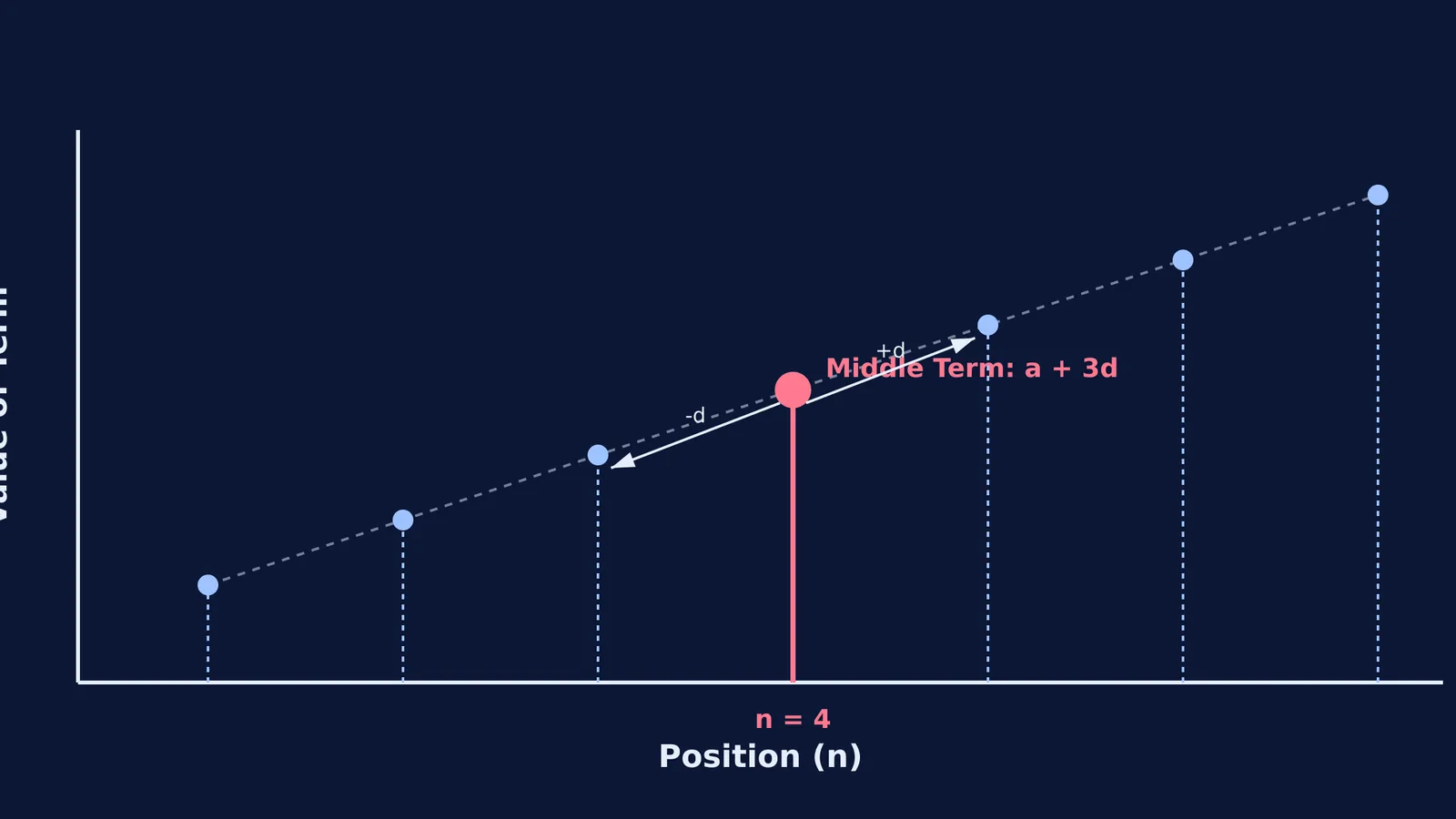
When you plot the terms of an arithmetic progression on a graph, they form a perfectly straight line. This linear behavior guarantees that the sequence is strictly symmetric. If you take steps outward from the center, the amount you add to reach the next higher term perfectly cancels the amount you subtract to reach the next lower term.
Imagine standing at the exact middle of an arithmetic sequence with an odd number of terms. If you walk one position to the right, the value changes by +d. If you walk one position to the left, the value changes by -d. If you take those two terms and add them together, the +d and -d completely cancel out. Their sum is exactly twice the middle term. This principle holds no matter how far you step outward, meaning the first term and the last term also add up to exactly twice the middle term. Consequently, dividing that sum by two will always give you the middle term.
Understanding this geometric property prevents you from relying entirely on rote memorization. When a problem gives you a long sequence and asks for the sum of its terms, recognizing that every pair of symmetric terms averages out to the middle value allows you to bypass tedious arithmetic.
A strategy for test questions
When facing an exam question asking for the middle term, use this simple checklist:
Check if the sequence is definitely an AP by confirming a constant difference.
Count the total number of terms. If you do not have n, use a_n = a + (n - 1)d to find it.
If n is odd, use (n + 1)/2. If n is even, use n/2 and (n/2) + 1.
To save time, if you know the first and last terms and n is odd, just average them. This is often the fastest route to solving arithmetic progressions in Class 10: nth term and sum problems.
This symmetry is not just a calculation trick; it is the fundamental property that allows us to find the sum of any arithmetic sequence quickly.


