

On this page
Why does methylamine form a brown precipitate with ferric chloride?
When you add aqueous methylamine (CH₃NH₂) to a pale yellow solution of ferric chloride (FeCl₃), an immediate reddish-brown gelatinous precipitate separates. In the NCERT Class 12 Chemistry textbook, this reaction forms a classic give-reason question in the chapter on amines. Students often find it puzzling because ferric chloride is an inorganic transition metal salt, while methylamine is an aliphatic organic amine.
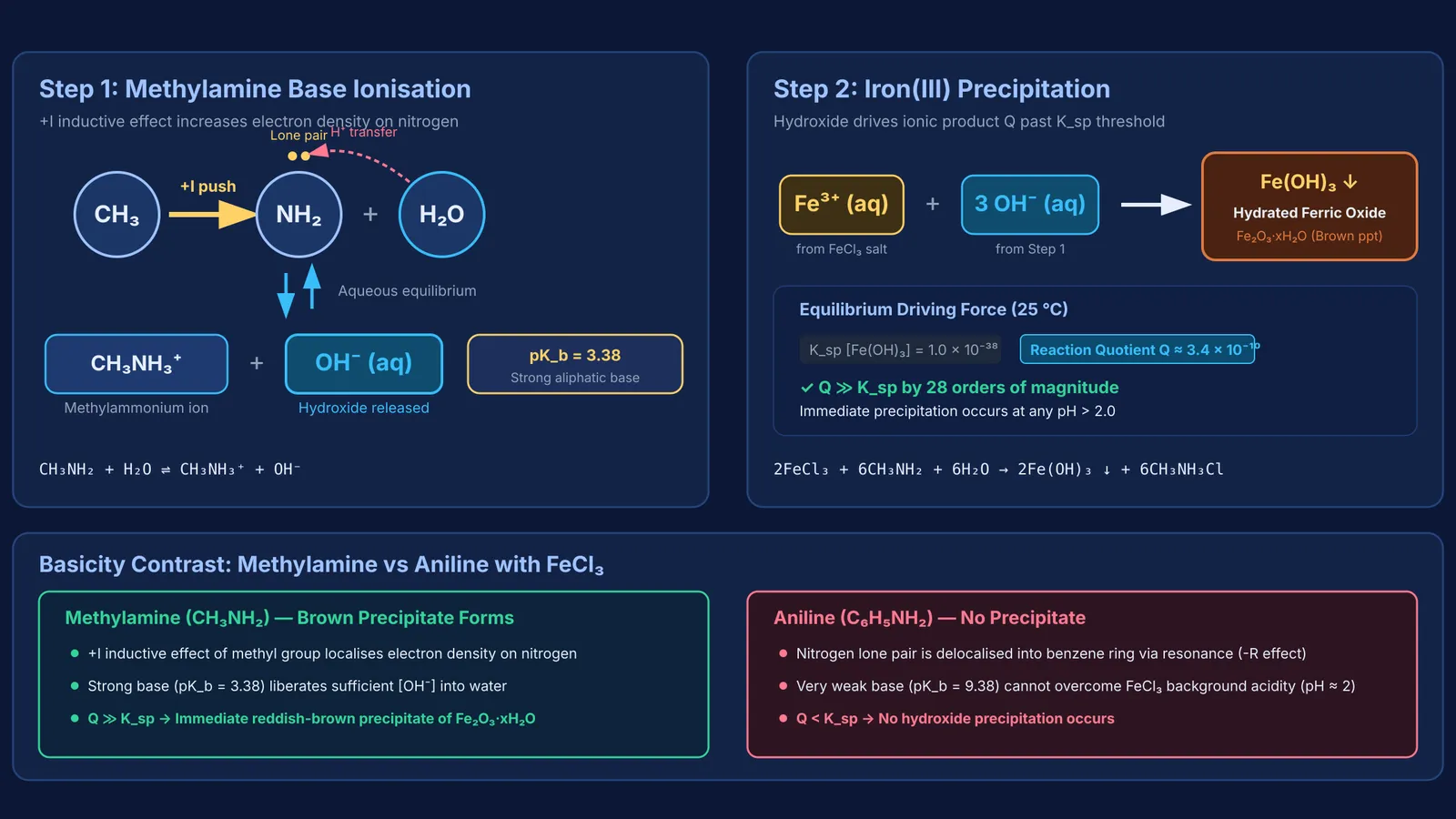
The reaction is an inorganic precipitation driven by acid-base equilibria rather than organic substitution. Methylamine dissolves in water to generate hydroxide ions (OH⁻). Ferric chloride dissociates completely into hydrated iron(III) cations (Fe³⁺) and chloride ions (Cl⁻). Because ferric hydroxide is exceptionally insoluble, the generated hydroxide ions immediately precipitate iron(III) as a reddish-brown solid, conventionally designated hydrated ferric oxide.
What is the chemical mechanism and reaction equation?
To understand the pathway, consider how each substance behaves in water. Methylamine contains an sp³-hybridised nitrogen atom with an unshared electron pair. According to the PubChem compound record for methylamine, the methyl group donates electron density through its positive inductive (+I) effect, making the lone pair more available to accept a proton than that of ammonia.
The reaction proceeds in two steps:
Base ionisation of methylamine:
CH₃NH₂ + H₂O ⇌ CH₃NH₃⁺ + OH⁻ As catalogued in NCERT Class 12 Chemistry, methylamine is a strong base with an aqueous pKb of 3.38 at 25 °C, compared to 4.75 for ammonia. The gaseous amine dissolves readily in water, as detailed in the NIST Chemistry WebBook.
Precipitation of iron(III):
Ferric chloride dissociates in water: FeCl₃(s) → Fe³⁺(aq) + 3Cl⁻(aq) The liberated hydroxide ions react with ferric ions: Fe³⁺(aq) + 3OH⁻(aq) → Fe(OH)₃(s) ↓ Freshly precipitated ferric hydroxide condenses into hydrated iron(III) oxide, Fe₂O₃·xH₂O.
The overall balanced equation is: 2FeCl₃ + 6CH₃NH₂ + 6H₂O → 2Fe(OH)₃ ↓ + 6CH₃NH₃Cl
You can review these principles in our guides to conjugate acid-base pairs and Kw and inductive and resonance effects in ranking bases.
How does the solubility product drive this reaction?
The reaction's physical driving force is the tiny solubility product (Ksp) of iron(III) hydroxide. According to equilibrium tables in NCERT Class 11 Chemistry, the Ksp of ferric hydroxide at 25 °C is 1.0 × 10⁻³⁸ (with thermodynamic tables listing values near 2.79 × 10⁻³⁹).
Consider mixing equal volumes of 0.1 M methylamine and 0.02 M FeCl₃. With Kb = 10⁻³·³⁸ (≈ 4.17 × 10⁻⁴), the equilibrium hydroxide concentration of 0.1 M methylamine is √(Kb × C) ≈ 6.46 × 10⁻³ M. Upon mixing equal volumes, dilution yields [Fe³⁺] = 0.01 M and [OH⁻] ≈ 3.23 × 10⁻³ M. The reaction quotient Q = [Fe³⁺][OH⁻]³ reaches approximately 3.4 × 10⁻¹⁰. Because Q exceeds Ksp by twenty-eight orders of magnitude, precipitation is instantaneous. Iron(III) precipitates at any pH above 2, so even a weakly alkaline amine solution forces it out.
Why does methylamine precipitate iron(III) while aniline does not?
Exam questions frequently compare methylamine with aromatic amines like aniline (C₆H₅NH₂). Adding ferric chloride to aqueous aniline yields no brown precipitate. This difference highlights how molecular structure governs reactivity:
In methylamine, the electron-releasing methyl group (+I effect) localises charge on nitrogen, producing a strong base with a pKb of 3.38.
In aniline, the nitrogen lone pair is delocalised into the benzene ring across resonance structures, raising its pKb to 9.38 as recorded in NCERT Class 12 Chemistry.
Aqueous ferric chloride is acidic (pH ≈ 2) due to hydrolysis. Aniline is too weak a base to generate enough OH⁻ to overcome this acidity and reach Ksp. Instead, aniline undergoes redox complexation, giving a dark solution rather than a hydroxide precipitate.
You can trace these electronic contrasts further in our guide to amines, diazonium salts and basicity order.
How should you write this answer in CBSE and competitive exams?
When writing this answer for examinations under CBSE curriculum guidelines, organize your explanation into four steps:
Identify basicity: State that methylamine is more basic than water due to the methyl group's +I inductive effect.
Write the ionisation: Give the equilibrium CH₃NH₂ + H₂O ⇌ CH₃NH₃⁺ + OH⁻.
Identify the metal cation: State that FeCl₃ dissociates into Fe³⁺ and Cl⁻.
State precipitation: Write Fe³⁺ + 3OH⁻ → Fe(OH)₃ ↓, noting that the reaction quotient exceeds Ksp to form brown hydrated ferric oxide.
Mastering how organic functional groups behave in aqueous equilibrium requires connecting different areas of the syllabus. The Fermi Concept Library maps every concept in physics, chemistry, biology, mathematics and computing, each with its own lesson and its place in the map, so you can trace how electronic effects link to inorganic qualitative analysis. If you want to test your problem-solving skills across multi-step chemistry questions, the Fermi Problem Library provides worked problems with a step-by-step solver that explains the reasoning rather than printing an answer.


