

On this page
When you compare two molecules with the exact same number of carbon, hydrogen, and oxygen atoms, you might expect them to have similar physical properties. Methyl acetate and propanoic acid prove otherwise.
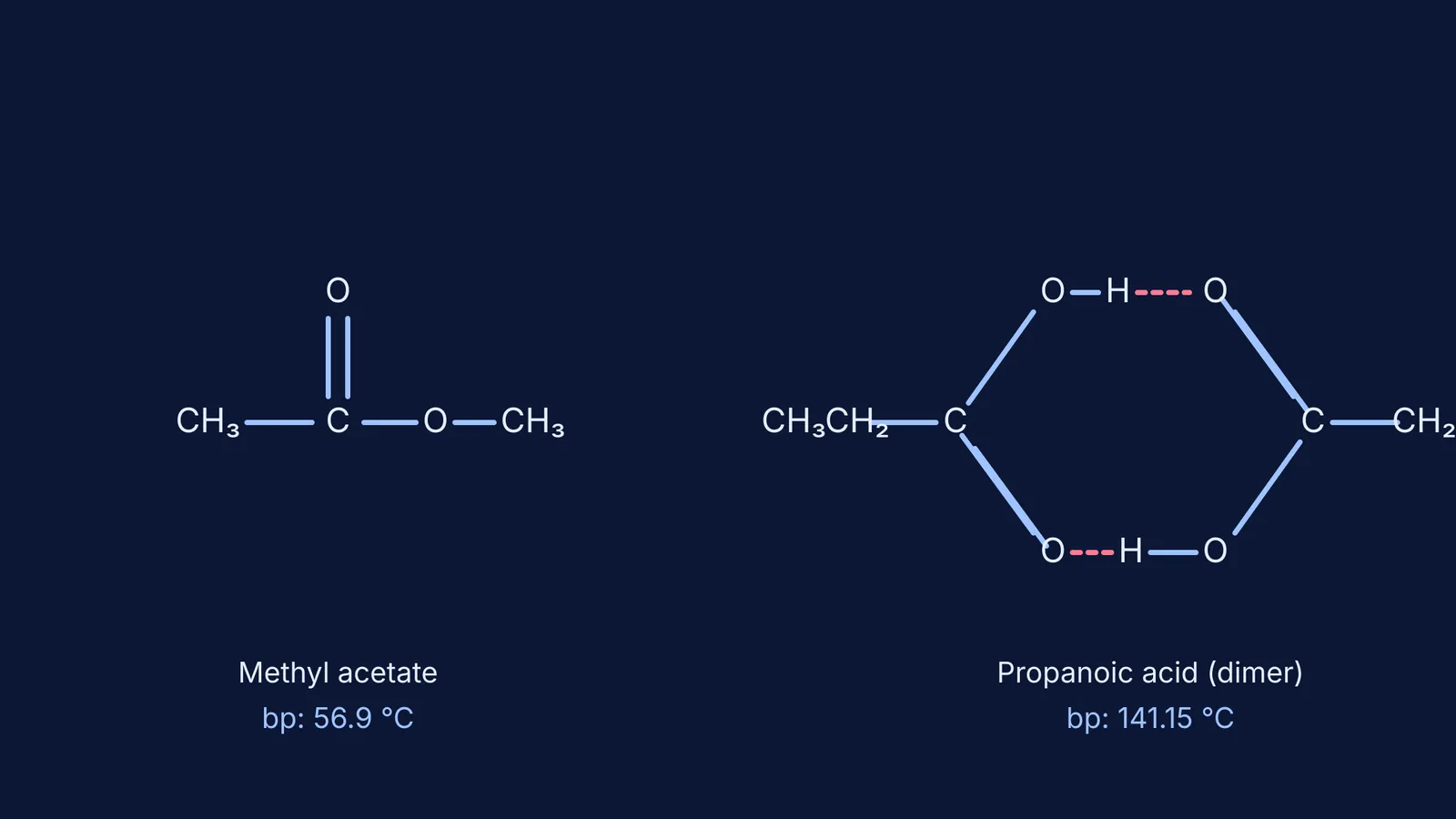
Both compounds share the molecular formula C3H6O2. However, the boiling point of methyl acetate is 56.9 °C. In contrast, the boiling point of propanoic acid is 141.15 °C. This dramatic 84-degree difference is a classic example of how a molecule's structure determines its intermolecular forces, a concept frequently tested in chemistry exams.
What is the difference between methyl acetate and propanoic acid?
The key to their different behaviours lies in how their atoms are arranged. They are examples of structural isomerism, where the same atoms form entirely different functional groups.
Methyl acetate (CH3COOCH3) is an ester. Its oxygen atoms are bonded only to carbon atoms—one via a double bond (C=O) and the other via two single bonds (C-O-C). There are no hydrogen atoms directly attached to an oxygen atom in this molecule.
Propanoic acid (CH3CH2COOH) is a member of the carboxylic acids family. It features a carboxyl group, which means it has a hydrogen atom covalently bonded directly to a highly electronegative oxygen atom (-OH).
Why does methyl acetate boil lower than propanoic acid?
To boil a liquid, you must supply enough heat energy to overcome the forces holding its molecules together. Since both molecules have the identical molar mass and roughly the same surface area, their London dispersion forces are nearly identical. The difference in boiling points is entirely due to the stronger intermolecular forces present in the acid.
Because methyl acetate lacks an -OH group, it cannot form hydrogen bonds with other methyl acetate molecules. Instead, its molecules are held together primarily by dipole-dipole interactions, which are relatively weak. It takes only a moderate amount of heat to break these interactions and turn the liquid into a gas.
Propanoic acid, on the other hand, exhibits strong hydrogen bonding. The slightly positive hydrogen atom of one propanoic acid molecule is strongly attracted to the lone pair of electrons on the carbonyl oxygen of a neighbouring molecule.
In fact, carboxylic acids are so effective at this that they often pair up to form dimers—two molecules locked together by two hydrogen bonds—even in the vapour phase. Breaking these tight networks requires significantly more thermal energy, driving the boiling point up.
If you find yourself stuck on exam questions about molecular properties and functional groups, the Fermi Concept Library has a lesson for every concept in chemistry to help you close those concept gaps.
How do hydrogen bonds affect boiling points?
Hydrogen bonding is the most crucial factor when comparing the boiling points of organic isomers.
Here is a practical checklist for predicting boiling point trends in organic chemistry:
Check the molar mass: If one molecule is significantly heavier, its stronger London dispersion forces will usually give it a higher boiling point.
Look for hydrogen bonding: If molar masses are similar (like isomers), look for N-H, O-H, or F-H bonds. Molecules with these bonds will boil higher than those without.
Assess polarity: If neither can hydrogen-bond, the more polar molecule will have stronger dipole-dipole forces and a slightly higher boiling point.
Examine the shape: For molecules with identical functional groups, straight-chain isomers pack together better and boil higher than highly branched isomers.


