

On this page
If you are learning about salts, naming carbon compounds or extracting metals for ICSE Class 10 chemistry, memorising every reaction will quickly feel overwhelming. A 2023 study published in the *European Journal of Science and Mathematics Education* found that students often struggle with the preparation of salts because they try to memorise facts without understanding the underlying abstract concepts (Salleh et al., 2023).
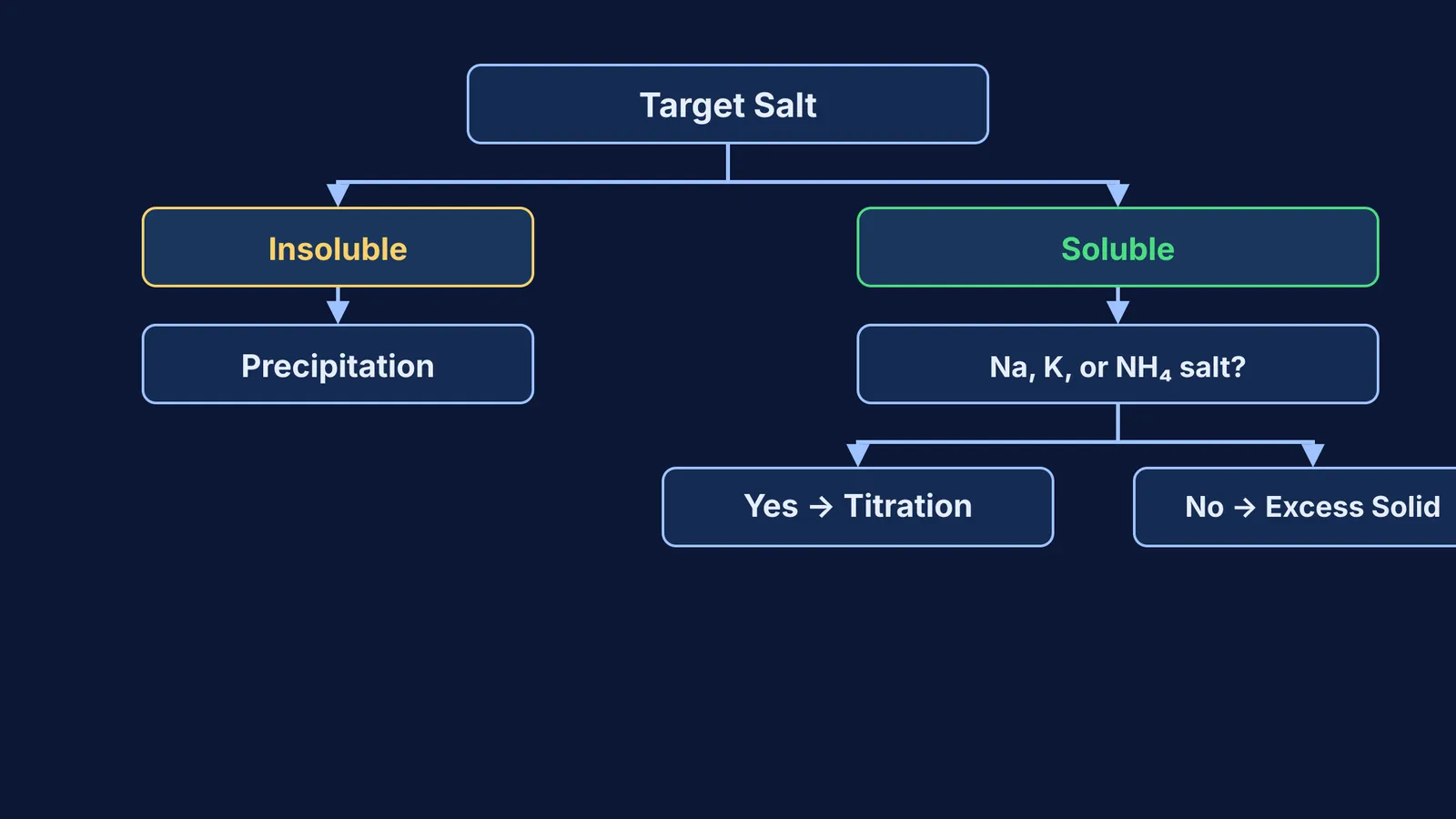
The secret is to not memorise the equations blindly. Instead, learn the rules that decide *which* method to use. Once you know whether a salt is soluble or insoluble, you can match it to one of the five standard preparation methods.
Is the salt soluble or insoluble?
The first question to ask when preparing a salt in an aqueous solution is about its solubility.
All nitrates are soluble.
All sodium, potassium and ammonium salts are soluble.
All chlorides are soluble, except silver and lead chloride.
All sulphates are soluble, except barium, calcium and lead sulphate.
All carbonates are insoluble, except sodium, potassium and ammonium carbonate.
If you find it difficult to picture these solubility rules, the Fermi Concept Library has every concept in physics, chemistry, biology, mathematics and computing, each with its own lesson and its place in the map.
How do you prepare insoluble salts?
If your target salt is insoluble in water (like barium sulphate or silver chloride), you must use precipitation (also known as double decomposition).
In this method, you mix two *soluble* salts. The ions swap partners, and the insoluble salt immediately falls out of the solution as a solid precipitate. You can then collect it by filtration, wash it with distilled water, and dry it.
For example, to prepare insoluble barium sulphate (BaSO₄), mix soluble barium chloride and sodium sulphate: BaCl₂ (aq) + Na₂SO₄ (aq) → BaSO₄ (s) + 2NaCl (aq)
How do you prepare sodium, potassium and ammonium salts?
If your target salt is soluble and contains sodium, potassium or ammonium, you use titration.
These salts are formed by reacting an alkali with a dilute acid. Because both the reactants (the alkali and the acid) and the product (the salt) dissolve in water, you cannot just mix them and filter out the excess. You need an indicator to tell you exactly when the acid is neutralised. Once you find the exact volumes needed, you repeat the experiment without the indicator to get a pure salt solution, which you then heat to crystallise.
For example, to prepare sodium chloride (NaCl), titrate sodium hydroxide with hydrochloric acid: NaOH (aq) + HCl (aq) → NaCl (aq) + H₂O (l)
How do you prepare other soluble salts?
If the salt is soluble, but it is *not* a sodium, potassium or ammonium salt (such as copper(II) sulphate or zinc chloride), you use the excess solid method.
You start with a dilute acid and add an insoluble solid — usually an active metal, a metal oxide, or a metal carbonate. You keep adding the solid and stirring until no more dissolves. This ensures all the acid has reacted. Because the excess solid is insoluble, you can simply filter it out. The filtrate is your pure salt solution.
Action of dilute acid on an active metal:
Zn (s) + H₂SO₄ (aq) → ZnSO₄ (aq) + H₂ (g)
Action of dilute acid on an insoluble base:
CuO (s) + H₂SO₄ (aq) → CuSO₄ (aq) + H₂O (l)
Action of dilute acid on a metal carbonate:
CaCO₃ (s) + 2HCl (aq) → CaCl₂ (aq) + H₂O (l) + CO₂ (g)
If you get stuck trying to balance these equations or predict the products, the Fermi Problem Library has worked problems with a step-by-step solver that explains the reasoning rather than printing an answer.
How do you prepare binary salts?
Finally, if the salt is composed of only two elements (like iron(II) sulphide or iron(III) chloride), you can use direct combination (synthesis). This method often involves heating the two elements together directly, without water.
For example, heating iron and sulphur produces iron(II) sulphide: Fe (s) + S (s) → FeS (s)


