

On this page
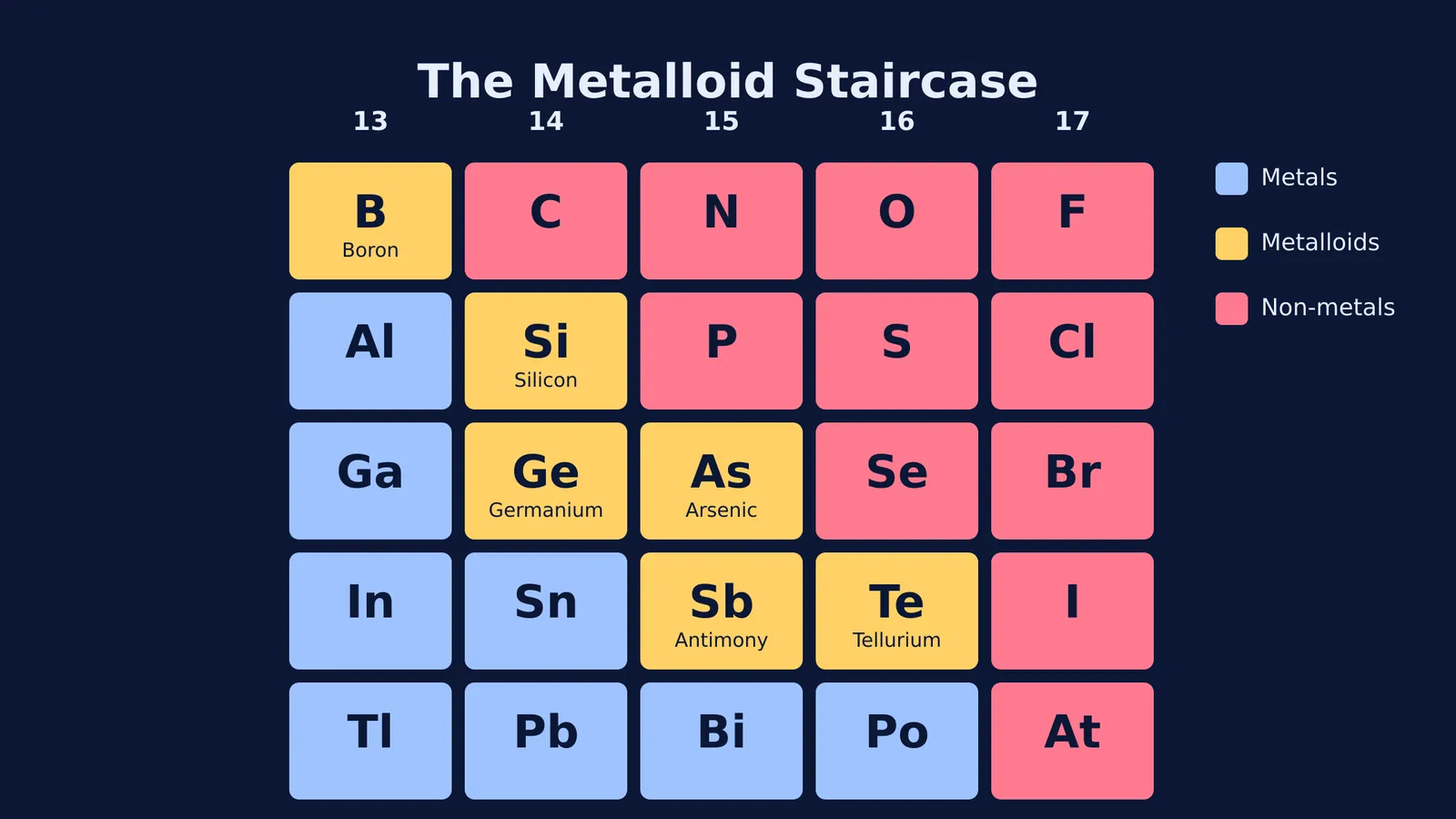
If you look at the right side of the periodic table, you will see a diagonal line stepping down from boron to astatine. This is the metalloid staircase. The elements along this line do not fit neatly into the categories of metals or non-metals. Instead, they share properties of both, making them incredibly useful in modern technology.
What makes an element a metalloid?
Metals are typically shiny, malleable, and excellent conductors of heat and electricity. Non-metals are usually dull, brittle, and poor conductors. Metalloids (often called semimetals) sit right in the middle.
While there is no single strict definition, the six commonly recognised metalloids are boron, silicon, germanium, arsenic, antimony, and tellurium.
Physically, they tend to look like metals. Most of them are solid and shiny at room temperature. However, they are brittle rather than malleable, meaning they shatter if struck rather than bending or stretching into wires like copper does. Chemically, they behave more like non-metals. They often form covalent bonds when reacting with other elements, rather than the metallic bonds found in purely metallic structures.
Why are silicon and germanium semiconductors?
The most defining feature of metalloids like silicon and germanium is their electrical conductivity. They are semiconductors.
In a solid material, electrons occupy distinct energy levels called bands. The valence band holds the outermost electrons, which are bound to the atoms. Above it lies the conduction band, where electrons are free to move and carry an electric current. The energy difference between these two bands is called the band gap.
In insulators, the band gap is huge. Electrons cannot jump across it, so no current flows.
In metals, the bands overlap, so electrons move freely.
In semiconductors, there is a small band gap.
For pure silicon, the band gap is approximately 1.12 eV at room temperature (300 K) (Wikipedia). For pure germanium, it is even smaller, at about 0.67 eV (Wikipedia). At absolute zero, these elements act as perfect insulators. But at room temperature, thermal energy is enough to excite a small number of electrons across the gap into the conduction band.
This partial conductivity is what makes them so valuable. By adding tiny amounts of impurities—a process known as doping—engineers can precisely control how well these materials conduct electricity. This principle is explored in detail when calculating n-type and p-type carrier concentration, and you can review how different materials compare in our guide to energy bands in conductors, semiconductors and insulators.
Examples of metalloids and their uses
Because of their hybrid nature, metalloids have a wide range of applications outside of just electronics. In fact, many of these elements play crucial roles in biological systems, advanced manufacturing, and everyday consumer products.
Boron (B) Boron is the lightest metalloid. It is extremely hard, measuring 9.3 on the Mohs scale, and has a very high melting point of around 2,076 °C (Wikipedia). It is an essential nutrient for plant growth and is heavily used in industry to make borosilicate glass, which resists thermal shock and is commonly found in laboratory beakers and household cookware.
Silicon (Si) Silicon is the second most abundant element in the Earth's crust (about 28.2% by mass) (Wikipedia), mostly found locked up in silicate minerals and sand. As a highly purified crystal, it is the foundation of the modern digital age, used to manufacture almost all computer chips, transistors, and solar cells.
Germanium (Ge) Germanium is chemically similar to silicon and is a lustrous, greyish-white solid. Historically, the very first decade of semiconductor electronics relied entirely on germanium before silicon became the standard due to its higher temperature tolerance. Today, it is widely used in fibre-optic cables and infrared optics, such as the lenses in thermal imaging cameras and night-vision equipment.
Arsenic (As) Arsenic is a brittle, grey solid that is notoriously toxic to living organisms. Interestingly, when heated at standard pressure, it does not melt; it sublimes directly into a gas. Despite its toxicity, it is a crucial industrial material. It is used as an n-type dopant in silicon devices and is combined with gallium to create gallium arsenide (GaAs), a compound used in high-efficiency LEDs and high-speed integrated circuits.
Mastering the periodic table
Understanding the trends across the periodic table—from highly reactive metals on the left to the metalloid staircase and non-metals on the right—is key to mastering chemistry. If you are revising atomic structure and bonding, the Fermi Concept Library holds every concept in physics and chemistry, each with its own lesson and its place in the map.
If you struggle to predict how an element will react based on its position, Fermi's AI tutor can work out what you already know and build a plan for the session, holding a line of reasoning with you until the trend clicks into place.


