

On this page
When a straight line cuts through a triangle, it does not just create random segments. The segments formed on the three sides are locked into a strict mathematical relationship. This rule, first described by the ancient Greek mathematician Menelaus of Alexandria, lets you find missing lengths without relying on coordinate geometry.
Whether you are preparing for JEE Advanced or solving Olympiad problems, Menelaus's theorem is the standard algebraic test for proving that three points lie on a straight line. If you are building your coordinate geometry skills, you might also explore the condition for three lines to be concurrent or how to find a circle through three given points.
What is Menelaus's theorem?
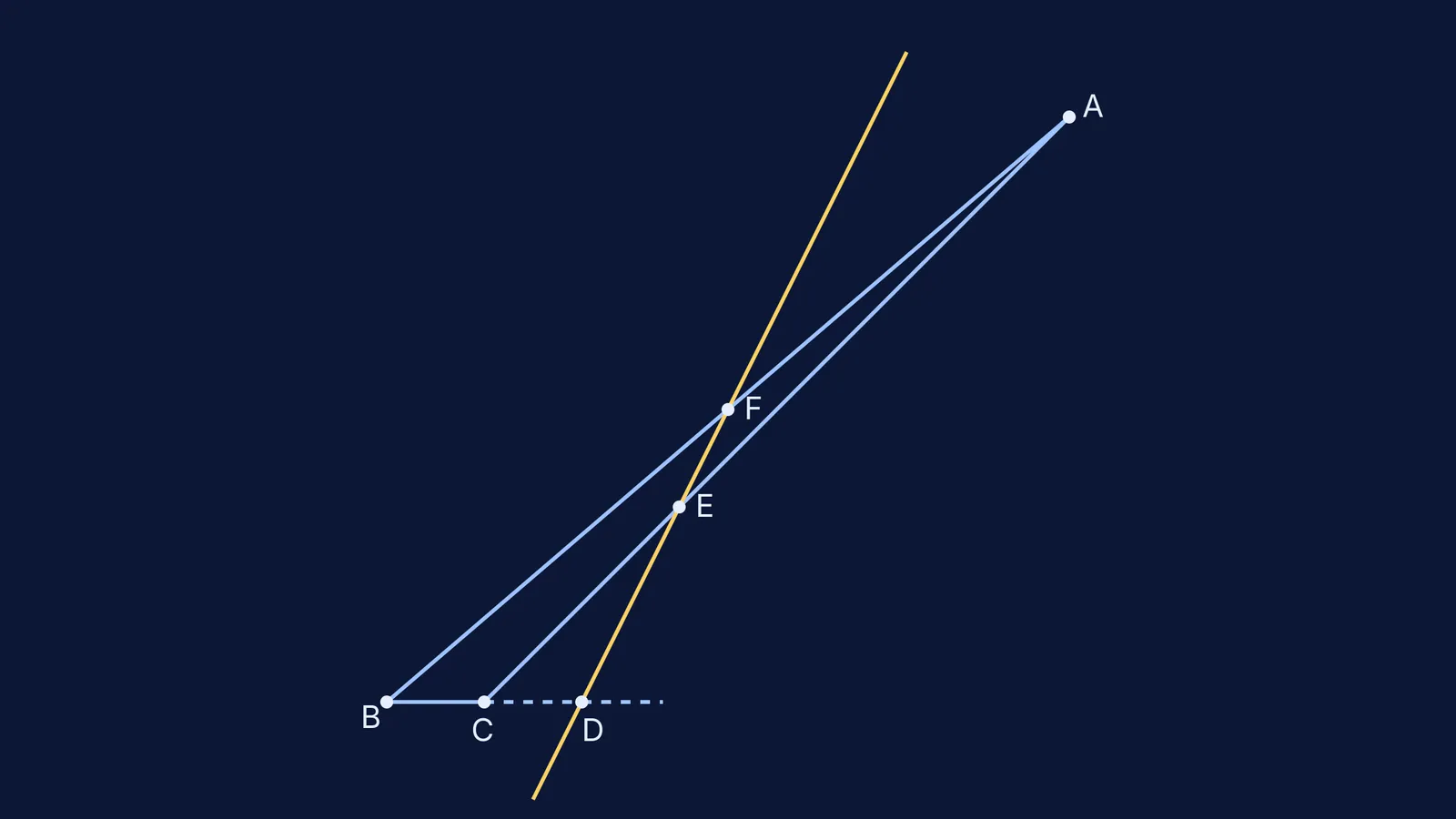
Imagine a triangle ABC. If a transversal line intersects the side AB at point F, the side AC at point E, and the extended side BC at point D, the theorem states that the product of the ratios of the segments is 1.
Using the unsigned lengths of the segments, the formula is written as: (AF / FB) × (BD / DC) × (CE / EA) = 1
When solving advanced problems, mathematicians often use signed, directed segments where moving from A to B is the opposite of B to A. In this signed version, the product of the three ratios is −1 (Wolfram MathWorld). This negative sign happens because a straight line must cut either two sides internally and one externally, or all three sides externally.
How do you write the Menelaus equation?
The easiest way to remember the formula is the "loop" rule. Start at any vertex, go to the intersection point on that line, and then go to the next vertex.
Start at vertex A. Go to the transversal point F, then to vertex B. The ratio is AF / FB.
From vertex B, go to the transversal point D on the extended side, then to vertex C. The ratio is BD / DC.
From vertex C, go to the transversal point E, then back to the starting vertex A. The ratio is CE / EA.
Multiply these three ratios together and set the result to 1.
If you are stuck on coordinate geometry or transversal proofs, the Fermi Problem Library has worked problems with a step-by-step solver that explains the reasoning rather than printing an answer.
Worked example: finding a missing ratio
Consider a triangle ABC where F is the midpoint of AB, so the ratio AF:FB is 1:1. Point E lies on AC such that CE:EA = 1:2. A transversal line is drawn through F and E, meeting the extension of side BC at a point D. What is the ratio of BC to CD?
Using Menelaus's theorem, we set up our loop: (AF / FB) × (BD / DC) × (CE / EA) = 1
Substitute the known ratios: (1 / 1) × (BD / DC) × (1 / 2) = 1
Multiply the numbers: 0.5 × (BD / DC) = 1
Solve for the unknown ratio: BD / DC = 2
This tells us that the total length BD is twice the length of DC. Since D lies on the extension of BC, we know that BD = BC + CD.
Substituting this back in: (BC + CD) / CD = 2 (BC / CD) + 1 = 2 BC / CD = 1
The ratio of BC to CD is 1:1, meaning the extended segment CD is exactly equal in length to the side BC.
What is the difference between Menelaus and Ceva's theorems?
Menelaus's theorem is closely related to Ceva's theorem, but they are used for opposite goals.
Menelaus's theorem deals with one transversal line cutting across three sides. It is used to prove that three points are collinear (they lie on the same straight line).
Ceva's theorem deals with three lines (cevians) starting from the vertices and meeting inside the triangle. It is used to prove that three lines are concurrent (they intersect at a single point).
To see how Menelaus's theorem connects to Ceva's theorem and the method of mass points, the Fermi Concept Library maps out every concept in physics, chemistry, biology, mathematics and computing, each with its own lesson and its place in the map.
Often in JEE Advanced geometry, Ceva's theorem is used to find internal ratios, and Menelaus's theorem is applied to find the ratios on the boundary or the extended sides. By mastering the loop rule, you can avoid pages of coordinate geometry and solve these problems in just a few lines.


