

On this page
When preparing for competitive exams like JEE Main and Advanced, you often face optimisation problems that ask you to find the maximum or minimum value of a product given a fixed sum. A classic example in algebra and calculus is finding the maximum value of the expression x²y³ subject to the constraint that x + y = 10, where x and y are positive real numbers.
These constrained optimisation problems test your ability to connect algebra with calculus. The standard way through this is by substituting one variable for the other to create a single-variable function, and then differentiating it to find the critical points. However, the weighted AM-GM inequality (Arithmetic Mean-Geometric Mean inequality) offers a much faster and more elegant route.
If you get stuck on questions like this in your practice, the Fermi Problem Library has worked problems with a step-by-step solver that explains the reasoning rather than printing an answer, helping you choose the right approach for the exam. Let us look at both the calculus method and the algebraic inequality method for this problem in detail.
What happens when you substitute y = 10 − x?
The most reliable, systematic method is to turn the two-variable expression into a function of a single variable. Since you know the constraint is x + y = 10, you can rewrite this linear relationship as y = 10 − x.
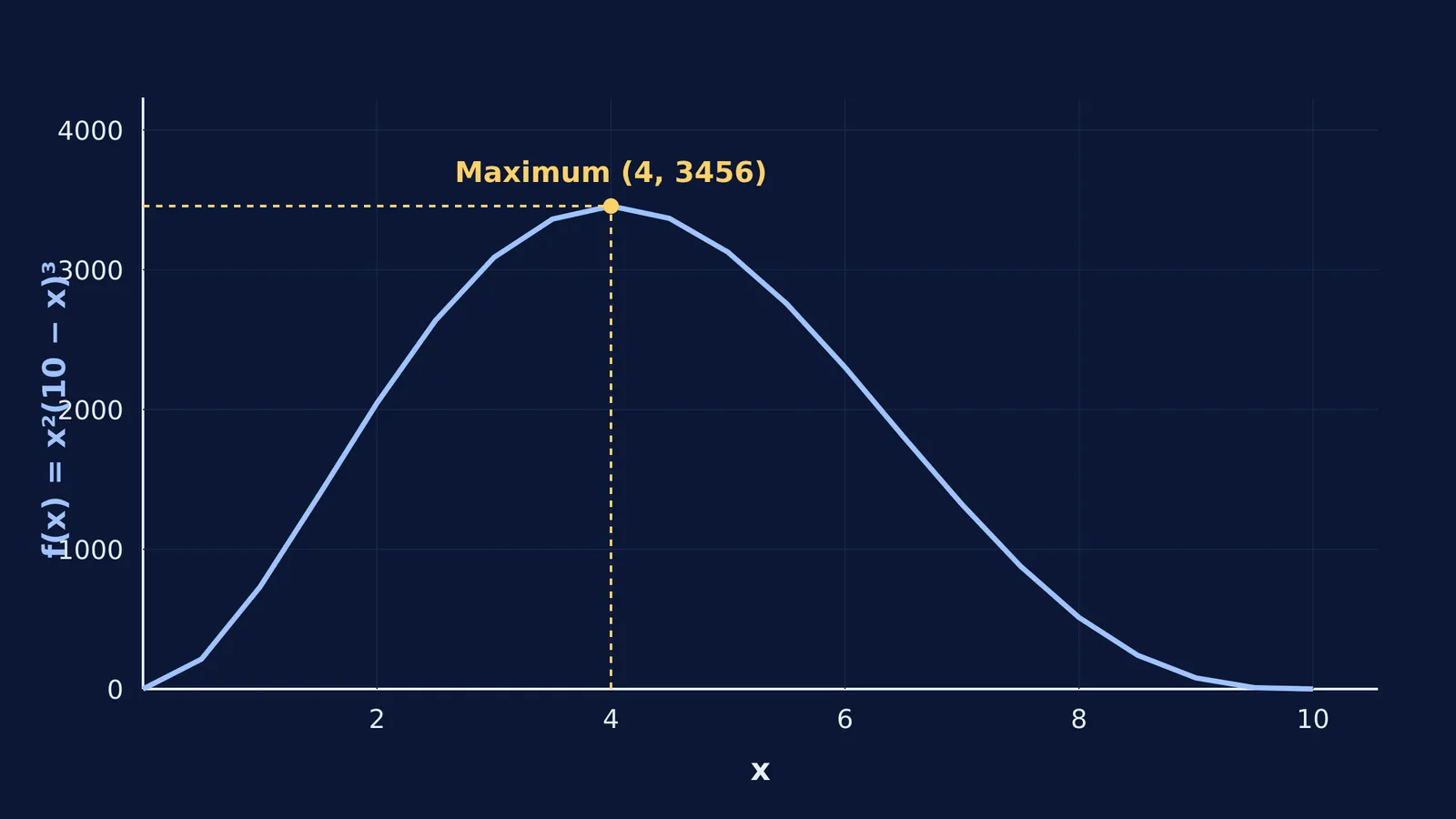
Substituting this directly into your original product x²y³ gives the single-variable function f(x) = x²(10 − x)³. Because x and y must be non-negative to maximise a product of positive powers, we are looking for the maximum of this function on the interval between x = 0 and x = 10. You have now successfully reduced a constrained two-variable algebraic problem into a standard single-variable calculus problem, which you can solve using derivatives.
How do you find the maximum by differentiation?
To find the maximum of this function, you must differentiate it with respect to x and set the first derivative to zero. The product rule in calculus states that the derivative of two multiplied functions, u × v, is u' × v + u × v'.
Applying the product rule here to our two parts, u = x² and v = (10 − x)³: f'(x) = 2x(10 − x)³ + x² × 3(10 − x)²(−1)
The (−1) at the end comes from the chain rule applied to the inner function (10 − x). Now, you can factor out the common terms x and (10 − x)² from both parts of the expression: f'(x) = x(10 − x)² × [2(10 − x) − 3x] f'(x) = x(10 − x)² × (20 − 2x − 3x) f'(x) = x(10 − x)² × (20 − 5x)
Setting f'(x) = 0 gives three critical points where the slope of the tangent line is zero: x = 0, x = 10 and x = 4. The points x = 0 and x = 10 are the endpoints of our domain, and we check them as part of finding absolute extrema on a closed interval. Substituting x = 0 or x = 10 into the original function makes the product zero, which is the absolute minimum.
The absolute maximum therefore occurs at the interior critical point, x = 4. Substituting this value back into our constraint equation y = 10 − x gives y = 6.
The maximum value of the product is therefore 4² × 6³ = 16 × 216 = 3,456.
Can weighted AM-GM solve it faster?
While calculus works every time, algebraic inequalities often provide a quicker shortcut. The inequality of arithmetic and geometric means (AM-GM) states that the arithmetic mean of a list of non-negative real numbers is always greater than or equal to their geometric mean. In simpler terms, if you have n non-negative numbers, their sum divided by n will be at least as large as the nth root of their product. This mathematical principle is especially powerful when you need to maximise a product under a fixed sum, because you can set the arithmetic mean to a known constant and find a strict upper bound for the product.
To use the AM-GM inequality for the expression x²y³, you need to split the variables strategically to match their exponents. Because you have an x² and a y³, you must split x into two equal parts (x/2 and x/2) and y into three equal parts (y/3, y/3 and y/3).
Now, apply the AM-GM inequality to these five distinct numbers: x/2, x/2, y/3, y/3, and y/3.
The sum of these five numbers perfectly reconstructs your original constraint: 2 × (x/2) + 3 × (y/3) = x + y = 10. Their arithmetic mean is therefore this sum divided by the number of terms: 10 / 5 = 2.
Their geometric mean is the fifth root of their product: ⁵√( (x/2) × (x/2) × (y/3) × (y/3) × (y/3) ) = ⁵√( (x/2)² (y/3)³ ).
Because the arithmetic mean is greater than or equal to the geometric mean (AM ≥ GM), you can set up the inequality: 2 ≥ ⁵√( x²y³ / (4 × 27) ) 2 ≥ ⁵√( x²y³ / 108 )
Raising both sides to the fifth power clears the root: 32 ≥ x²y³ / 108 x²y³ ≤ 32 × 108 = 3,456.
The AM-GM inequality also states a crucial condition: equality holds if and only if all the individual numbers in the set are equal. Setting x/2 = y/3 = 2 (the arithmetic mean) immediately gives x = 4 and y = 6. This confirms the exact same result we derived from calculus differentiation, but without needing to expand complex polynomials or check any second-order derivatives.
To explore the mathematics behind this, read the AM-GM lesson in the Fermi Concept Library.


