

On this page
When you bend a conducting wire into a closed loop and pass a current through it, the loop acts like a tiny magnet. But if you have a fixed length of wire, how should you shape it to get the strongest magnetic effect?
The answer lies in the geometry of the shapes. Here is why the circle always comes out on top, and how to prove it for your physics exams.
Why does area determine the magnetic moment?
A current-carrying loop creates a magnetic field. Its strength as a magnetic source is measured by its magnetic moment (m).
For a flat loop with a single turn, the magnetic moment is the product of the steady current (I) and the area (A) enclosed by the loop:
m = I × A
If we use the exact same wire for different shapes, the length of the wire (L) and the current (I) remain constant. Because the current does not change, the magnetic moment depends entirely on the enclosed area. The shape that encloses the most area will automatically have the highest magnetic moment.
This is true whether you are comparing simple shapes or calculating the magnetic moment of an orbiting electron.
Which loop shape encloses the most area?
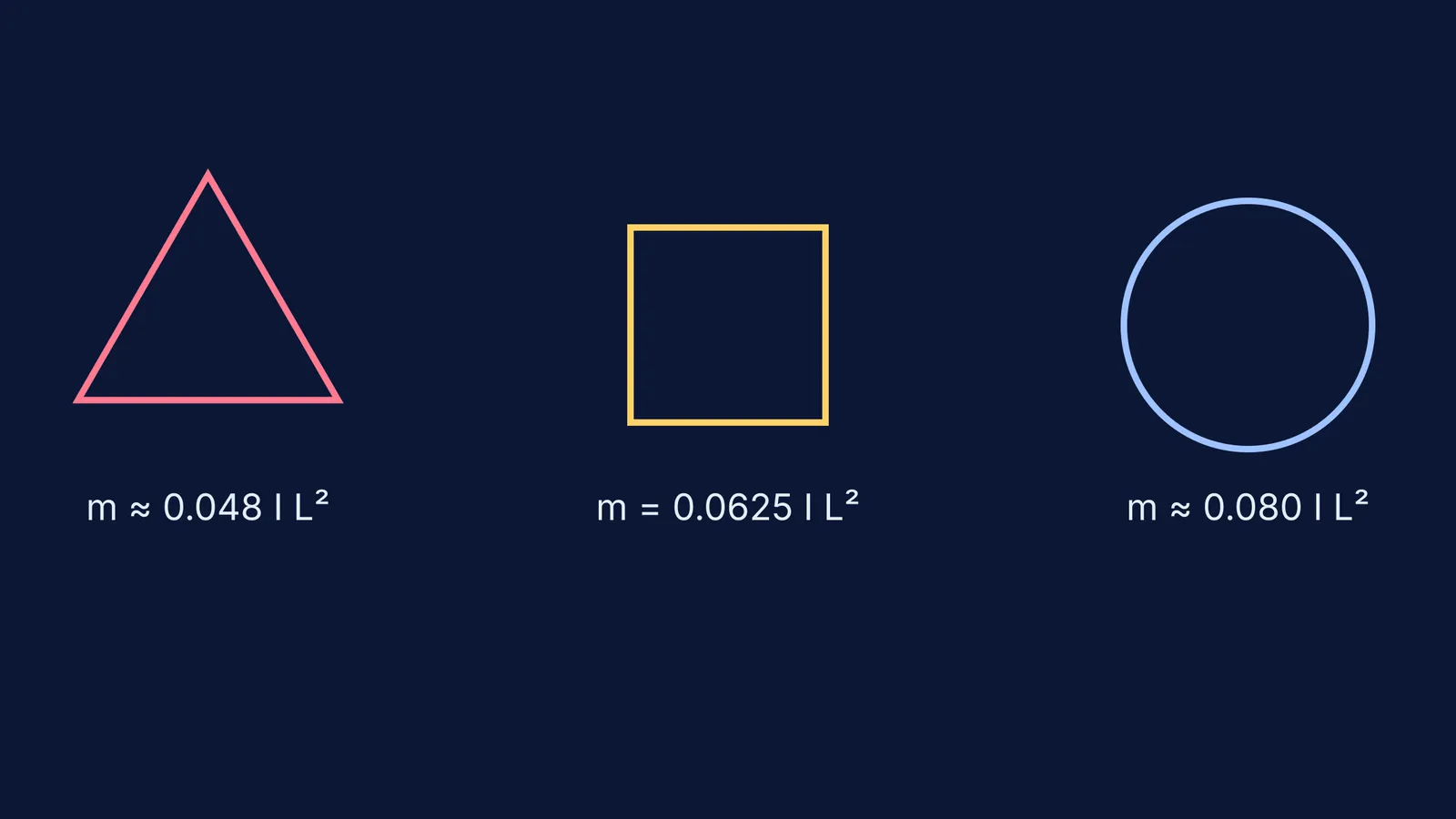
To see which shape wins, we can calculate the area of an equilateral triangle, a square, and a circle, all made from a wire of length L.
Equilateral Triangle: The wire forms three equal sides, so each side is a = L/3. The area of an equilateral triangle is (√3 / 4)a². Substituting the side length gives an area of about 0.048 L².
Square: The wire forms four equal sides, so each side is s = L/4. The area of a square is s². Substituting the side length gives an area of exactly 0.0625 L².
Circle: The wire forms the circumference, so 2πr = L, which means the radius is r = L / 2π. The area of a circle is πr². Substituting the radius gives an area of L² / 4π, or roughly 0.080 L².
Comparing the three results, the circle encloses significantly more area than the square, which in turn encloses more area than the triangle. Since m = I × A, the circular loop produces the maximum magnetic moment.
Why is the circle mathematically optimal?
You do not have to calculate the areas every time to know the circle wins. The isoperimetric inequality states that for a given perimeter, the shape that encloses the largest possible area is a circle.
Because of its perfect symmetry, a circle has no "dents" or sharp corners that waste perimeter without adding area. Any other shape—whether it is a rectangle, a hexagon, or an irregular blob—will enclose less area for the same length of boundary.
This geometric fact appears across physics, from the shape of soap bubbles minimizing surface tension to the spinning charged ring maximizing its magnetic properties.
Building a plan for physics problems
It is easy to get tangled in formulas when studying magnetism. Sometimes, the physics is straightforward, but the underlying geometry or algebra is what actually trips you up.
When you bring a tricky electromagnetism assignment to the Fermi Problem Library, Fermi's AI tutor works out what you already know and builds a plan for the session. Rather than just printing an answer, it holds a line of reasoning. If you are stuck on finding the area of an equilateral triangle, it will step back and draw the figure to help you see the geometry, before returning to the magnetic moment calculation.


