

On this page
If you place two identical point charges a certain distance apart, their electric fields push back against each other in the space between them. Finding the net electric field along the line that perfectly divides them (the perpendicular bisector) is a classic electrostatics problem that tests your grasp of vector addition in two dimensions, much like calculating the work to assemble point charges.
The surprising result? The field is zero at the very centre, grows to a peak, and then fades to zero again as you move infinitely far away.
Setting up the field vectors
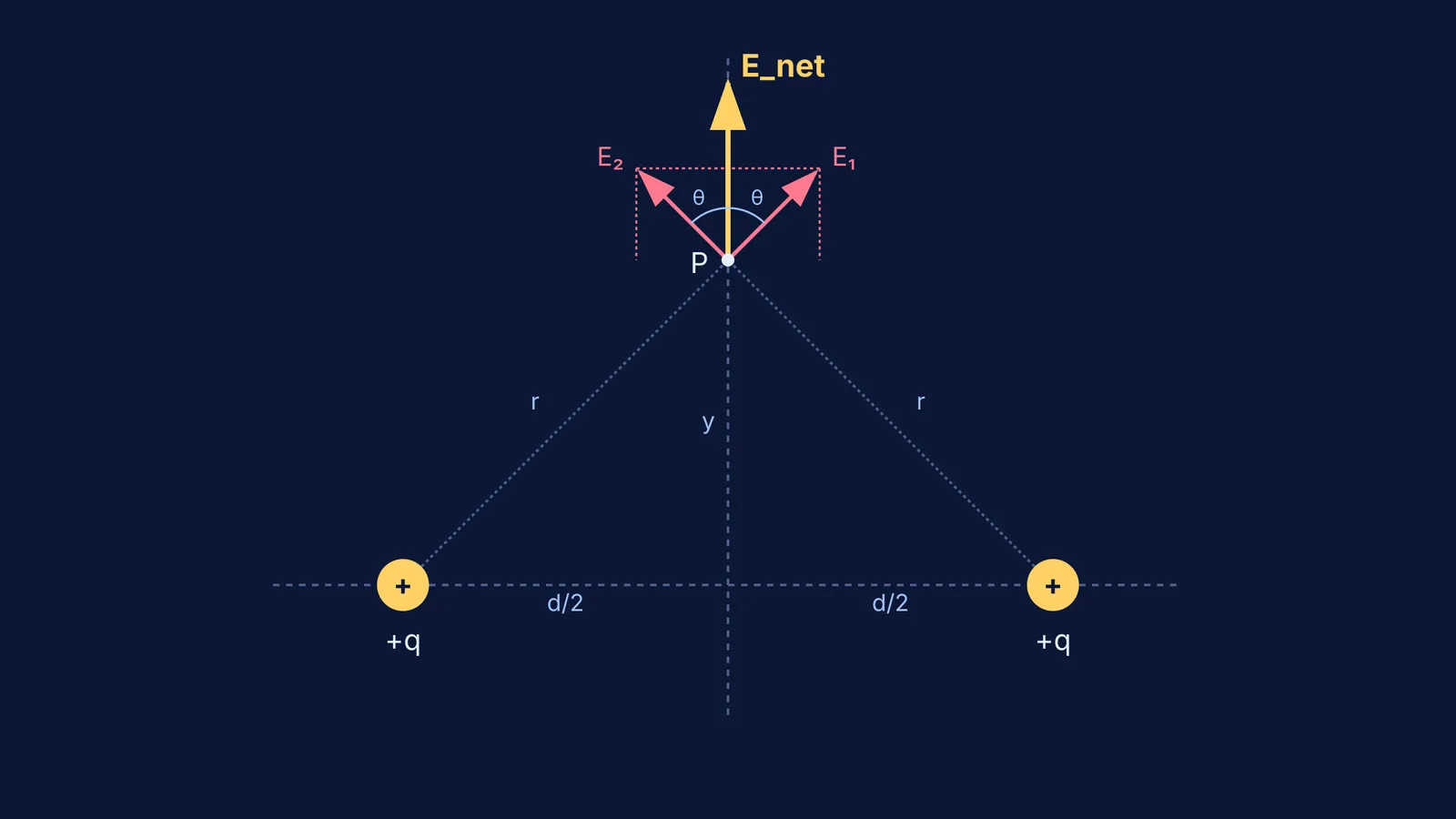
Imagine two equal positive charges, +q, separated by a distance *d*. We want to find the net electric field at a point P on the perpendicular bisector, located a distance *y* from the midpoint.
Because of the symmetry, the distance *r* from either charge to the point P is exactly the same. By Pythagoras' theorem, this distance is *r* = √(y² + (d/2)²).
Each charge creates an electric field at P pointing directly away from it. The magnitude of each individual field is determined by Coulomb's law: E₁ = E₂ = kq / (y² + (d/2)²)
To find the total electric field, we must add these two vectors together. If we break them down into horizontal and vertical components:
The horizontal components point in opposite directions and cancel each other out perfectly.
The vertical components both point away from the midpoint along the bisector, so they add together to form the net field.
If the angle between each electric field vector and the vertical axis is θ, the net electric field *E* is just the sum of the two vertical components: E = 2 E₁ cos θ
From the geometry of the triangle, cos θ = y / r. Substituting this in gives the full expression for the electric field at any point on the bisector: E = 2kqy / (y² + (d/2)²)³ᐟ²
Where is the electric field zero?
The formula tells us the electric field disappears in two distinct places.
First, at the exact midpoint (*y* = 0), the numerator becomes zero, making *E* = 0. Here, the forces from the two identical charges pull equally in opposite directions, keeping a test charge completely stationary if it were placed there.
Second, at an infinite distance (*y* → ∞), the denominator grows much faster than the numerator, pulling the field strength smoothly to zero. If you are very far away, the two charges look like a single fused point, and its field spreads out over an ever-increasing area until it vanishes completely.
Finding the point of maximum electric field
If the field starts at zero, grows, and eventually returns to zero, it must have a distinct peak somewhere in between.
To find this maximum point, we take the derivative of the electric field *E* with respect to the distance *y* and set it to zero: dE/dy = 0. By applying the quotient rule to our field expression, we differentiate the numerator and the denominator. The calculation reveals that the rate of change is zero, meaning the field is at its absolute strongest, exactly when y² = d² / 8.
Taking the square root gives the precise location of the peak. The maximum electric field on the perpendicular bisector of two equal charges occurs at a distance of d/(2√2) from the midpoint. Because the field is symmetric, this peak exists on both sides of the axis.
If you plug this specific distance back into the original formula for the electric field, you can calculate the maximum possible field strength. The expression simplifies neatly to: E_max = 16kq / (3√3 d²)
This exact mathematical expression closely mirrors the electric field on the axis of a uniformly charged circular ring. In both physical scenarios, the field steadily grows as you move away from the centre until it hits a sweet spot. At this precise point, the increasing angle perfectly balances the fading distance, right before the inverse-square law takes over and diminishes the field entirely.
This result is a fundamental part of electrostatics. If you are preparing for these kinds of problems, working through them with the Fermi Problem Library—a step-by-step solver that explains the reasoning—can help you spot the symmetry before you start calculating. For related concepts, you can also explore how to calculate energy density in an electric field.
How does an electric dipole compare?
It is incredibly helpful to contrast this situation with an electric dipole, which consists of two *opposite* point charges (+q and −q) separated by the same distance.
For an electric dipole, the vertical components of the field on the bisector are the ones that perfectly cancel out, while the horizontal components point in the same direction and reinforce one another. This fundamental difference in vector addition changes the behaviour of the net field completely.
As a result, the electric field is not zero at the midpoint between the two charges. In fact, for an electric dipole, the field on the perpendicular bisector is actually *strongest* at the exact midpoint, pointing strictly parallel to the axis connecting the two charges. From that strong central maximum, the field strength strictly decreases as you move further away along the bisector, eventually dropping completely to zero at an infinite distance.


