

On this page
If you lay a metal chain on a desk and slowly let one end dangle over the edge, it will stay still—until you push just a little too much over the side. At that precise tipping point, the entire chain accelerates rapidly and eventually slides completely off the table.
This scenario is a limiting equilibrium problem in physics. To solve it, we must find the exact point where the downward pull of gravity on the hanging section overcomes the maximum static friction holding the rest of the chain in place. It is a fundamental application of Newton's laws of motion that frequently appears in university engineering foundations and competitive entrance exams.
What is the maximum length of chain that can hang from a rough table?
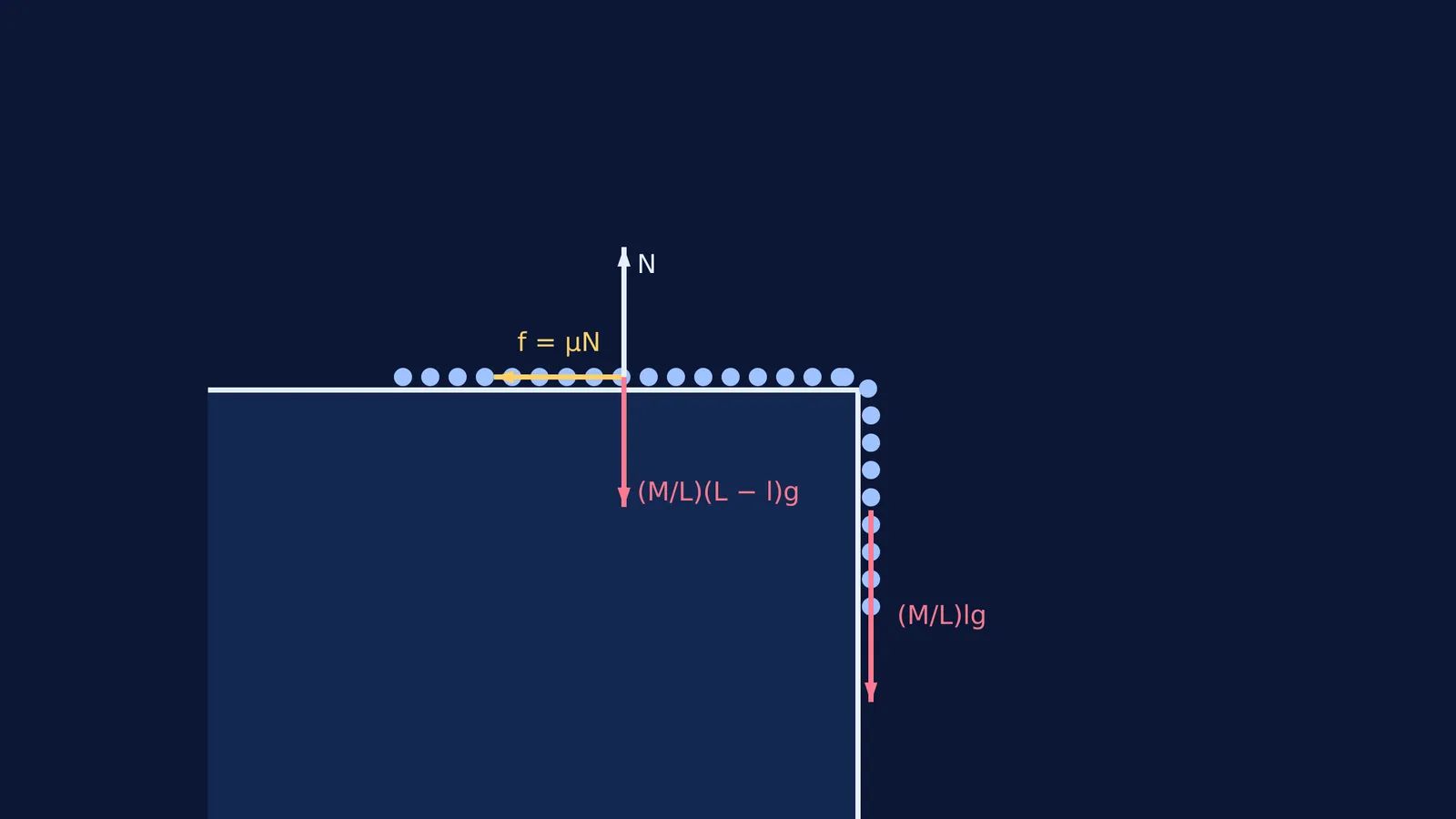
To derive the answer, we look at the chain as two distinct, connected masses at the verge of slipping. Let's define the variables for this uniform chain:
L is the total length of the chain.
l is the length of the hanging part.
L − l is the length of the part remaining on the table.
M is the total mass, making the linear mass density (mass per unit length) equal to M/L.
μ is the coefficient of static friction between the chain and the table surface.
The maximum possible fraction of a uniform chain that can hang over the edge of a rough horizontal table is determined solely by the coefficient of static friction, μ [[1]](https://www.vedantu.com/question-answer/a-heavy-uniform-chain-lies-on-a-horizontal-table-class-11-physics-cbse-5f6a41184825125346eee977). We prove this by equating the two opposing forces acting on the system.
First, consider the hanging portion of the chain. The weight of this hanging part pulls the entire chain downward towards the floor. Its mass is the linear density multiplied by its length, or (M/L) × l. Therefore, its downward force (weight) is (M/L) × l × g.
Second, consider the horizontal portion of the chain. Friction acts exclusively on the portion that is still resting on the table. The normal force on this horizontal section is equal to its weight, which is (M/L) × (L − l) × g. The maximum static frictional force available to resist the pull is μ times this normal force.
At limiting equilibrium, these two forces balance: (M/L) × l × g = μ × (M/L) × (L − l) × g
Notice that both the mass per unit length (M/L) and the gravitational acceleration g appear on both sides of the equation. We can cancel them out entirely: l = μ(L − l)
Expanding the right side and rearranging the terms gives: l = μL − μl l + μl = μL l(1 + μ) = μL
Dividing by L gives the standard result. Friction on the part on the table balances the weight of the hanging part: l/L = μ/(1 + μ).
How do you find the coefficient of friction from the hanging length?
Sometimes a question asks you to work backwards: you are given the fraction of the chain that hangs over the edge and must calculate the surface's coefficient of friction. By rearranging the equilibrium equation l = μ(L − l), we get a direct formula for the friction coefficient: μ = l / (L − l)
Worked example: Calculating hanging length
Suppose a 100 cm uniform chain sits on a laboratory table, and the coefficient of static friction between the metal and the wood is 0.25. What is the maximum length that can hang over the edge before the chain falls?
Using the formula we derived: l = μL / (1 + μ) l = (0.25 × 100) / (1 + 0.25) l = 25 / 1.25 l = 20 cm
Exactly 20% of the chain can hang over the edge before it begins to slide [[1]](https://www.vedantu.com/question-answer/a-heavy-uniform-chain-lies-on-a-horizontal-table-class-11-physics-cbse-5f6a41184825125346eee977).
What happens in extreme cases?
What happens if the table is perfectly smooth, meaning μ = 0? If we plug μ = 0 into our formula, we get l/L = 0/(1 + 0) = 0. This proves that on a frictionless surface, any overhang at all, no matter how small, will cause the chain to slide off immediately.
Conversely, if the table is very rough with μ = 1, the formula yields l/L = 1 / (1 + 1) = 1/2. On a surface with a friction coefficient of 1, exactly half of the chain can hang off the edge while the other half acts as an anchor.
Many students memorize these end results without understanding how the free-body diagram leads to them. If you struggle to set up force equations for linked systems, the Fermi Problem Library has worked problems with a step-by-step solver that explains the reasoning rather than printing an answer.
Where else does limiting equilibrium appear?
The mass-cancellation effect seen in the hanging chain problem is a recurring mathematical theme in Newtonian mechanics. You will see similar patterns when exploring these related physics concepts:
Angle of repose and angle of friction, where the mass and gravity terms cancel out completely to leave the result tan θ = μ.
Minimum force to drag a block on a rough floor, where calculating the optimal angle requires balancing weight, tension, and maximum static friction simultaneously.


