

On this page
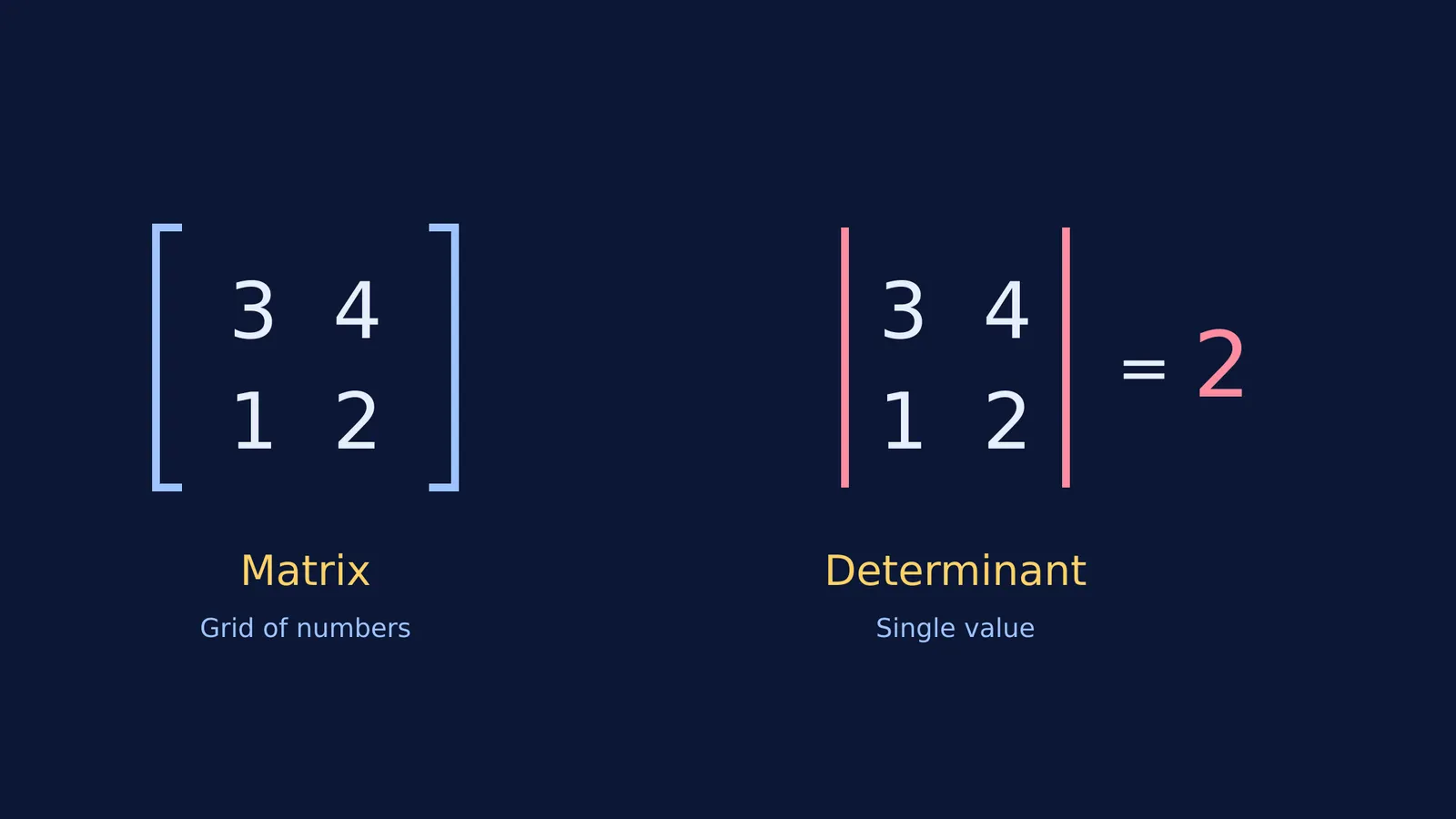
When starting linear algebra, it is easy to mix up a matrix with its determinant. Both look like blocks of numbers, and both are central to solving systems of equations. But they are completely different mathematical objects. A matrix is a structure, while a determinant is a single value that tells you something about that structure.
Here is a breakdown of the differences, how to read the notation, and why taking a constant out of a matrix works differently than taking it out of a determinant.
What is the difference between a matrix and a determinant?
The fundamental difference lies in what they are. A matrix is a rectangular array of numbers, symbols, or expressions arranged in rows and columns (Wikipedia)). It does not have a single numerical value; it is simply a container for organizing data, much like a spreadsheet.
A determinant, on the other hand, is a scalar-valued function (Wikipedia). It is a single number computed from the entries of a square matrix. You evaluate it by multiplying and subtracting specific elements according to strict rules.
Because a matrix is just an arrangement, it can have any dimensions: you can have a 2 × 3 matrix, a 4 × 1 matrix (often called a vector), or a 3 × 3 matrix. But a determinant can only be calculated for a square matrix—meaning the number of rows must equal the number of columns, like 2 × 2 or 3 × 3. You simply cannot find the determinant of a rectangular matrix.
How do matrix and determinant notations differ?
The brackets around the numbers tell you exactly which object you are dealing with, and misreading them is a common source of lost marks.
Matrix notation: A matrix is enclosed in square brackets `[ ]` or large parentheses `( )`. If you see `A = [ ... ]`, you are looking at the full array of numbers.
Determinant notation: A determinant is enclosed in straight vertical bars `| |`. If you see `|A|` or `det(A)`, it means you are being asked to calculate the single scalar value of that matrix.
Never mix these up on an exam. Writing a matrix with vertical bars changes the meaning of your answer from an array to a single number.
Why does |kA| not equal k|A|?
One of the most common mistakes happens when multiplying by a constant (a scalar). The rules are entirely different for matrices and determinants.
When you multiply a matrix `A` by a scalar `k`, you multiply every single entry in that matrix by `k` (Wikipedia)). The scalar distributes to every element in the entire grid.
However, when you multiply a determinant by a scalar, the rule changes. Multiplying a determinant by `k` means you multiply the entries of only one row or one column by `k` (Wikipedia).
Because of this, if you pull a common factor out of an entire `n × n` matrix, you have to pull it out of every row. Pulling it out of the first row brings out one `k`, pulling it out of the second row brings out another `k`, and so on. Therefore, the property for an entire matrix is `det(kA) = kⁿ det(A)`, where `n` is the number of rows.
What happens if you swap rows or columns?
If you swap rows and columns in a matrix (turning row 1 into column 1, row 2 into column 2, etc.), you create a new matrix called the transpose. If you swap just two rows, you have completely scrambled the data, producing a different matrix altogether.
But determinants have strict rules for swapping. Interchanging any two rows or any two columns of a square matrix simply multiplies its determinant by −1 (Wikipedia). The numerical value stays the same, but the sign flips. If you swap rows and columns completely (taking the transpose), the determinant does not change at all: `det(A) = det(Aᵀ)`.
What are matrices and determinants used for?
Think of a matrix as the dataset and the determinant as a diagnostic test for that dataset.
A determinant tests whether a matrix is invertible. A square matrix has an inverse if and only if its determinant is non-zero (Wikipedia). If the determinant is zero, the matrix is called "singular" and cannot be inverted. Determinants are also used in Cramer's rule to solve systems of linear equations by setting up a ratio of two determinants.
In geometry, you can calculate the Area of a triangle using determinants, and the determinant's absolute value represents how much a linear transformation scales an area or volume.
Practical checklist
Before you solve a linear algebra problem, run through this quick checklist:
Check the brackets: Are they `[ ]` (matrix) or `| |` (determinant)?
Check the dimensions: Is it a non-square grid? If so, you cannot find a determinant.
Check the scalars: Are you pulling a constant out of a determinant? Make sure to raise it to the power of *n* (the number of rows).
Check the goal: Are you looking for an arrangement of data (matrix) or a single value to test for an inverse (determinant)?
If you have concept gaps around these rules, the Fermi Concept Library contains every concept in mathematics mapped out, each with its own lesson, so you can review how scalar multiplication and determinants work before your next exam. You can also explore patterns in matrices, like Finding Aⁿ by spotting the pattern.


