

On this page
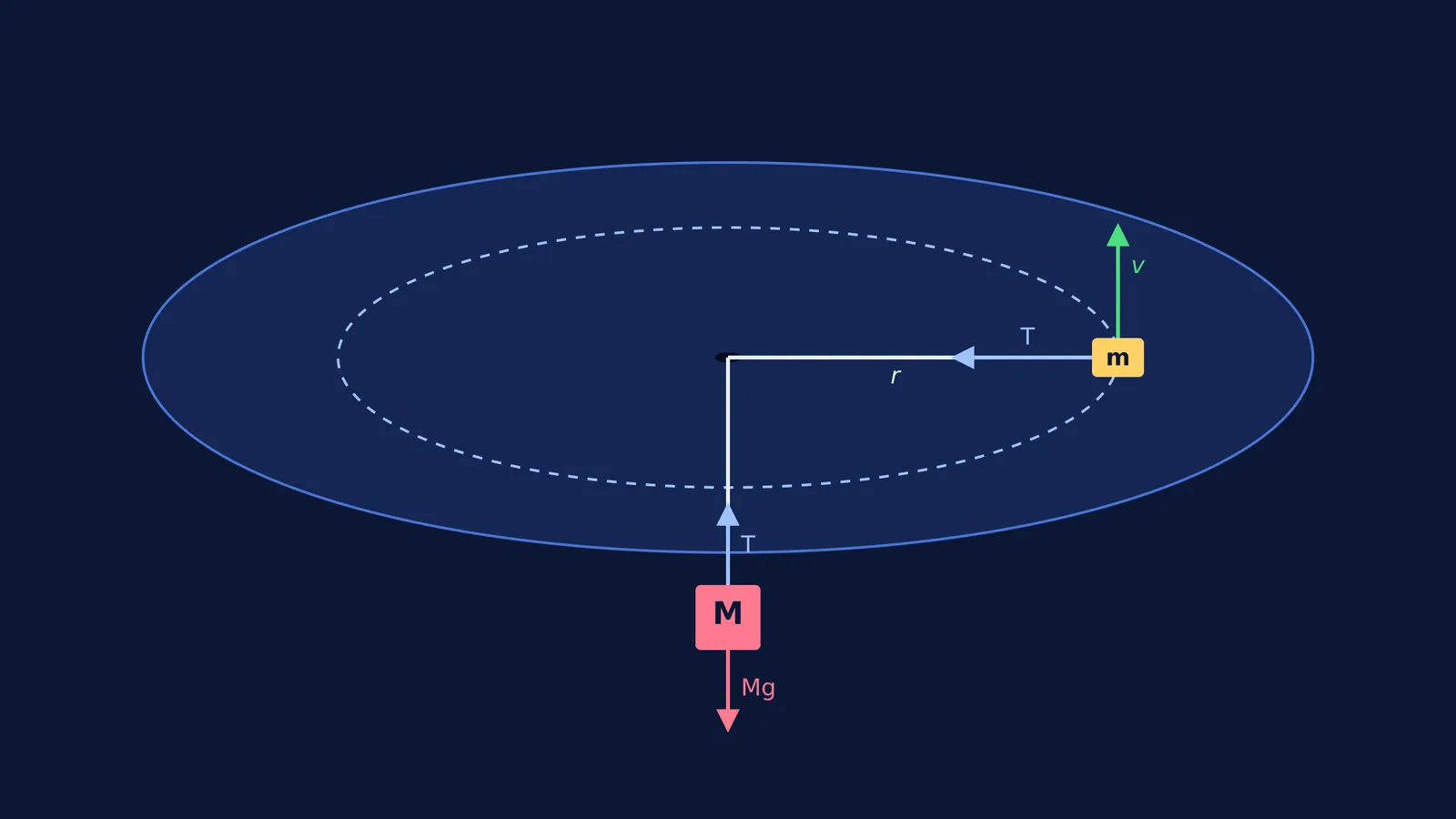
When studying circular motion, one of the most common exam problems features a block moving in a circle on a table, connected by a string through a central hole to another block hanging below. It looks like a complex system, but it breaks down into two straightforward applications of Newton's laws.
Here is how the tension in the string links the two masses and how to calculate the exact speed required to keep the system perfectly balanced.
How does a mass rotating on a table balance a hanging mass?
The secret to this system is the string. Because it connects both masses, it carries the same tension (*T*) to each of them. We can find the condition for balance by looking at the forces on each mass separately.
First, consider the hanging mass (*M*). It experiences two forces: gravity pulling it down (*Mg*) and the string tension pulling it up (*T*). For the hanging mass to remain completely stationary—neither falling nor being pulled up through the hole—the net force must be zero. Therefore, the tension must equal the weight: *T* = *Mg*
Next, look at the mass on the table (*m*). According to OpenStax University Physics, any object moving in a circle requires a net force directed toward the center, called a centripetal force. In this setup, the string's tension provides that inward pull. The formula for centripetal force is *F* = *mv*²/*r*, where *v* is the speed of the mass and *r* is the radius of its circular path. Therefore: *T* = *mv*²/*r*
Because the tension is the same throughout the string, we can set the two equations equal to each other. The weight of the hanging mass supplies the exact centripetal force needed for the rotating mass: *Mg* = *mv*²/*r*
How to find the speed or radius for balance?
Once you have the balancing equation *Mg* = *mv*²/*r*, finding the required speed or radius is just a matter of rearranging the algebra.
If an exam question asks for the speed (*v*) required to keep the hanging mass stationary at a given radius, rearrange to solve for *v*: *v* = √(*Mgr* / *m*)
If the problem instead asks for the radius (*r*) that will keep the system balanced at a known speed, rearrange to solve for *r*: *r* = *mv*² / (*Mg*)
For questions involving angular velocity (*ω*) instead of linear speed, remember that *v* = *rω*. Substituting this into the balance equation gives *Mg* = *mrω*², which means the required angular velocity is *ω* = √(*Mg* / *mr*).
If you are unsure how to set up the force equations for a specific variation of this problem, the Fermi Problem Library has worked problems with a step-by-step solver that explains the reasoning rather than printing an answer.
Worked example: Finding the balancing speed
Let's put the formula into practice with a numerical example typical of those in OpenStax University Physics.
Suppose a 0.5 kg puck is rotating on a frictionless table, attached to a string that passes through a hole. At the other end of the string hangs a 2.0 kg block. The radius of the circular path is 0.4 m. What speed must the puck maintain to keep the hanging block stationary? (Use *g* = 9.8 m/s²).
Identify the given values: *m* = 0.5 kg, *M* = 2.0 kg, *r* = 0.4 m.
State the balance condition: *Mg* = *mv*²/*r*.
Plug in the numbers: (2.0)(9.8) = (0.5)(*v*²) / 0.4.
Simplify the left side: 19.6 = 1.25 *v*².
Solve for *v*²: *v*² = 19.6 / 1.25 = 15.68.
Find the square root: *v* = 3.96 m/s.
The puck must travel at 3.96 m/s to keep the 2.0 kg block from moving.
Understanding how tension connects different parts of a system is a recurring theme in mechanics, similar to finding the monkey climbing a rope: tension when it speeds up or slows down or calculating the simple pendulum string tension at any angle: mg cos θ + mv²/l.
What if the rotating mass speeds up or slows down?
The delicate balance only holds as long as the rotating mass maintains the exact speed calculated above.
If the mass on the table speeds up, it requires more centripetal force than the hanging weight can provide. The tension increases, pulling the hanging mass upwards and widening the radius of the circle.
Conversely, if friction on the table causes the rotating mass to slow down, the centripetal force drops. The weight of the hanging mass overcomes the tension needed for circular motion, pulling the rotating mass inward as the hanging mass falls.
When students struggle to visualize these dynamic changes, Fermi's AI tutor can help. It works out what they already know and builds a plan for the session, teaching through it by running the simulation and checking understanding as it goes.


