

On this page
A classic challenge in mechanics is the "painter on a scaffold" setup: a person stands on a suspended platform and pulls on a rope that runs over a fixed pulley and attaches back down to the platform.
It looks like they are trying to lift themselves by their bootstraps. To understand how this works and whether it is even possible, you have to break the physical system apart using Newton's laws of motion.
What is the tension in the rope?
To find the tension in the rope (T), it is often easiest to begin by treating the man and the platform as a single, combined system.
If the man has a mass M and the platform has a mass m, the total weight pulling the entire system down toward the Earth is (M + m)g, where g is the acceleration due to gravity.
Looking at the ropes, there are two distinct upward forces acting on this combined system. The first upward force is the tension in the rope attached directly to the right side of the platform. The second upward force is the tension in the rope the man is holding on the left side. Because the rope pulls up on his hands just as hard as he pulls down on it, this also acts as an upward force on the combined system.
If the system is stationary or moving upward at a constant speed, the net force is zero. Therefore, the upward forces must perfectly balance the downward forces: 2T = (M + m)g
This means the tension in the rope is T = (M + m)g / 2. By standing on the platform he is lifting, the man effectively halves the pulling force he needs to apply, taking advantage of the mechanical advantage provided by the two supporting rope segments.
What is the normal force on his feet?
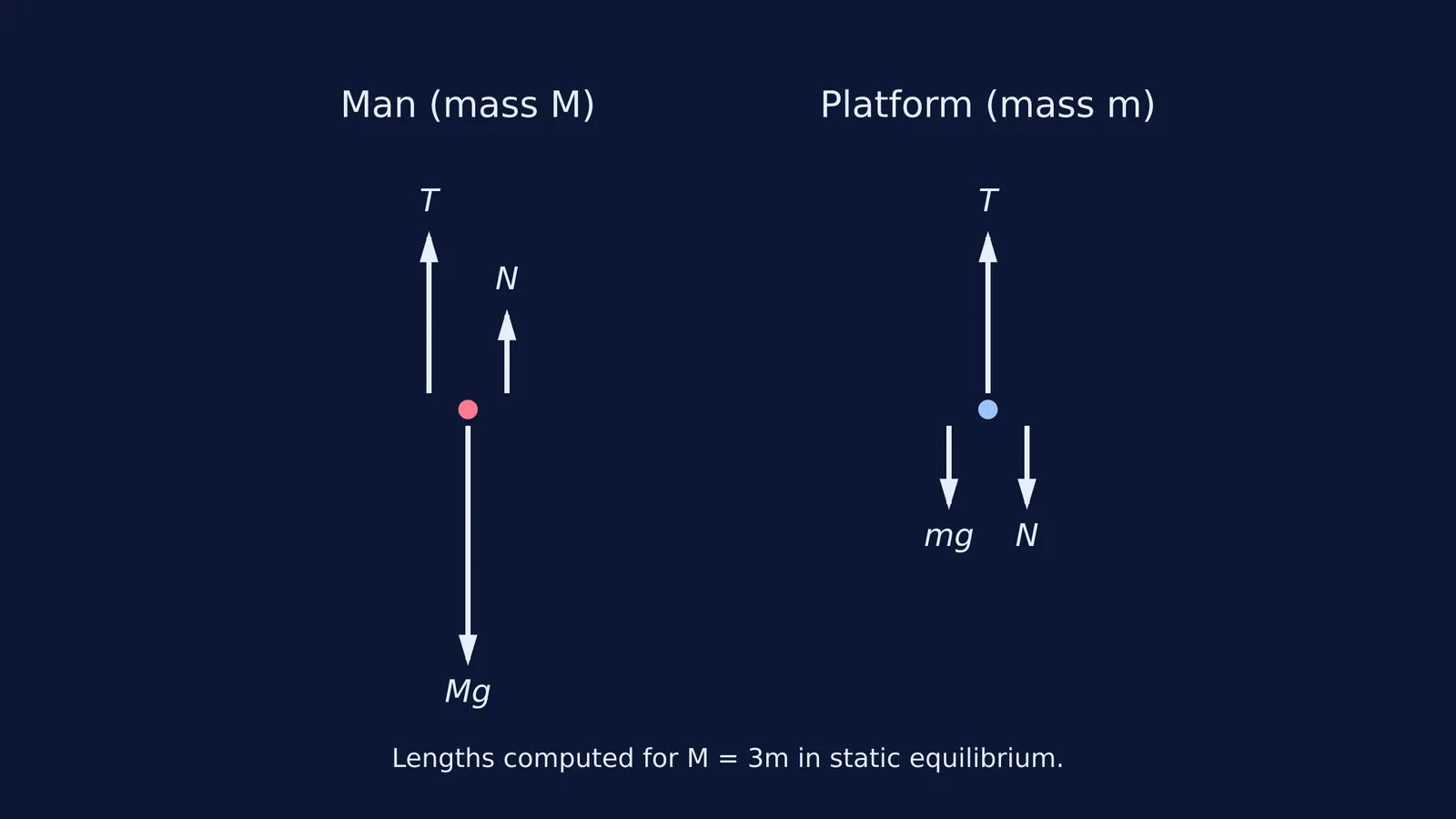
Finding the normal force (N) requires a different approach. You cannot find internal contact forces by looking at the whole system; you must draw a free-body diagram for the man alone.
A 2009 study by David Rosengrant and colleagues in physics education found that 60 to 70% of students draw free-body diagrams voluntarily when taught with multiple representations. Those who draw correct diagrams are significantly more likely to reach the correct answer in exam problems.
For the man's isolated diagram, the downward force is his own weight, Mg. The upward forces are the tension T pulling up on his hands and the normal force N from the platform pushing up on his feet.
Balancing these specific forces gives: N + T = Mg
We already know that the tension is T = (M + m)g / 2. Substituting that into the equation: N = Mg - (M + m)g / 2
When we simplify this expression, we get the final normal force: N = (M - m)g / 2
If you are struggling to isolate objects like this, the Fermi Problem Library has worked problems with a step-by-step solver that explains the reasoning rather than printing an answer. The AI tutor helps you check your system boundaries and force vectors before you set up the final math equations.
Why must the man be heavier than the platform?
Look closely at the final result for the normal force between the painter and the scaffold: N = (M - m)g / 2.
For the man to remain standing firmly on the platform, the normal force must be a positive number (N > 0). If the normal force drops to zero, he loses physical contact with the floor.
This means that the difference M - m must be greater than zero, which simplifies to M > m. The man must be physically heavier than the platform he is trying to lift.
If the platform is heavier than the man (m > M), the tension required to lift the heavy platform is greater than the man's own weight. When he pulls hard enough to lift it, the upward tension on his hands exceeds his downward weight. He will simply lift himself off the ground, leaving the platform sitting exactly where it started.
When preparing for competitive exams, remember that many mechanics problems follow this pattern. Whether you are finding the contact force between blocks pushed together or calculating the tension when a monkey climbs a rope, your success relies on this exact skill: choosing the correct boundary for your free-body diagram and identifying only the external forces acting across it.


