

On this page
When you learn about electricity and magnetism, they are often taught as equal partners. But if you compare the forces between two moving charges, you will find a massive imbalance. The magnetic force is essentially a relativistic side effect of the electric force.
Why is magnetic force between moving charges much weaker than electric?
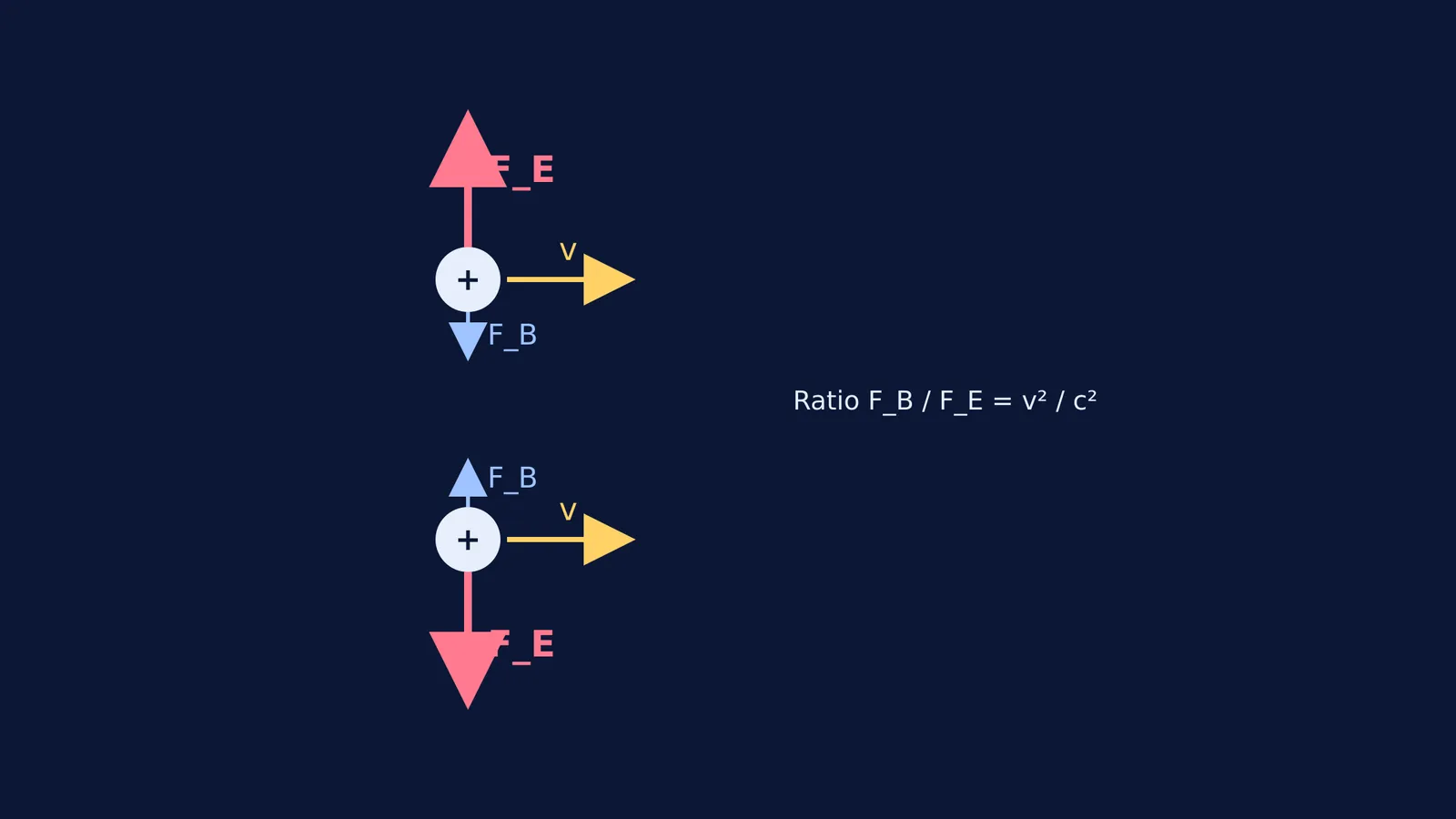
If you have two identical charges moving side by side at a velocity v, they push away from each other with an electric force and pull towards each other with a magnetic force. The ratio of this magnetic attraction to the electric repulsion is exactly v²/c², where c is the speed of light. This relativistic connection is rigorously explained in the Feynman Lectures on Physics.
Because the speed of light is so large (3 × 10⁸ m/s), any everyday velocity makes this ratio incredibly small. The magnetic force only approaches the strength of the electric force when the charges are moving at relativistic speeds, close to the speed of light itself. At normal speeds, the magnetic force is just a faint whisper compared to the overwhelming shout of the electric force. If you want to review how these forces add up for individual charges, the Fermi Concept Library explains both Coulomb's law and the Biot-Savart law step by step.
How slow is the drift velocity of electrons in a wire?
To see how small this force ratio gets in practical terms, we can look at a standard copper wire. When you turn on a light switch, the electrical signal travels near the speed of light, but the electrons themselves barely move. Instead of zipping through the wire, they bump and drift at a snail's pace. According to the OpenStax University Physics Volume 2 textbook, the drift velocity of electrons in a typical 12-gauge copper wire carrying a 20-ampere current is just 4.54 × 10⁻⁴ m/s. This equates to about 0.45 millimetres per second, meaning an electron takes over half an hour to travel just one metre.
Let's find the exact force ratio for an electron moving at v = 4.54 × 10⁻⁴ m/s.
Take the speed of light c ≈ 3 × 10⁸ m/s.
Find the ratio v/c: (4.54 × 10⁻⁴) / (3 × 10⁸) ≈ 1.51 × 10⁻¹².
Square the ratio: (1.51 × 10⁻¹²)² ≈ 2.3 × 10⁻²⁴.
The magnetic force between two such electrons is roughly 2.3 × 10⁻²⁴ times their electric repulsion.
This mathematical reality means the magnetic interaction between two individual electrons in a wire is almost non-existent compared to how strongly they repel each other electrically.
If the magnetic force is so weak, why do magnets work?
If the magnetic force is genuinely smaller by a factor of 10⁻²⁴, it seems mathematically impossible that a simple permanent magnet could hold a heavy piece of paper to your fridge, or that massive industrial motors could turn. The answer to this paradox lies entirely in charge neutrality.
A standard copper wire contains perfectly equal numbers of positive protons and negative electrons. Their massive electrical forces cancel each other out completely. Because the net electric force is exactly zero, it leaves the tiny magnetic force as the only observable interaction between parallel wires. The magnetic forces are allowed to add up without cancellation because there are a staggering number of electrons in motion—about 10²⁹ per cubic metre of copper, as shown in OpenStax University Physics. To see how these tiny fields stack up to create macroscopic forces, you can use the Fermi Simulation Lab to model the magnetic field of a current-carrying wire.
How does relativity explain this difference?
Einstein's theory of special relativity shows that magnetism is not fundamentally a separate force at all, but rather what the electric force looks like when charges move relative to the observer. When electrons flow through a wire, the space between them undergoes Lorentz contraction from the perspective of a stationary lab frame.
This relativistic contraction slightly changes the apparent charge density of the wire. The tiny "leftover" electric force resulting from this microscopic distortion of space is exactly what we call the magnetic force. The v²/c² term is the identical mathematical factor that dictates time dilation and length contraction, proving that magnetism is just a first-order relativistic correction to electrostatics. If you find the geometry of relativity tricky to visualise, Fermi's AI tutor can help you draw the different reference frames and calculate the contracted lengths.
Read more:


