

On this page
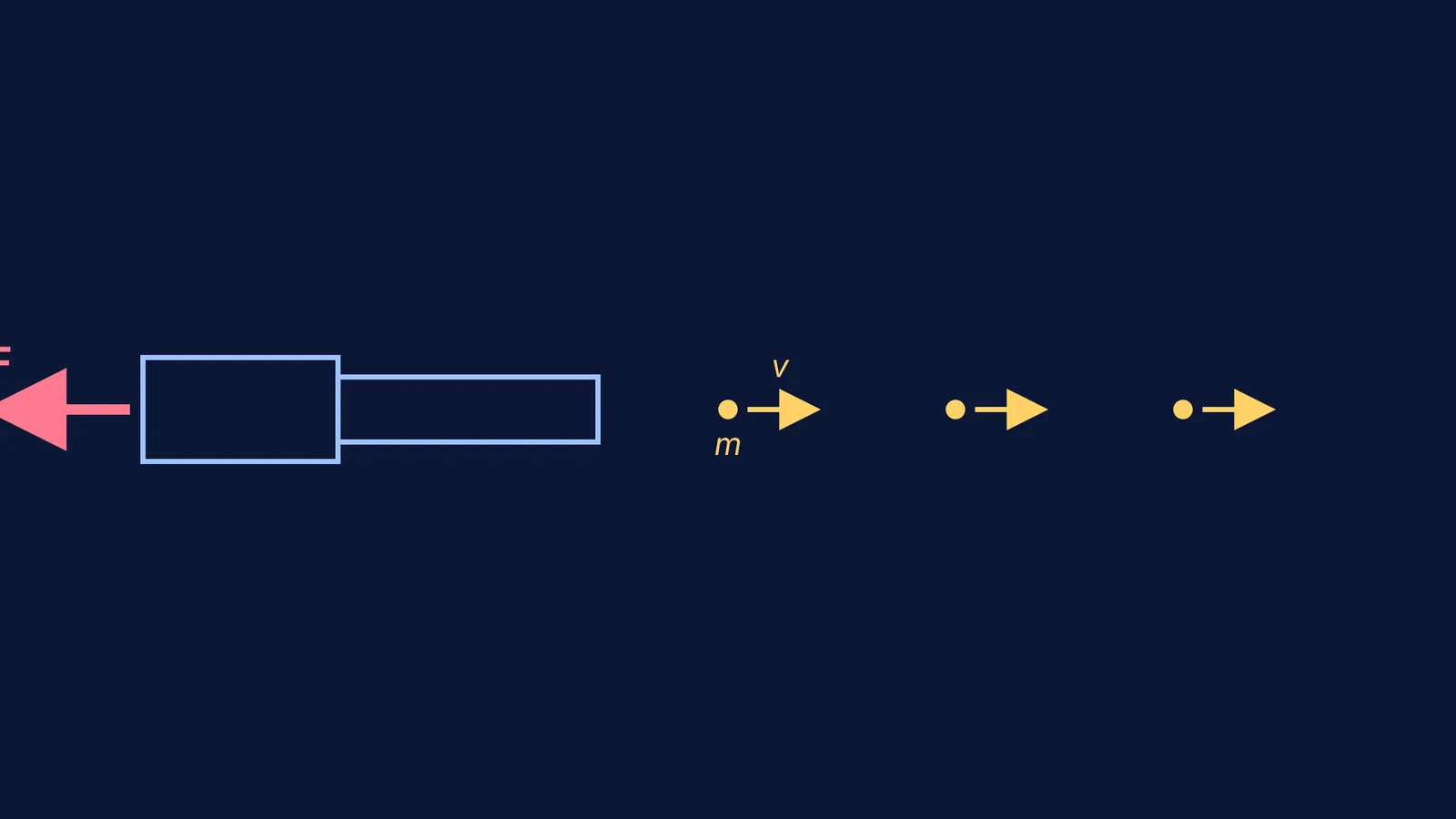
When a machine gun fires a stream of bullets, it kicks back. To hold the weapon steady, a person must push forward continuously. In physics exams like JEE Main and NEET, this scenario is a classic way to test your understanding of momentum and force.
The problem looks like kinematics, but it is actually a straightforward application of Newton's laws of motion.
Why does a machine gun recoil?
Every time a bullet is pushed forward out of the barrel, the expanding gases push the gun backward with an equal and opposite force. This is a direct consequence of Newton's third law of motion.
When you fire a single shot from a rifle, you feel a distinct, sharp kick against your shoulder. However, because a machine gun fires a continuous stream of bullets at a very high rate, this series of discrete backward kicks blends together. The person firing the weapon feels it as one steady, continuous backward push. To keep the gun from flying backward and to hold it stationary, the person holding it must apply an equal force in the forward direction.
But how do we calculate that force? We turn to Newton's second law of motion. Most students memorize this law as F = ma (force equals mass times acceleration). However, the true, fundamental form of the law states that force is the rate of change of momentum. Therefore, the force needed to hold the gun is exactly equal to the total momentum of the bullets fired in one second.
The formula for recoil force
Because the gun is stationary, we are not dealing with a single accelerating object. Instead, we are dealing with a system losing mass (the bullets) at a constant velocity.
To find the continuous holding force, we look at the momentum of a single bullet and multiply it by the firing rate.
Let the mass of a single bullet be m, and its velocity as it leaves the barrel be v. The momentum (p) of one bullet is exactly: p = m × v
If the gun fires n bullets every second, the total momentum transferred to the bullets per second is simply n times the momentum of one bullet: Force (F) = n × m × v
This single equation handles almost every machine gun problem in competitive exams. You just need to identify which three variables are given and solve for the fourth.
How to find the force needed to hold a machine gun?
Let us look at a standard problem that appeared in the AIEEE 2004 (now JEE Main) exam (Sarthaks):
Step 1: Convert units to standard SI form Exam setters almost always give the bullet's mass in grams to catch you out. Force is measured in Newtons (kg·m/s²), so you must convert the mass to kilograms first. m = 40 g = 0.04 kg v = 1200 m/s Maximum Force (F) = 144 N
Step 2: Find the momentum of one bullet We calculate the momentum carried away by a single round leaving the chamber. p = m × v p = 0.04 kg × 1200 m/s p = 48 kg·m/s
Step 3: Solve for the firing rate (n) We know the continuous force exerted on the man is the total momentum per second. F = n × p 144 = n × 48 n = 144 / 48 n = 3
The man can fire a maximum of 3 bullets per second before the recoil force overpowers his grip.
If you find yourself guessing which formula to use for scenarios like this, the Fermi Problem Library has worked problems with a step-by-step solver that explains the reasoning rather than printing an answer.
The three-step framework for recoil problems
When you face a rate-of-momentum question in a test, stick to this routine to avoid common errors:
Check your mass units: Convert grams to kilograms immediately (divide by 1000). Leaving the mass in grams is the single most common mistake in these problems and will result in an incorrect answer.
Calculate one unit of momentum: Find the mv for a single bullet or single packet of mass first. This breaks the problem into manageable pieces and makes it easier to track your logic.
Connect rate to force: Multiply that single momentum by the rate (bullets per second, or kg per second if dealing with a water jet or rocket exhaust) to get the total force in Newtons.
Once you master basic recoil, you will see similar principles in other variable-mass systems. The exact same rate-of-momentum logic applies to a shell exploding midair: momentum, fragments and energy. You can also extend these concepts to non-linear kinematics, such as finding the horizontal projectile from a cliff: time, range and impact speed or dealing with acceleration given as a function of v or x: how to integrate it.


