

On this page
While the kidneys handle most nitrogenous waste (and are tightly regulated by hormones like ADH, the RAAS and ANF), they are not the only organs cleaning your blood. Your lungs, liver and skin also play essential roles in eliminating metabolic wastes.
If you are studying how different animals handle waste—from ammonotelic to ureotelic and uricotelic organisms—it is crucial to remember that human excretion extends far beyond the urinary system. The kidneys are highly specialized for filtering urea, uric acid, and excess water, but they leave other metabolic byproducts untouched. This is where the secondary excretory organs step in. Here is a detailed look at how these organs clear out carbon dioxide, bile pigments, and excess salts to maintain your body's internal balance.
What is the role of lungs in excretion?
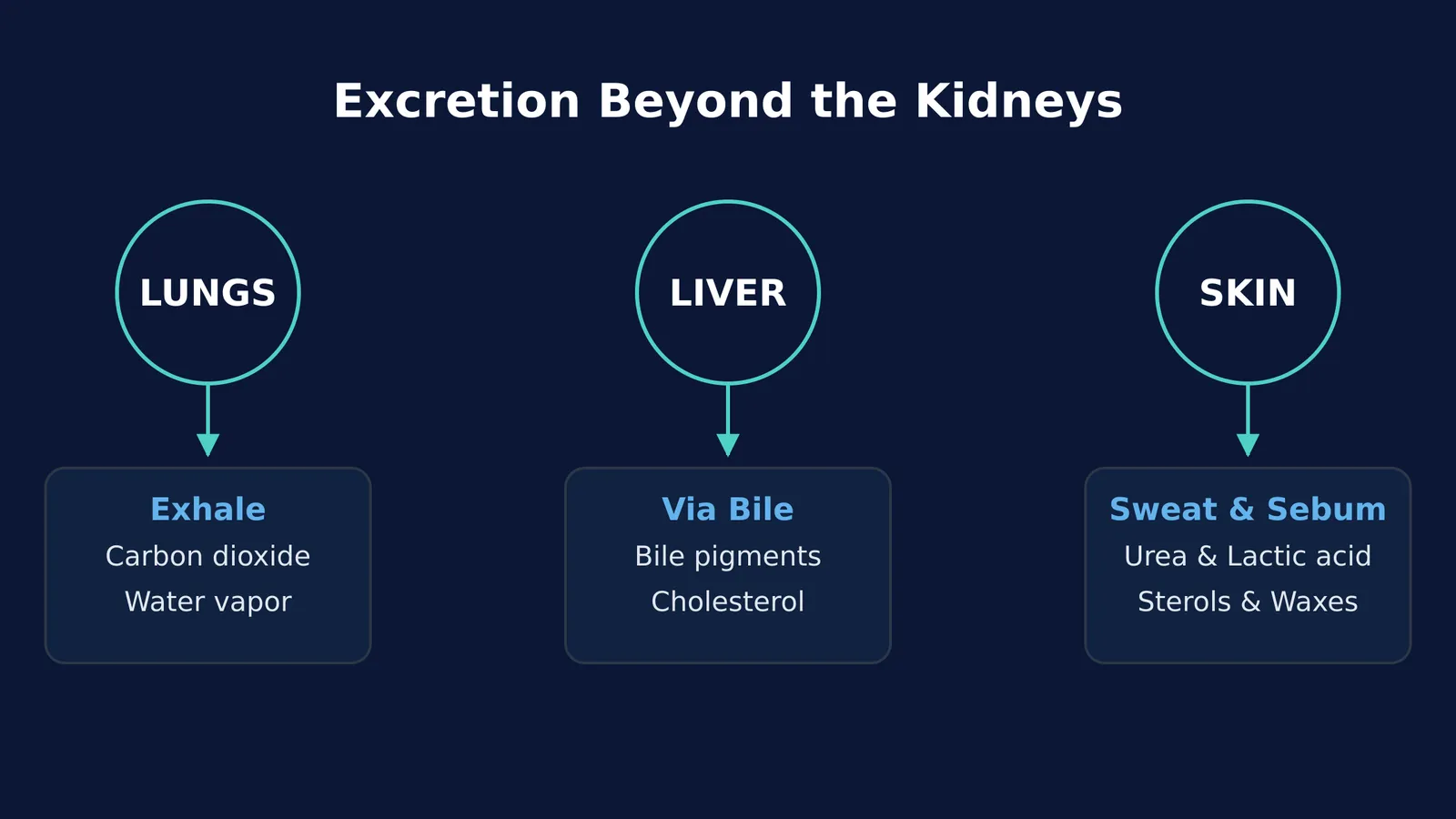
Your lungs are primarily responsible for respiration, constantly bringing oxygen into your body. However, they are equally important as a major excretory organ. Every time you exhale, you remove the major waste products of cellular metabolism: carbon dioxide (CO₂) and water vapor.
Carbon dioxide is continuously generated by all your cells during aerobic respiration, specifically in the mitochondria during the Krebs cycle. If this gas were allowed to accumulate, it would react with water in your blood to form carbonic acid, causing your blood pH to drop. This condition, known as respiratory acidosis, can be fatal. By breathing out, your lungs maintain the delicate acid-base balance of your bloodstream.
The volume of waste they clear is staggering. In fact, your lungs are actually the primary excretory organ for weight loss: for every 10 kg of fat you lose, 8.4 kg is exhaled as CO₂. The remaining portion turns into water. This means that when you burn fat, the vast majority of its mass literally vanishes into thin air with every breath you take.
What is the role of the liver in excretion?
The liver is the largest gland in the body and acts as a central biochemical clearinghouse. It is responsible for processing many toxic substances, metabolic byproducts, and drugs so they can be safely removed from circulation. Without the liver's detoxification pathways, the kidneys would be quickly overwhelmed.
Its main excretory route is through the production of bile. Red blood cells have a limited lifespan. When these old red blood cells are broken down in the spleen and liver, the body recycles the iron but must dispose of the remaining heme group. The liver converts this hemoglobin byproduct into bile pigments, primarily bilirubin and biliverdin, which give bile its characteristic colour.
Beyond bilirubin, the liver also actively excretes excess cholesterol, degraded steroid hormones, certain vitamins, and pharmaceutical drugs into the bile. This bile flows from the liver into the gallbladder for storage, and then empties into the small intestine to aid in fat digestion. Eventually, these waste products travel through the entire gastrointestinal tract and are ultimately eliminated from the body with digestive wastes. Furthermore, the liver plays a critical role in the ornithine cycle, converting highly toxic ammonia—a byproduct of protein metabolism—into much less toxic urea, which is then sent to the kidneys for excretion.
What is the role of the skin in excretion?
Your skin is the body's largest organ, providing a physical barrier against the outside world. Embedded within its layers are specialized glands that help eliminate specific wastes from the blood, though excretion is not their primary evolutionary purpose.
Sweat glands: Also known as sudoriferous glands, these produce a watery fluid that contains sodium chloride (NaCl), small amounts of urea, and lactic acid. While the primary function of sweat is thermoregulation—cooling the body down as the water evaporates from the skin surface—it acts as a helpful secondary excretory route for these dissolved substances. In cases of severe kidney failure, the concentration of urea in sweat can become so high that it leaves a white, powdery residue on the skin known as uremic frost.
Sebaceous glands: These glands eliminate sterols, hydrocarbons, and waxes through a lipid-rich secretion called sebum. Though this physiological process effectively removes these specific chemicals from the body, the primary purpose of sebum is to lubricate the skin, keep it pliable, and provide a protective, oily, mildly acidic covering for the skin and hair that deters bacterial growth.
If you need to build a clear mental model of human physiology, the Fermi Concept Library covers every concept in biology, each with its own lesson and its place in the map. Additionally, Fermi's AI tutor can work out what you already know and build a plan for the session, so you sit down to a clear next step in your learning.


