

On this page
When you walk into a completely dark room, you cannot see the chairs, the walls, or the books on the desk. You can only see them once you turn on a lamp or open a window. In physics, this simple observation splits everything you see into two distinct categories: luminous and non-luminous objects.
Understanding the difference between the two is the first step in optics, explaining how light travels and how human vision works.
What is a luminous object?
A luminous object is anything that emits its own light. It acts as an active source of light because it converts another form of energy—like heat, electricity, or chemical energy—into light energy that travels outward in straight lines.
The Sun has an effective surface temperature of 5772 K (NASA). This immense heat makes it glow brightly enough to light up the entire solar system.
Common examples of luminous objects include:
The Sun and stars: Our primary natural sources of light in the universe.
Electric bulbs and tube lights: Everyday objects that convert electrical energy into visible light.
A burning candle or campfire: These release light and heat through the chemical process of combustion.
Bioluminescent animals: Some living things, such as fireflies and certain deep-sea anglerfish, produce their own "cold light" through complex chemical reactions within their bodies.
When studying optics or preparing for physics exams, you might find it hard to picture exactly how light rays behave. The Fermi Simulation Lab lets you interact with moving light rays to see how they leave a luminous source and interact with lenses, mirrors, and everyday obstacles.
What is a non-luminous object?
A non-luminous object does not produce any light of its own. Instead, we are only able to see it because it reflects light from a luminous source into our eyes. When you look around a room during the day, almost everything you see—the furniture, other people, your clothes, and the walls themselves—is non-luminous.
If you place a non-luminous object in the path of a light source (for example, by standing directly between a bright lamp and the wall), it blocks the light rays, and a shadow forms behind it. This interaction is a core topic in early optics, as covered in our guide to shadows, mirrors and pinhole cameras in Class 7 science.
Why does the Moon shine if it is non-luminous?
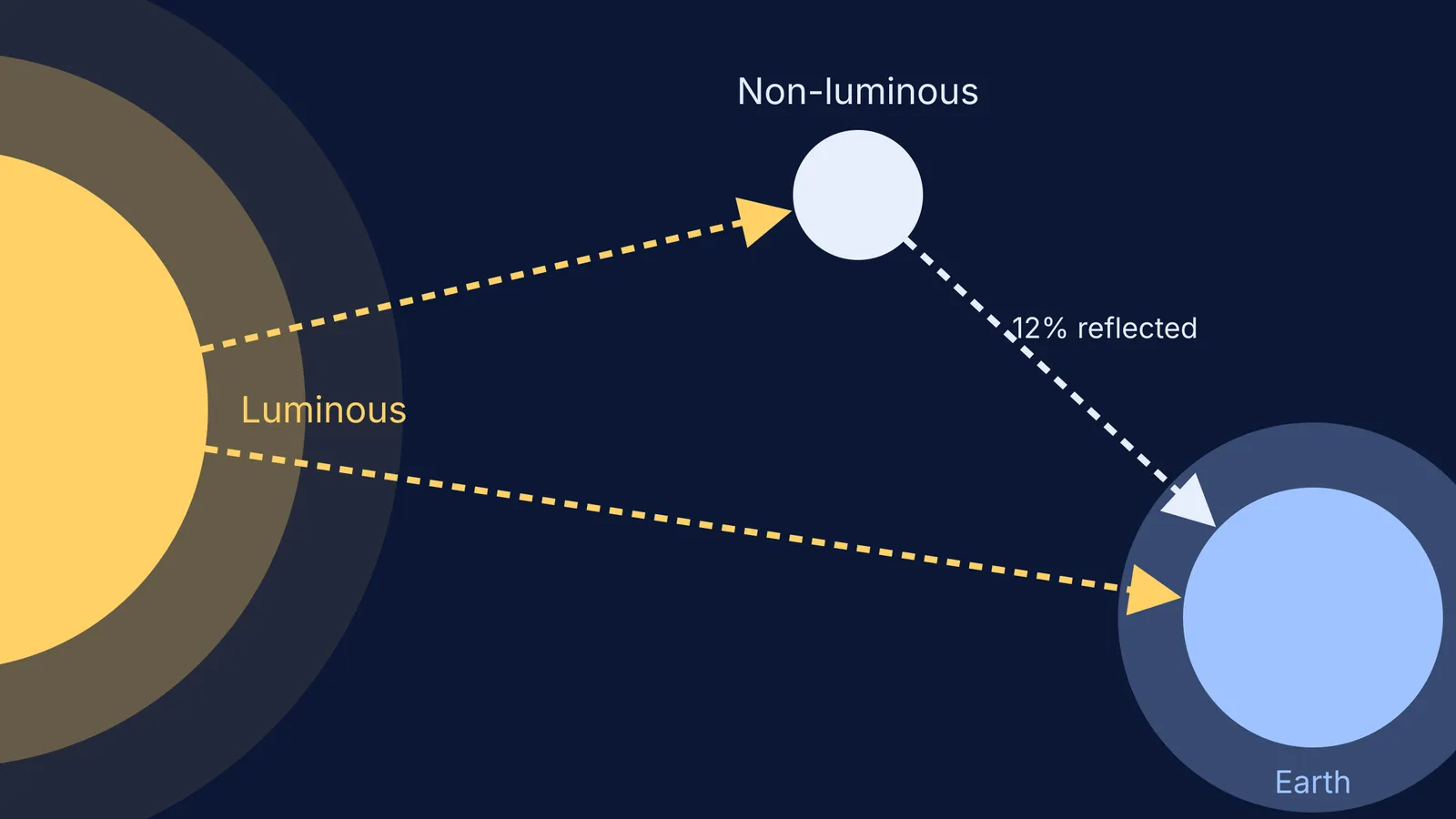
The Moon is the brightest object in the night sky, which understandably makes many people assume it is luminous. However, the Moon is strictly a non-luminous object. It consists entirely of rock and dust, and it does not generate any light of its own through heat or chemical reactions.
We see the Moon purely because it acts like a giant mirror, reflecting the Sun's light back towards Earth. Interestingly, its surface is actually quite dark, similar in colour to worn asphalt. According to NASA's planetary data, the Moon has an average geometric albedo of 0.12, meaning it reflects just 12% of the sunlight that hits it (NASA Moon Fact Sheet). Despite this relatively low reflectivity, the intense, unfiltered light from the Sun makes the Moon appear brilliantly bright against the pitch-black backdrop of space.
How do we see non-luminous objects?
Seeing a non-luminous object requires three specific things to happen in sequence:
A luminous source must produce light rays.
A non-luminous object must intercept and reflect those light rays.
Your eyes must receive the reflected light to form an image in your brain.
When a light ray strikes a non-luminous object, some of the light is absorbed by the material and some is bounced back into the environment. This bouncing of light is called reflection. The rules governing how light bounces off smooth and rough surfaces are essential to understanding mirrors, which you can review in our detailed piece on light in Class 10: reflection, refraction and the lens formula.
It is important to remember that even a highly polished, glittering mirror is non-luminous; it does not make light, it simply redirects the light that hits it.
If you have gaps in your understanding of how light travels and reflects, the Fermi Concept Library maps out the fundamental rules of optics, helping you build a solid foundation before tackling more complex physics problems.
By separating objects into these two fundamental groups, physics gives us a clear framework for tracing how light moves through the world—whether it is streaming outward from a distant star or bouncing off the pages of a book.


