

On this page
Most mirror problems ask about an upright object standing on the principal axis. The ratio of the image height to the object height is the transverse (or lateral) magnification, m = −v/u.
But what happens when a rod or an arrow lies flat along the axis itself? This is where longitudinal magnification comes in. The length of the image along the axis is entirely different from its height, and the way it stretches or squashes depends on how close it is to the mirror.
What is longitudinal magnification?
According to Wikipedia, longitudinal magnification is the magnification of an image along the optical axis, defined as the ratio of image length to object length.
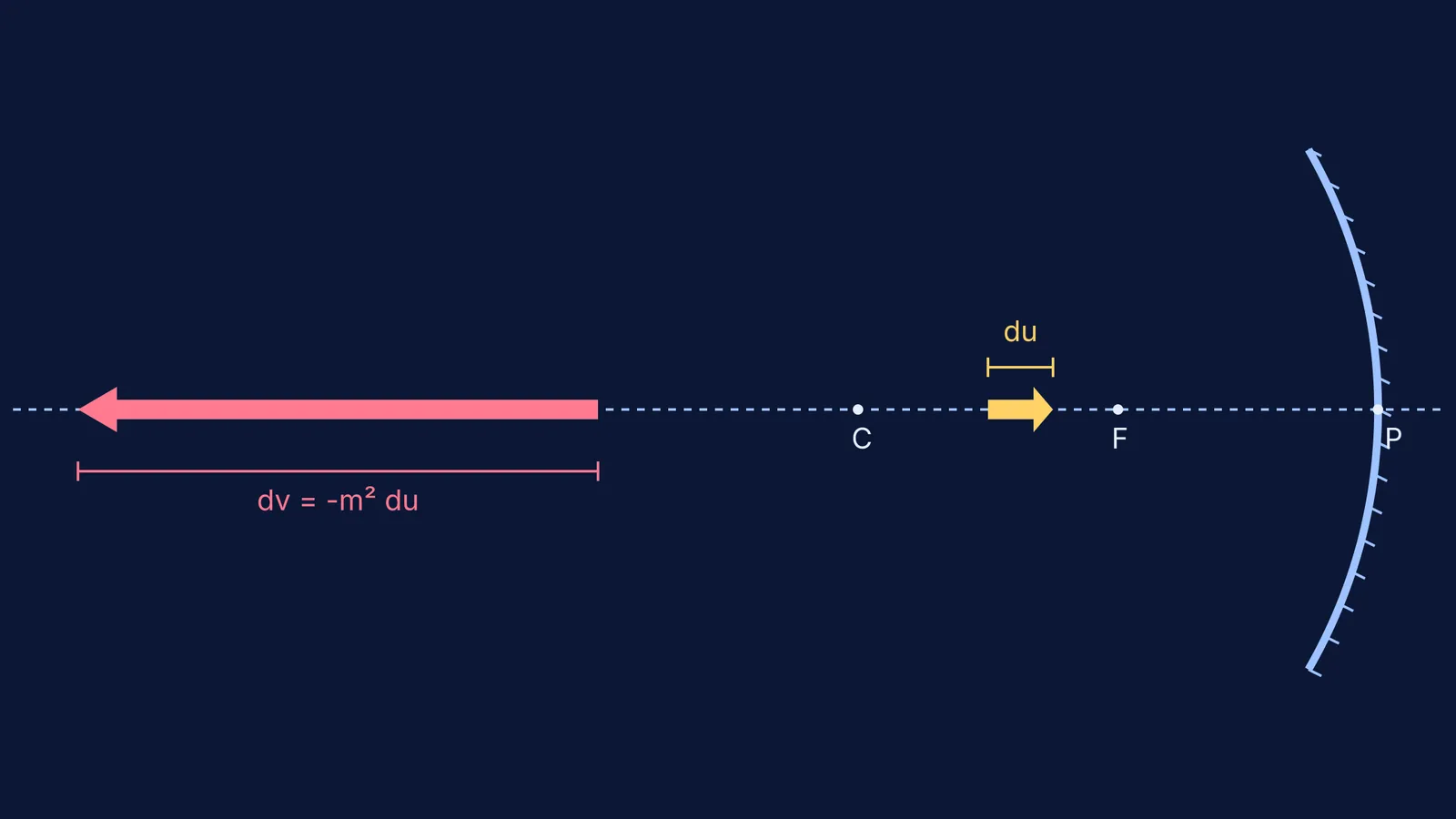
A short rod of length du on the axis forms an image of length dv, making the longitudinal magnification dv/du.
How to derive the longitudinal magnification of a mirror?
For a very short object, we can find the longitudinal magnification by differentiating the spherical mirror formula.
The mirror formula connects the object distance u, image distance v, and focal length f: 1/v + 1/u = 1/f
Differentiating both sides with respect to u, treating the focal length f as a constant: −1/v² (dv/du) − 1/u² = 0
Rearranging gives: dv/du = −v²/u²
Since transverse magnification is m = −v/u, v²/u² is exactly m², giving the final formula: mL = −m²
What does the negative sign mean?
Since m² is positive, Wikipedia notes the longitudinal magnification −m² is strictly negative.
This negative sign means the image is longitudinally inverted. An arrow pointing toward the mirror has an image pointing away. The end closer to the pole forms an image further away.
If you are plotting an image for Concave mirror images for all six object positions, you can see this effect: as an object moves from infinity towards the focus, its image moves from the focus towards infinity in the opposite direction.
Large objects: when to avoid the −m² formula
The −m² shortcut only works for very short objects. If the object is a long rod, the magnification is not constant across its length. As longitudinal magnification varies with the square of the transverse magnification, a long object creates a distorted 3D image where the end closer to the focus gets stretched much more than the end further away.
For a large object whose ends are at u1 and u2, you cannot use calculus. You must instead calculate the exact image positions v1 and v2 separately using the mirror formula.
Follow these steps for a long rod:
Find the image position v1 for the first end u1 using 1/v1 + 1/u1 = 1/f.
Find the image position v2 for the second end u2 using 1/v2 + 1/u2 = 1/f.
Find the length of the image by taking the absolute difference: |v2 − v1|.
The longitudinal magnification for the large object is (v2 − v1) / (u2 − u1).
Because the image stretches unevenly, you cannot just find the transverse magnification at the centre of the rod and square it.
Worked example: longitudinal magnification of a rod
Let us place a rod of length 10 cm on the principal axis of a concave mirror of focal length f = −20 cm. The rod lies between u1 = −30 cm and u2 = −40 cm.
First, we find the image of the near end (u1 = −30 cm): 1/v1 + 1/(−30) = 1/(−20) 1/v1 = −1/20 + 1/30 = −1/60 v1 = −60 cm
Next, we find the image of the far end (u2 = −40 cm): 1/v2 + 1/(−40) = 1/(−20) 1/v2 = −1/20 + 1/40 = −1/40 v2 = −40 cm
The length of the image is the distance between v1 and v2, which is |−60 − (−40)| = 20 cm.
The longitudinal magnification of the rod is the image length divided by the object length: 20 cm / 10 cm = 2. Taking the direction into account, mL = (−40 − (−60)) / (−40 − (−30)) = 20 / (−10) = −2.
If we had mistakenly used the short-object formula at the centre of the rod (u = −35 cm): 1/v + 1/(−35) = 1/(−20) 1/v = −1/20 + 1/35 = −7/140 + 4/140 = −3/140 v = −46.67 cm
The transverse magnification m = −v/u = −(−46.67 / −35) = −1.33. The formula mL = −m² gives −(−1.33)² = −1.78.
For a 10 cm rod, a predicted magnification of −1.78 suggests an image length of 17.8 cm. But the true image length is 20 cm.
Optics problems often hide traps like these. If you keep dropping minus signs or picking the wrong magnification formula, the Fermi Problem Library has worked problems with a step-by-step solver that explains the reasoning rather than printing an answer.
Whether you are placing a pin along the axis or rotating a plane mirror by θ, keeping track of which way the image moves is the surest way to the right answer.


