

On this page
When you encounter the definite integral I = ∫₀¹ [ln(1 + x) / (1 + x²)] dx, standard integration by parts quickly stalls. Differentiating ln(1 + x) gives 1/(1 + x), while integrating dx/(1 + x²) yields arctan x. You are then left with ∫₀¹ [arctan x / (1 + x)] dx, which is just as obstinate as the starting problem.
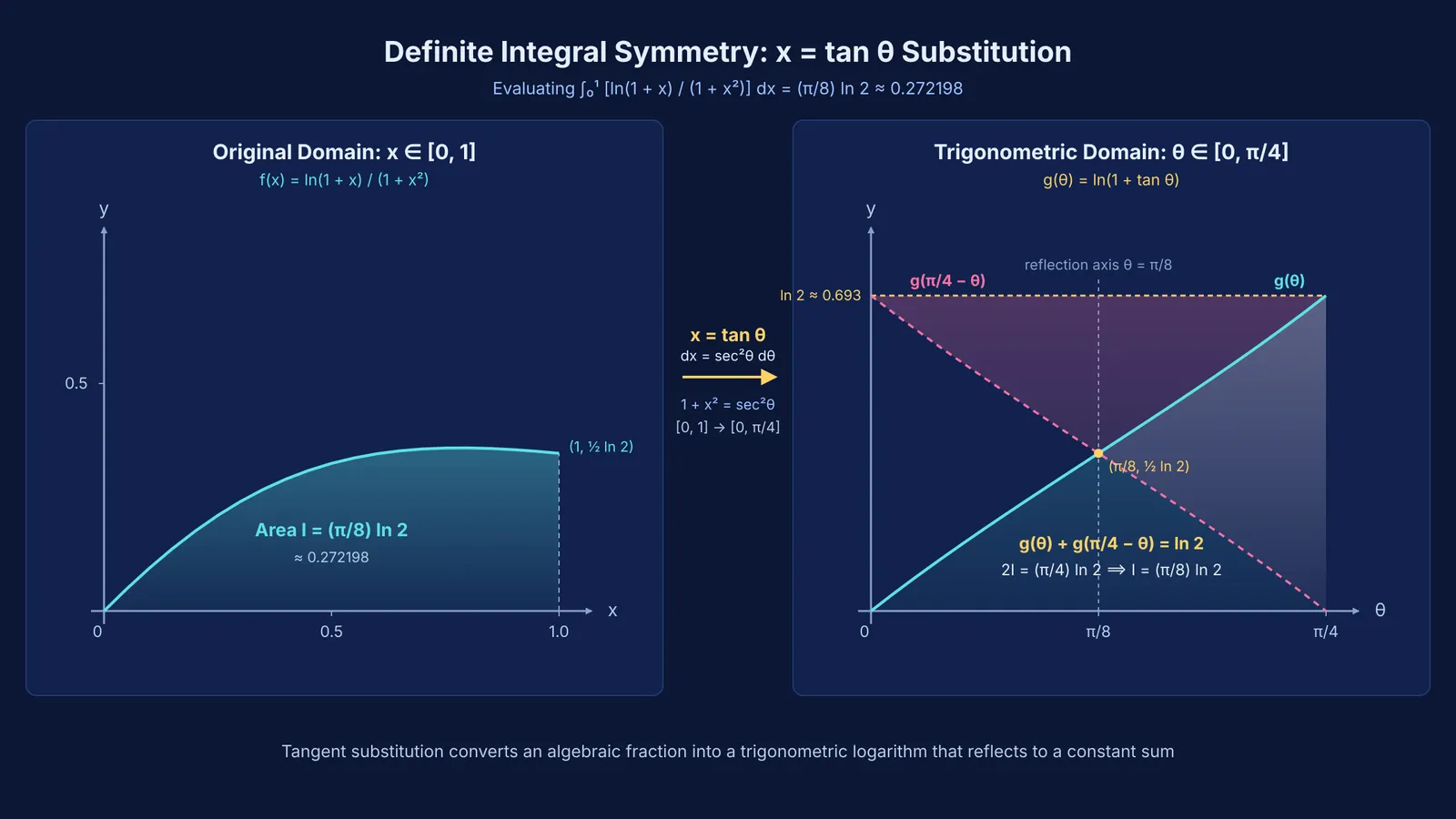
The structural clue sits directly in the denominator: 1 + x². Whenever 1 + x² appears alongside limits between 0 and 1, setting x = tan θ aligns the expression with the trigonometric identity 1 + tan² θ = sec² θ. Differentiating x gives dx = sec² θ dθ. When changing integration bounds during substitution, x = 0 becomes θ = arctan(0) = 0, and x = 1 becomes θ = arctan(1) = π/4.
Why does the substitution x = tan θ simplify this integral?
Substituting x = tan θ directly into the integral replaces every algebraic component with a trigonometric counterpart:
I = ∫₀^(π/4) [ln(1 + tan θ) / (1 + tan² θ)] × sec² θ dθ
Because 1 + tan² θ equals sec² θ, the denominator cancels the differential factor sec² θ completely:
I = ∫₀^(π/4) ln(1 + tan θ) dθ
This reduction replaces an algebraic quotient with a pure trigonometric logarithm on the symmetric interval [0, π/4]. In Serret's 1844 note in Liouville's journal, French mathematician Joseph-Alfred Serret demonstrated that this trigonometric form uncovers a hidden reflection symmetry.
How do you evaluate the transformed integral using King's property?
With the integral simplified to I = ∫₀^(π/4) ln(1 + tan θ) dθ, you can apply one of the most useful reflection properties of definite integrals, often called King's property: ∫₀ᵃ f(θ) dθ = ∫₀ᵃ f(a − θ) dθ.
Here the upper bound is a = π/4. Replacing θ with (π/4 − θ) gives:
I = ∫₀^(π/4) ln(1 + tan(π/4 − θ)) dθ
Next, expand tan(π/4 − θ) using the tangent subtraction identity tan(A − B) = (tan A − tan B) / (1 + tan A tan B). Since tan(π/4) = 1:
tan(π/4 − θ) = (1 − tan θ) / (1 + tan θ)
Now add 1 to this quotient:
1 + tan(π/4 − θ) = 1 + (1 − tan θ) / (1 + tan θ) = (1 + tan θ + 1 − tan θ) / (1 + tan θ) = 2 / (1 + tan θ)
Substituting this back into the logarithm yields:
ln(1 + tan(π/4 − θ)) = ln(2 / (1 + tan θ)) = ln 2 − ln(1 + tan θ)
Now insert this expanded form back into the integral:
I = ∫₀^(π/4) [ln 2 − ln(1 + tan θ)] dθ = ∫₀^(π/4) ln 2 dθ − ∫₀^(π/4) ln(1 + tan θ) dθ
The second term on the right-hand side is your original integral I. Therefore:
I = ln 2 × [θ]₀^(π/4) − I
I = (π/4) ln 2 − I
Adding I to both sides yields 2I = (π/4) ln 2, which gives the closed-form value:
I = (π/8) ln 2 ≈ 0.272198
Can you solve the integral using an algebraic substitution?
You do not have to leave the algebraic domain to exploit this symmetry. As documented in Kedlaya's 2005 Putnam archive for Problem A5 of the 66th William Lowell Putnam Mathematical Competition, you can bypass trigonometry altogether with the involutory substitution:
x = (1 − u) / (1 + u)
This transformation is the direct algebraic counterpart of the tangent angle-subtraction formula. When x = 0, u = 1; when x = 1, u = 0. Differentiating gives dx = −2/(1 + u)² du. The denominator transforms into:
1 + x² = 1 + [(1 − u) / (1 + u)]² = 2(1 + u²) / (1 + u)²
Dividing dx by 1 + x² produces:
dx / (1 + x²) = [−2 / (1 + u)²] / [2(1 + u²) / (1 + u)²] du = −du / (1 + u²)
Meanwhile, the logarithmic argument simplifies into:
ln(1 + x) = ln(1 + (1 − u)/(1 + u)) = ln(2 / (1 + u)) = ln 2 − ln(1 + u)
Reversing the reversed bounds using the negative sign of the differential, the integral becomes:
I = ∫₀¹ [(ln 2 − ln(1 + u)) / (1 + u²)] du = ln 2 × ∫₀¹ [1 / (1 + u²)] du − I
Since ∫₀¹ [1 / (1 + u²)] du = [arctan u]₀¹ = π/4, this again yields 2I = (π/4) ln 2, confirming I = (π/8) ln 2.
How do you spot when an arctan substitution applies in JEE problems?
In the official CBSE 2024-25 Mathematics curriculum, the Unit III Calculus section carries 35 marks out of the 80-mark theory paper. Definite integral questions in both CBSE board exams and JEE Main frequently test whether you can recognize when an algebraic form hides an angular symmetry.
Use this decision checklist when analyzing unfamiliar integrals:
Identify quadratic denominators: Expressions with 1 + x² strongly suggest x = tan θ, whereas 1 − x² points to x = sin θ and x² − 1 points to x = sec θ.
Check the integration limits: Bounds of [0, 1] for x map to [0, π/4] for θ, setting up tan(π/4 − θ) reflections. Bounds of [0, ∞) map to [0, π/2], setting up cot θ co-function symmetries.
Inspect logarithmic or rational arguments: If 1 + x transforms into 1 + tan θ, check whether King's property will produce a reciprocal fraction that decomposes using logarithm quotient laws.
Test self-inverse substitutions: If you want to avoid trigonometry, test x = (1 − u)/(1 + u) when bounds are [0, 1] or x = 1/u when bounds run from 0 to ∞.
When an exam problem combines unfamiliar expressions, choosing the right variable for substitution is often the hardest hurdle. The Fermi Problem Library provides worked problems with a step-by-step solver that explains the reasoning rather than printing an answer, allowing you to trace why a substitution was selected. To reinforce how these identities connect across calculus, the Fermi Concept Library gives every concept in physics, chemistry, biology, mathematics and computing its own lesson and its place in the map.


