

On this page
After glycolysis splits a single glucose molecule into two molecules of pyruvate, the cell faces a metabolic crossroads. If oxygen is present, the cell can extract significantly more energy than it would through anaerobic fermentation. To do this, pyruvate moves into the mitochondria for the next major phase of cellular respiration.
The oxidative decarboxylation of pyruvate (often referred to simply as the link reaction) is the vital bridge connecting glycolysis to the Krebs cycle. Without this specific transitional step, the high-energy bonds left over in pyruvate cannot be fed into the aerobic respiration pathway.
Where does oxidative decarboxylation of pyruvate occur?
Glycolysis takes place in the cytoplasm, but the machinery for the Krebs cycle is locked inside the mitochondria. Therefore, pyruvate must be actively transported across both the outer and inner mitochondrial membranes.
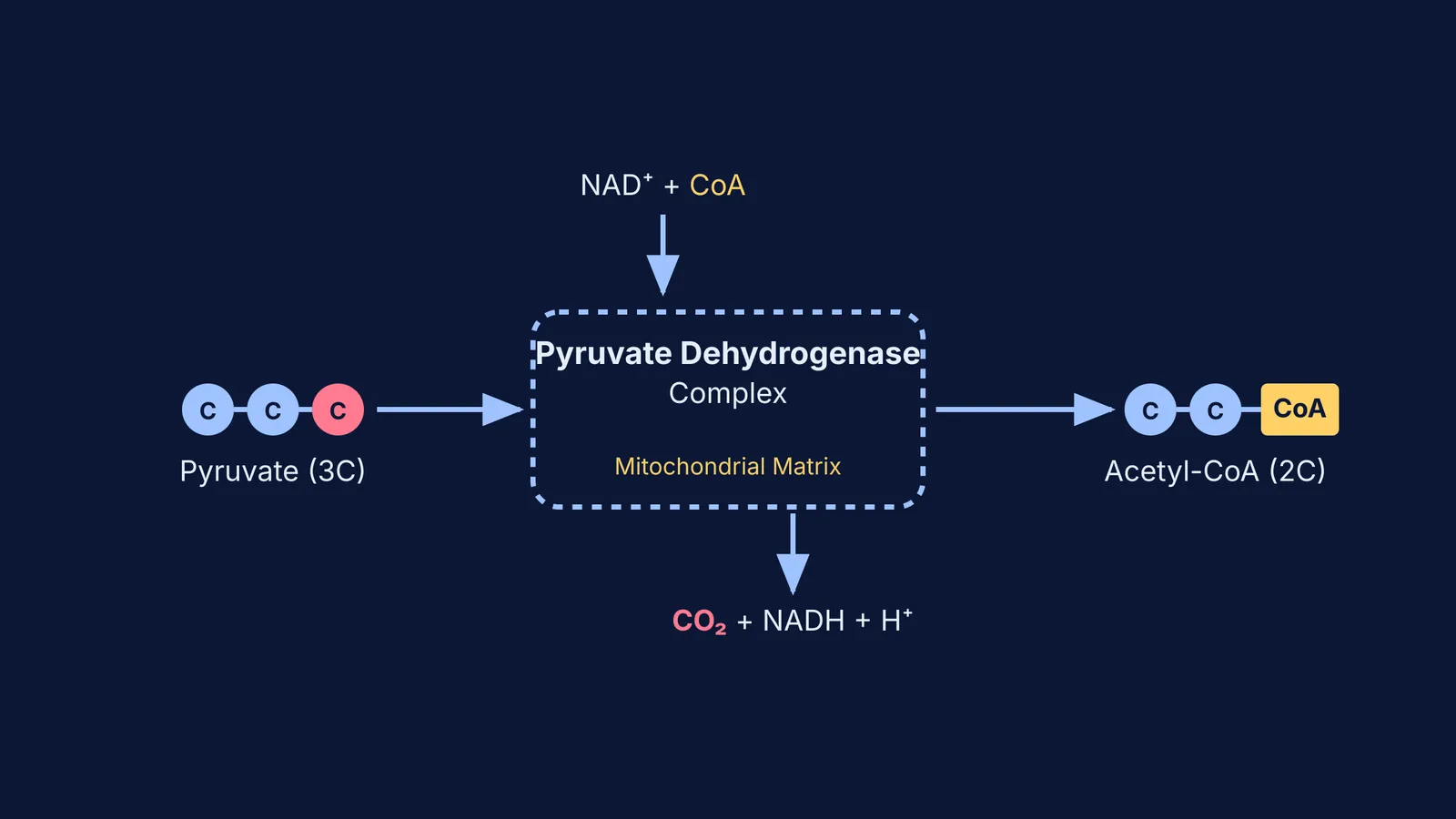
Once inside, the link reaction occurs entirely within the mitochondrial matrix (the fluid-filled inner chamber of the mitochondrion). This location is highly strategic: by producing acetyl CoA directly inside the matrix, the molecule is immediately available for the first enzyme of the Krebs cycle, which also resides there.
What does the pyruvate dehydrogenase complex do?
This reaction is not handled by a single simple enzyme, but rather by a massive multi-enzyme assembly called the pyruvate dehydrogenase complex (PDC). The PDC orchestrates three distinct chemical changes in rapid succession:
Decarboxylation: The first enzyme in the complex removes a carboxyl group from the 3-carbon pyruvate molecule. This carboxyl group is released into the surrounding matrix as a molecule of carbon dioxide (CO₂).
Oxidation: The remaining 2-carbon fragment is then oxidised. It loses hydrogen atoms, and the high-energy electrons are transferred to NAD⁺, reducing it to NADH + H⁺.
Acetylation: Finally, the oxidised 2-carbon acetyl group is transferred and attached to Coenzyme A (often written as CoA), forming Acetyl CoA.
This sequence requires a team of cofactors to work properly, including magnesium ions (Mg²⁺), thiamine pyrophosphate (TPP), and lipoic acid. The overall equation for this transformation is:
Pyruvic acid + CoA + NAD⁺ → Acetyl CoA + CO₂ + NADH + H⁺
Why is it called oxidative decarboxylation?
In biology, long names often describe exactly what a reaction is doing. Breaking down the name can help you remember the products without memorisation:
Oxidative: The reaction involves an oxidation step (the removal of electrons and hydrogen). You can spot this because NAD⁺ is reduced to NADH.
Decarboxylation: The reaction involves the removal of carbon (de-carbon). You can spot this because a 3-carbon pyruvate turns into a 2-carbon acetyl group, releasing the spare carbon as CO₂.
What are the products per glucose molecule?
A very common trap in exams is forgetting to multiply the products. Because one molecule of glucose produces two molecules of pyruvate during glycolysis, the link reaction happens twice for every glucose molecule consumed.
The net yield per single glucose molecule is exactly:
2 Acetyl CoA: These 2-carbon molecules are the primary fuel for the Krebs cycle.
2 NADH + H⁺: These carry high-energy electrons directly to the electron transport chain to generate ATP later in respiration.
2 CO₂: These are released as a metabolic waste product, eventually diffusing out of the cell and into the bloodstream to be exhaled.
A framework for tracking carbons in respiration
Losing track of carbon atoms across metabolic pathways is a frequent source of errors. To avoid this, use a simple carbon-counting checklist when studying:
Start with the source: Glucose is a 6-carbon (6C) sugar. Glycolysis halves it into two 3-carbon (3C) pyruvates. (For a refresher on basic carbohydrate structures, review the difference between reducing and non-reducing sugars.)
Watch for the CO₂: Every time a respiration reaction releases a molecule of CO₂, the main carbon chain loses one carbon. Because a 3C pyruvate loses one CO₂ in the link reaction, the resulting acetyl group must be 2C.
Follow the carrier: Think of Coenzyme A as a delivery truck. It carries the 2C acetyl group into the Krebs cycle, where it joins a 4-carbon acceptor molecule (oxaloacetic acid) to form a 6-carbon molecule (citric acid).
Compare with other pathways: Keep an eye out for competing or wasteful carbon processes in biology, such as photorespiration and why RuBisCO wastes energy, which also hinge heavily on carbon tracking.
If you struggle to remember where enzymes operate or how these complex pathways connect, the Fermi Concept Library maps out every step of cellular respiration. Fermi's AI tutor can work out what you already know and build a plan for the session, testing your recall of carbon counts and enzyme locations before you move on to the complexities of the electron transport chain.


