

On this page
Class 11 algebra introduces a fundamental shift from equations to constraints. While an equation models balance at a single numerical value, linear inequalities model operational boundaries: a minimum mark needed across three unit tests to secure a grade, a permissible temperature range for a chemical solution, or a spending ceiling in a student budget. In an empirical study published in the International Journal of Mathematical Education in Science and Technology, researchers Pessia Tsamir and Nava Almog evaluated 160 secondary students and found that an over-reliance on equation analogies is the primary source of difficulty in algebraic inequalities. Students frequently overlook the continuous nature of solution sets, mishandle boundary conditions, and confuse strict inequalities with inclusive bounds.
Why do word problems with inequalities feel harder than equations?
Cognitive research by Pessia Tsamir and Luciana Bazzini in the International Journal of Mathematical Education in Science and Technology shows that students struggle to interpret boundary values and solution sets due to persistent intuitive beliefs and rigid equation analogies. Translating natural language into mathematical constraints introduces several subtle semantic traps:
The phrase "at least" sounds diminutive, tempting students to write ≤ instead of ≥. In reality, "at least 60 marks" sets 60 as the minimum floor, meaning marks must be greater than or equal to 60.
The phrase "at most" or "no more than" sounds expansive, tempting students to write ≥ instead of ≤. Spending "at most ₹200" establishes a ceiling, meaning expenditure must be less than or equal to 200.
The term "between" denotes strict boundaries (< and >), whereas "inclusive" or "from... to..." requires inclusive inequalities (≤ and ≥).
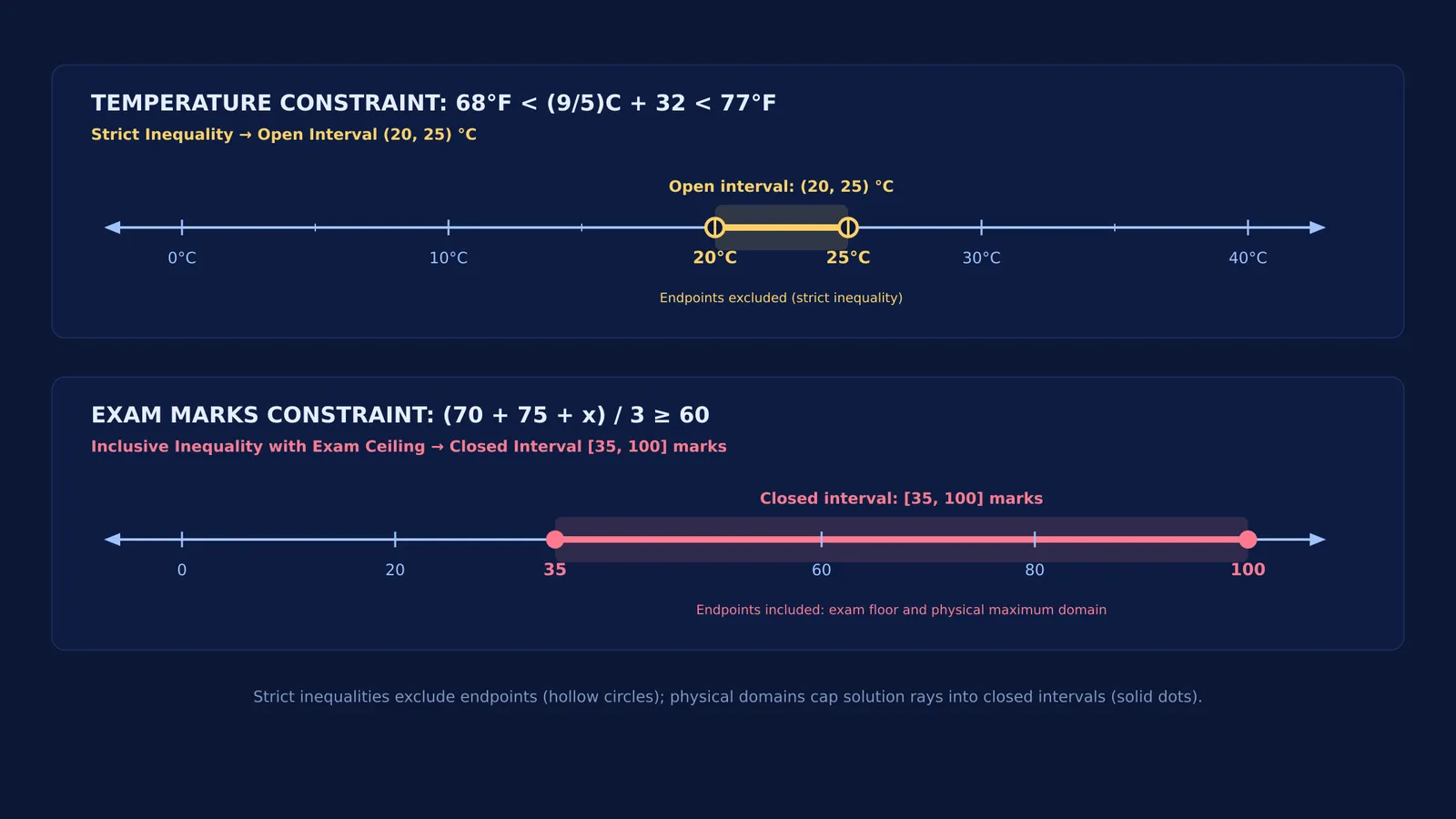
Beyond vocabulary, word problems impose implicit physical domain restrictions. While solving x ≥ 35 in pure algebra yields the ray [35, ∞), an examination score cannot exceed 100, capping the valid interval at [35, 100]. Similarly, lengths, volumes, and purchased goods cannot be negative.
How do you translate marks, temperatures, and budgets into inequalities?
The CBSE senior secondary mathematics curriculum organizes linear inequalities around three primary word problem archetypes:
Target average marks: Set up the average of known scores and the unknown mark x, enforcing average ≥ target.
Temperature ranges: Substitute F = (9/5)C + 32 into a compound inequality a < F < b, then isolate C across all three parts simultaneously.
Budget ceilings: Enforce unit cost × quantity x ≤ budget, restricting x to non-negative integers for discrete items.
How do you solve Class 11 linear inequality word problems step by step?
Example 1: Test marks average Ravi scored 70 and 75 marks in his first two unit tests. What minimum mark must he score in the third test to maintain an average of at least 60 marks?
Let x be Ravi's score in the third test. The average constraint is: (70 + 75 + x) / 3 ≥ 60 (145 + x) / 3 ≥ 60 145 + x ≥ 180 x ≥ 35 Because the exam is scored out of 100, the interval solution is [35, 100]. Ravi must score at least 35 marks.
Example 2: Temperature conversion A laboratory solution must be kept between 68°F and 77°F. What is the corresponding temperature range in degrees Celsius, given F = (9/5)C + 32?
Set up the compound inequality: 68 < (9/5)C + 32 < 77 Subtract 32 across all parts: 36 < (9/5)C < 45 Multiply every part by 5/9: 20 < C < 25 In interval notation, the solution is (20, 25) °C. Both endpoints are excluded because the original specification required the temperature to stay strictly between the bounds.
Example 3: Discrete budget allocation A science club has ₹200 to purchase slide packets costing ₹30 each. How many complete packets can the club buy?
Let x be the number of packets: 30x ≤ 200 x ≤ 6.67 Because packets are discrete items (x ∈ W), the allowable set is {0, 1, 2, 3, 4, 5, 6}. The maximum number of complete packets is 6.
Later in Class 11 and 12, polynomial expressions build on these principles using the wavy curve method for rational inequalities, while tolerance bounds require the case-splitting approach in equations and inequalities with modulus. For two-variable graphical regions, consult linear inequalities in Class 11.
What checks ensure your interval matches physical reality?
Before finalizing your answer, verify your solution with four checks:
Endpoint check: Substitute the boundary value into the problem statement. At x = 35, Ravi's average is (70 + 75 + 35) / 3 = 60, confirming the boundary.
Interior check: Test a point inside your interval. At C = 22 °C, F = (9/5)(22) + 32 = 71.6 °F, which safely falls inside (68, 77).
Domain check: Enforce physical reality—marks cannot exceed 100, physical lengths cannot be negative, and discrete items must be whole numbers.
Notation check: Use square brackets [ ] for non-strict bounds (≤, ≥) where endpoints are included, and parentheses ( ) for strict inequalities (<, >) or unbounded rays.
The Fermi Problem Library has worked problems with a step-by-step solver that explains the reasoning rather than printing an answer, helping you master both algebraic transformations and interval notation. To see how these boundary concepts anchor higher-level functions and domains, explore the Fermi Concept Library.


