

On this page
When solving two linear equations, elimination is often the quickest path: scale one equation, subtract it from the other, and watch a variable vanish. But when one equation is quadratic—containing squared terms such as x² or y²—elimination stalls because subtraction does not clear higher powers. Substitution becomes the primary algebraic tool: you isolate one variable in the linear equation and substitute that expression into the quadratic relation.
In a study of 30 secondary students published in *Infinity Journal*, Johari and Shahrill (2020) identified variable selection as a primary error source, an issue they termed "complicating the subject." When solving an equation like 2x + y = 7, rearranging to x = (7 − y)/2 introduces unnecessary fractions into the quadratic substitution. Squaring that fraction later invites arithmetic and sign errors. The practical rule is straightforward: always isolate the variable that carries a coefficient of 1 or −1.
How do you solve linear and quadratic equations simultaneously?
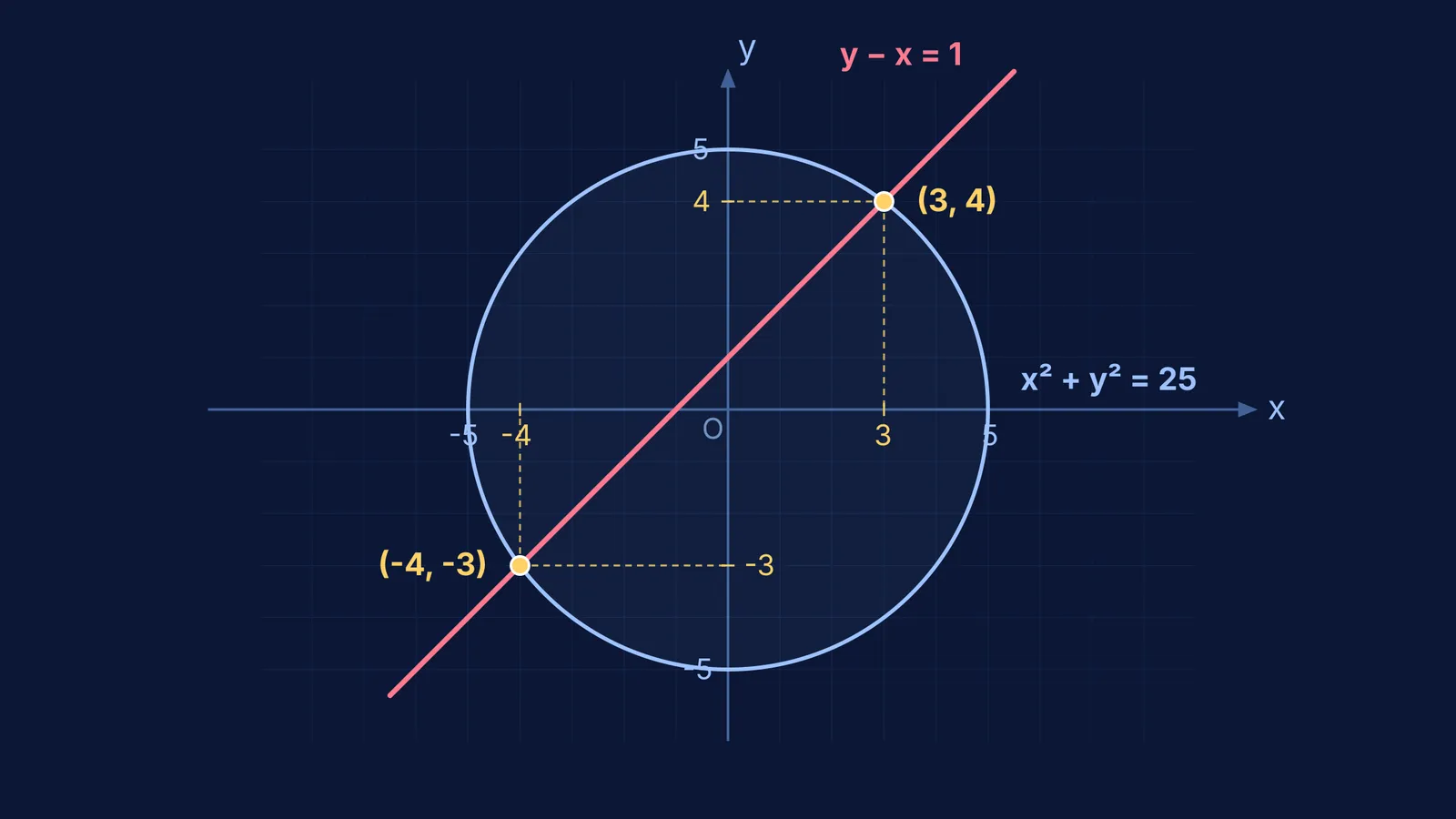
Consider a classic problem: find the values of x and y that satisfy both the linear equation y − x = 1 and the quadratic circle equation x² + y² = 25.
Rearrange the linear equation to make one variable the subject:
y = x + 1
Substitute this linear expression into the quadratic equation, keeping parentheses intact:
x² + (x + 1)² = 25
In an error analysis of 46 secondary students solving quadratics, Baybayon and Lapinid (2024) observed that mishandling signs and expanding binomials incorrectly are persistent pitfalls. Expanding (x + 1)² gives x² + 2x + 1, not x² + 1: x² + (x² + 2x + 1) = 25 2x² + 2x + 1 − 25 = 0 2x² + 2x − 24 = 0
Dividing the entire equation by 2 simplifies the coefficients: x² + x − 12 = 0
Solve the resulting single-variable quadratic:
Factorising the quadratic gives: (x + 4)(x − 3) = 0 This yields two real values for x: x = 3 or x = −4
If the quadratic cannot be factorised by inspection, use the standard quadratic formula x = (−b ± √(b² − 4ac)) / (2a), as outlined in the NCERT Class 10 Mathematics syllabus.
How do you pair each x with its correct y without mistakes?
Finding two values of x is only half the journey. A simultaneous system in two unknowns requires complete coordinate pairs (x, y).
This step is where many students lose easy marks. Always substitute your solved x values back into the rearranged linear equation (y = x + 1), never back into the quadratic equation. If you substitute x = 3 into x² + y² = 25, you obtain y² = 16, which suggests y = 4 or y = −4. But y = −4 does not satisfy the linear equation: (−4) − 3 = −7 ≠ 1. The quadratic equation squares the variable, which strips away sign information and produces spurious, extraneous solutions.
By substituting into the linear equation y = x + 1:
For x = 3: y = 3 + 1 = 4, giving the coordinate pair (3, 4).
For x = −4: y = −4 + 1 = −3, giving the coordinate pair (−4, −3).
Examiner reports across secondary mathematics examination boards repeatedly caution that writing unlinked answers like "x = 3, −4 and y = 4, −3" risks losing marks for ambiguity. Always present your final answers as explicit coordinate pairs: (3, 4) and (−4, −3).
Verify your pairs by testing them in the original quadratic equation:
3² + 4² = 9 + 16 = 25
(−4)² + (−3)² = 16 + 9 = 25
Both pairs satisfy both equations simultaneously.
What does the line-meets-circle picture actually tell you?
Every algebraic step in this procedure corresponds to a geometric reality on the Cartesian coordinate plane. The quadratic equation x² + y² = 25 defines a circle of radius 5 centred at the origin (0, 0). The linear equation y − x = 1 represents a straight line with a gradient of 1 and a y-intercept at (0, 1). Solving the system simultaneously determines where the line and circle meet.
The discriminant D = b² − 4ac of the substituted single-variable quadratic determines the geometry of the intersection:
Two intersections (D > 0): The line cuts through the circle at two distinct points, functioning as a secant line. For our simplified quadratic x² + x − 12 = 0, D = 1² − 4(1)(−12) = 49 > 0, corresponding to the two intersection points (3, 4) and (−4, −3).
One intersection (D = 0): The line grazes the circle at exactly one point of contact, acting as a tangent line. The quadratic produces a single repeated root.
No intersection (D < 0): The line misses the circle completely. The quadratic has no real roots, meaning no real coordinate pairs satisfy both equations.
Understanding this link connects algebraic manipulation with geometric intuition, forming a cornerstone for coordinate geometry and calculus.
How do you structure practice and avoid algebraic traps?
To build speed and accuracy across simultaneous systems, build a routine around deliberate checking. If you want to strengthen foundational techniques, review our guides on linear equations in two variables for Class 10, quadratic equations in Class 10, and circles in coordinate geometry.
Before submitting your final answers, run through this five-point checklist:
Choose the variable with a coefficient of 1 or −1 when rearranging the linear equation.
Enclose the substituted expression in brackets before expanding.
Retain the middle term 2ab when expanding squared binomials (a + b)².
Rearrange all terms to standard form ax² + bx + c = 0 before solving.
Back-substitute into the linear equation and write solutions as paired coordinates (x, y).
When you encounter an unfamiliar non-linear problem or want to inspect each step of a solution, the Fermi Problem Library offers worked problems with a step-by-step solver that explains the reasoning rather than printing an answer. For exploring how algebraic functions connect across disciplines, the Fermi Concept Library maps every concept in physics, chemistry, biology, mathematics and computing, each with its own lesson and its place in the map. As you practise, Fermi's AI tutor can notice where you are stuck and decide whether to explain, ask or show, helping you master algebraic reasoning with confidence.


