

On this page
In mathematics, the terms "line", "ray", and "line segment" are often used interchangeably in everyday conversation, but they mean entirely different things on paper. Understanding the difference between a line, a ray and a line segment is the first step in geometry, helping you accurately draw shapes, calculate distances, and measure angles.
What is the difference between a line, a ray and a line segment?
The differences boil down to whether the object has an end, and whether its length can be measured.
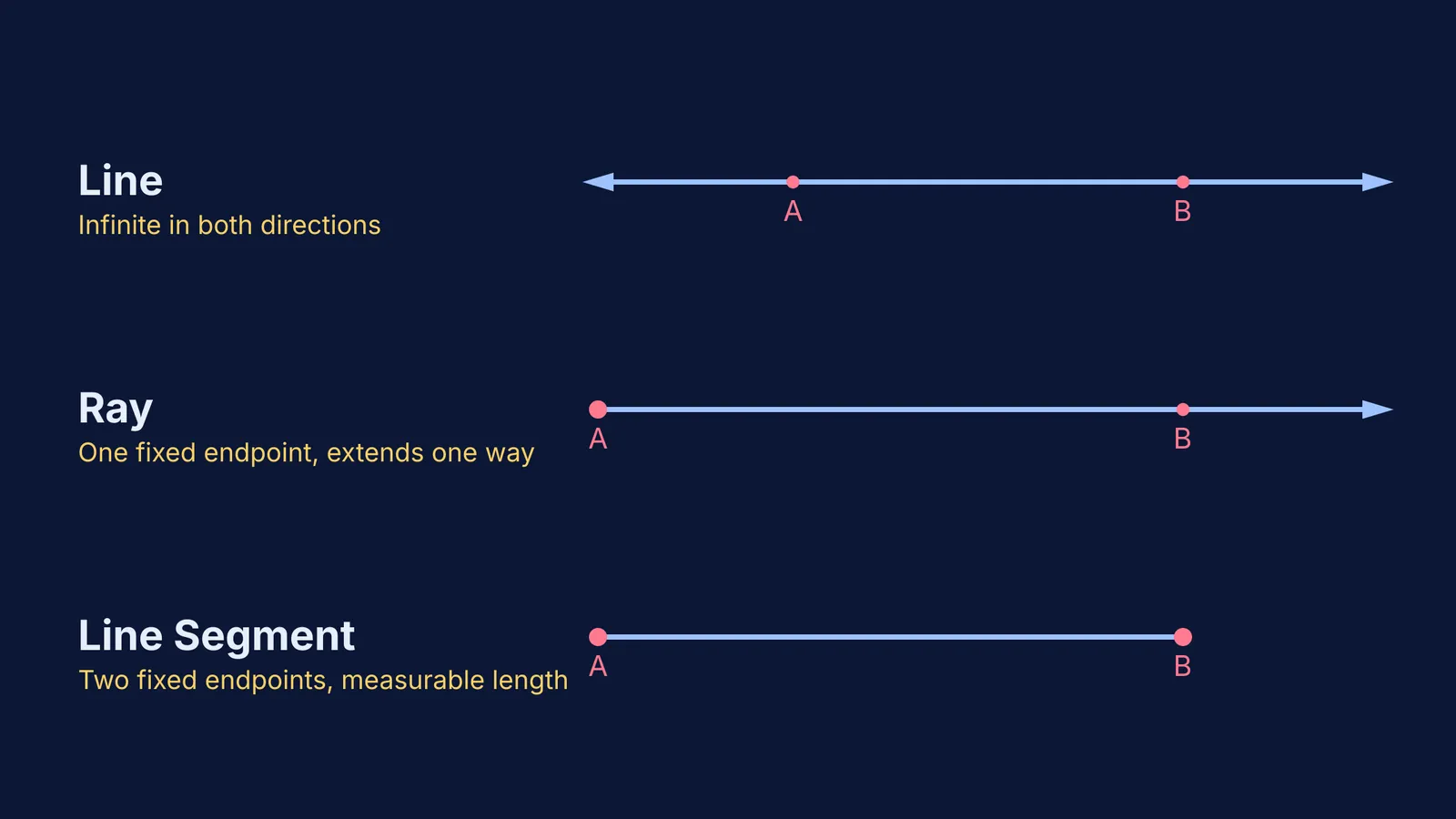
Line Segment: A line segment is a fixed path between two points. It has exactly two endpoints (a start and a finish) and represents the shortest distance between those two points. Because it has boundaries, you can measure its length with a ruler. When you name a segment connecting points A and B, you write it as AB with a simple bar over the letters.
Line: A line is what happens when you take a line segment and extend it indefinitely in both directions. It has no endpoints at all. Because it goes on forever, a true line has an infinite length and cannot be measured. To name it, you draw a double-headed arrow over the letters AB.
Ray: A ray sits halfway between a line and a segment. It has one fixed endpoint (a starting point) but extends infinitely in the other direction. Think of a laser pointer or the sun's rays—they start at a source and keep going. Because it never stops at the other end, its length is also infinite. You name it by drawing a single-headed arrow starting from its fixed point toward the other.
Why do endpoints matter in geometry?
It might seem pedantic to care about arrows on the end of a drawing, but this distinction is where many students first stumble in abstract geometry. As the NCERT Class 6 Mathematics curriculum points out, only a line segment corresponds to a measurable physical distance. You can calculate the exact dimensions of a circle through three given points precisely because the distances between those points are measurable line segments.
Conversely, when tracing a ray through a glass slab in an optics practical, the light beam behaves mathematically as a ray, starting at a distinct source and travelling outward continuously.
Research shows that the concept of an infinitely extending line or ray is cognitively challenging. Since a piece of paper has edges, a drawn line always looks like a line segment, which can make it hard to abstract the idea of a true mathematical line.
How does ray length affect an angle?
This confusion over infinity leads straight to one of the most common mistakes in geometry: thinking that a longer ray makes a larger angle.
An angle is formed when two rays share a common endpoint (the vertex). Because rays are infinite, the "length" of the arms drawn on paper is completely arbitrary. Yet, when students are asked to compare two identical angles where one has longer drawn arms, they often wrongly state that the one with longer arms is larger. The size of an angle is strictly the measure of the rotation between the rays, completely independent of how far you draw them.
When you tackle geometry problems, remind yourself that the ink on the page is just a snapshot. The lines and rays keep going.
If your geometry definitions are feeling tangled, the Fermi Concept Library holds clear, step-by-step lessons on every mathematical principle. And if you are stuck on a specific proof, Fermi's AI tutor can teach through the problem with you—drawing the figures and checking your understanding as it goes.
Start mapping out your next maths session with Fermi.


