

On this page
When a coordinate geometry problem asks you to find a line passing through a specific point and making a given angle with a known line, the answer is always a pair of lines. You can rotate away from the known line in two directions—clockwise or anticlockwise—to get the required angle.
The standard method is to use the tangent formula for the angle between two lines to find both slopes, then write the equations using the point-slope form.
How do you find the equation of lines making an angle with a given line?
If the given line has a slope m and the required lines make an angle α with it, you can find the unknown slope M using the acute angle formula. According to NCERT Class 11 Mathematics, the angle θ between two non-vertical lines is given by tan θ = |(m₂ − m₁) / (1 + m₁m₂)|.
Setting θ = α, m₁ = m, and m₂ = M, you get: tan α = |(M − m) / (1 + Mm)|
Removing the modulus sign gives two separate equations to solve for M:
(M − m) / (1 + Mm) = tan α
(M − m) / (1 + Mm) = −tan α
Rearranging these equations to make M the subject gives the direct formulas for the two slopes: M₁ = (m + tan α) / (1 − m tan α) M₂ = (m − tan α) / (1 + m tan α)
Once you calculate M₁ and M₂, you substitute them into the point-slope form, y − y₁ = M(x − x₁), to get the two equations.
How do you find the equation of lines making 45 degrees with a given line?
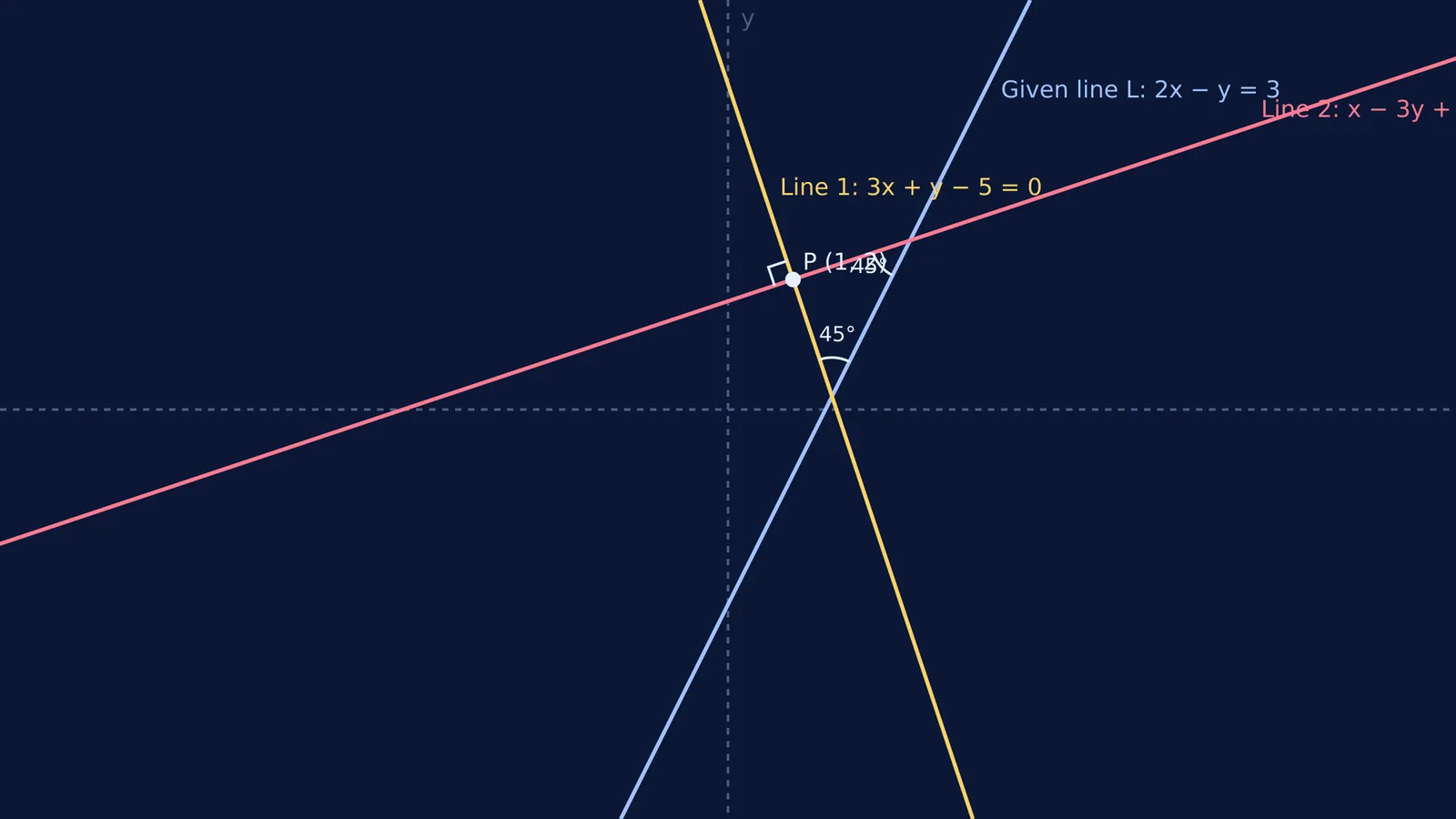
Suppose you need to find the equations of the lines passing through the point (1, 2) that make an angle of 45° with the line 2x − y = 3.
Find the given slope: Rearrange 2x − y = 3 to y = 2x − 3. The given slope is m = 2.
Find the two new slopes: Here, α = 45°, so tan α = 1. Using the two formulas:
M₁ = (2 + 1) / (1 − 2×1) = 3 / −1 = −3 M₂ = (2 − 1) / (1 + 2×1) = 1 / 3
Write the equations: Use the point (1, 2).
For M₁ = −3: y − 2 = −3(x − 1) implies 3x + y − 5 = 0 For M₂ = 1/3: y − 2 = (1/3)(x − 1) implies x − 3y + 5 = 0
Both lines satisfy the condition, and as expected for 45°, their slopes (−3 and 1/3) are negative reciprocals, confirming they are perpendicular.
What if the slope formula gives a zero denominator?
The most common trap in these problems is the vertical-line edge case. When evaluating M₁ or M₂, the denominator 1 ± m tan α might equal zero. This happens if the given slope m is exactly ±cot α.
When a denominator is zero, the slope M is undefined. This is not a calculation error; it tells you physically that one of the required lines is perfectly vertical.
A vertical line passing through the point (x₁, y₁) does not use the y = mx + c format. Its equation is simply x = x₁. The other line will still have a valid, calculable slope from the second part of the formula.
For instance, suppose you need to find the lines passing through the point (3, 4) that make an angle of 60° with the line x − √3y = 0.
Find the given slope: Rearranging gives y = (1/√3)x, so m = 1/√3.
Find the two new slopes: The angle is α = 60°, so tan α = √3.
M₁ = (1/√3 + √3) / (1 − (1/√3) × √3) = (4/√3) / 0 M₂ = (1/√3 − √3) / (1 + (1/√3) × √3) = (−2/√3) / 2 = −1/√3
Write the equations: The first slope, M₁, has a zero denominator. This means the first line is vertical. Since it passes through (3, 4), its equation is simply x = 3.
For M₂ = −1/√3, the equation is y − 4 = (−1/√3)(x − 3), which simplifies to x + √3y − 3 − 4√3 = 0.
Recognising the vertical line immediately saves you from abandoning a correct calculation just because of a division by zero.
When practising coordinate geometry for exams like JEE Main, it is easy to stumble on edge cases like division by zero. The Fermi Problem Library has worked problems with a step-by-step solver that explains the reasoning rather than printing an answer, helping you recognise when a vertical line is hiding in the algebra.
For more techniques in coordinate geometry, see our guides on the condition for three lines to be concurrent and finding the circle through three given points.


