

On this page
Reducing an alkyne looks like one reaction, but it is really three. The same triple bond can end up as a cis alkene, a trans alkene or an alkane, and the only thing that decides which is the reagent written over the arrow. That makes it a favourite in conversion questions: the examiner names the product, and you have to name the reagent.
What does Lindlar's catalyst do to an alkyne?
Lindlar's catalyst has three parts: palladium on calcium carbonate, lead acetate and quinoline, as set out in the LibreTexts chapter on alkyne reduction/09%3A_Alkynes_-_An_Introduction_to_Organic_Synthesis/9.05%3A_Reduction_of_Alkynes). It is named after the chemist H. Lindlar, whose 1952 paper in Helvetica Chimica Acta described a palladium-lead catalyst for partial hydrogenation.
The lead and quinoline "poison" the palladium, making it less active. An ordinary Pt, Pd or Ni catalyst is so efficient that the alkene formed from an alkyne cannot be isolated; it is hydrogenated straight on to the alkane. The poisoned catalyst stops one step earlier.
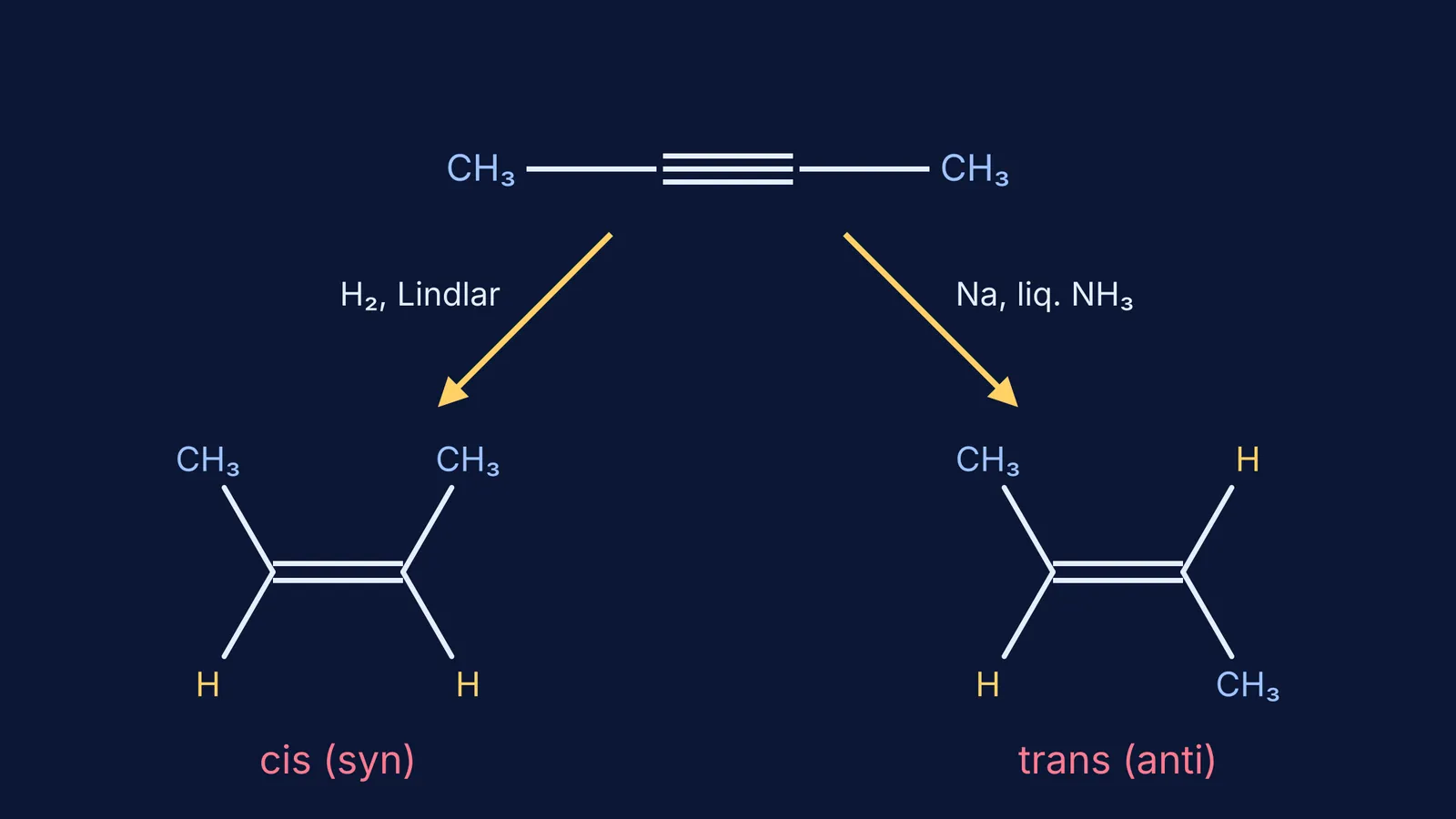
The shape comes from the surface. The alkyne lies flat on the metal and both hydrogen atoms arrive from that same face, which chemists call syn addition. Two hydrogens on the same side means the two remaining groups are also on the same side: H₂ over Lindlar's catalyst gives the cis alkene. With but-2-yne, that is cis-but-2-ene.
Why does sodium in liquid ammonia give the trans alkene?
Ammonia boils at about −33 °C, so this reaction runs in a cold liquid. Sodium (or lithium) dissolves in it and hands electrons to the alkyne one at a time; there is no metal surface and no H₂ gas.
The LibreTexts mechanism/09%3A_Alkynes_-_An_Introduction_to_Organic_Synthesis/9.05%3A_Reduction_of_Alkynes) runs in four steps:
One electron adds to the triple bond, giving a radical anion.
Ammonia gives it a proton, leaving a vinyl radical.
A second electron turns that into a vinyl anion.
A second proton gives the alkene.
The key moment is step 3. The vinyl anion can bend either way, and it settles in the trans form, where the two big groups are kept far apart and crowd each other less. The last proton locks that shape in. Because the two hydrogens come in separately from opposite sides, this is anti addition: sodium in liquid ammonia gives the trans alkene. With but-2-yne, that is trans-but-2-ene.
Which reagent should you pick in a conversion question?
Read the product before the reactant. The product's shape tells you the reagent, and the reactant only tells you where to start.
Product is a cis (or Z) alkene: H₂ with Lindlar's catalyst.
Product is a trans (or E) alkene: Na or Li in liquid NH₃.
Product is an alkane: H₂ with Ni, Pd or Pt.
Now try these. Cover the answers and say the reagent out loud first.
But-2-yne to cis-but-2-ene. Answer: H₂, Lindlar's catalyst.
But-2-yne to trans-but-2-ene. Answer: Na in liquid NH₃.
But-2-yne to butane. Answer: H₂ with Ni, Pd or Pt (Lumen's alkyne reduction page lists Pt, Pd/C and Raney nickel for full hydrogenation to the alkane).
Ethyne to trans-hex-3-ene. Answer: two steps. First build hex-3-yne by making the acetylide with sodamide and adding an ethyl group to each end (the acidity of the C–H in ethyne is what makes this possible; see our post on terminal alkyne acidity and sodamide). Then reduce with Na in liquid NH₃.
But-2-yne to meso-2,3-dibromobutane. Answer: Na in liquid NH₃ to the trans alkene, then Br₂. Anti addition of Br₂ to trans-but-2-ene gives the meso compound; the cis alkene would give the racemic pair.
If you get stuck on multi-step questions like 4 and 5, the Fermi Problem Library has worked problems with a step-by-step solver that explains the reasoning rather than printing an answer, so you can see where your chosen reagent sent the chain.
How do these reductions fit with the rest of hydrocarbons?
Partial reduction is one road out of an alkyne; our map of hydrocarbon reactions from alkanes to benzene puts the others on one page. For longer chains, the roadmap for organic conversions shows how to plan backwards from the product, the same habit that picks the right reduction.
If syn and anti addition still feel like words rather than pictures, the Fermi Concept Library gives each concept its own lesson and its place in the map.
Before your next mock, write the three reagents for but-2-yne from memory and draw each product.


