

On this page
Substituting x = a directly into (xⁿ − aⁿ)/(x − a) yields the indeterminate form 0/0. In calculus, this expression is a standard algebraic identity:
lim (x → a) (xⁿ − aⁿ)/(x − a) = n aⁿ⁻¹
As specified in the CBSE Senior Secondary Mathematics Curriculum, evaluating limits of rational functions requires removing the common factor that causes both terms to vanish. This standard result holds not only for positive integers, but for all rational exponents n whenever a > 0. Mastering its algebraic structure allows you to evaluate polynomial differences, fractional roots, and conjugate limits quickly without writing out lengthy series expansions.
Why does the limit of (xⁿ − aⁿ)/(x − a) equal n aⁿ⁻¹?
For any positive integer n, factoring the difference of nth powers yields:
xⁿ − aⁿ = (x − a)(xⁿ⁻¹ + xⁿ⁻² a + xⁿ⁻³ a² + ... + x aⁿ⁻² + aⁿ⁻¹)
Because x approaches a without equalling a, the term (x − a) is non-zero. Cancelling (x − a) leaves an (n − 1)-degree polynomial with exactly n terms:
(xⁿ − aⁿ)/(x − a) = xⁿ⁻¹ + xⁿ⁻² a + xⁿ⁻³ a² + ... + aⁿ⁻¹
Direct substitution is now valid. Setting x = a makes every term equal to aⁿ⁻¹, summing to n aⁿ⁻¹:
aⁿ⁻¹ + aⁿ⁻²(a) + ... + aⁿ⁻¹ = n aⁿ⁻¹
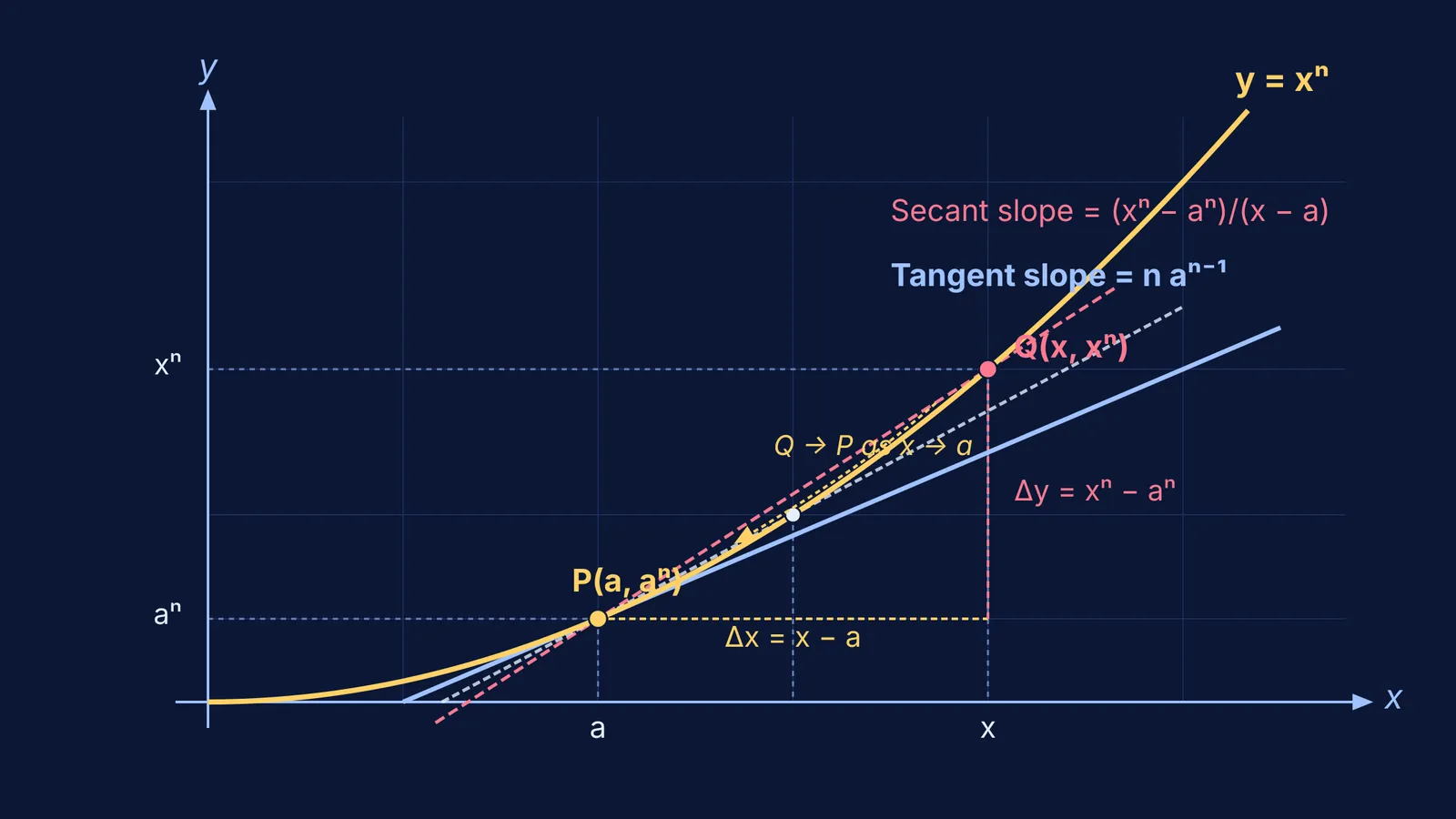
Geometrically, this quotient is the slope of the secant line between P(a, aⁿ) and Q(x, xⁿ) on the curve y = xⁿ. As explained in OpenStax Calculus Volume 1, as x approaches a, point Q slides toward P, pivoting the secant chord into the tangent line at P with instantaneous slope n aⁿ⁻¹. Cancelling the common factor eliminates an isolated algebraic gap, distinguishing this removable hole from non-removable jumps explored in our guide on removable and jump discontinuities.
How do you prove the formula for fractional and negative powers?
For rational powers n = p/q (with integers p, q, q > 0, and a > 0), set x = y^q and a = b^q, so y = x^(1/q) and b = a^(1/q). As x → a, y → b. Substituting yields:
(x^(p/q) − a^(p/q))/(x − a) = (y^p − b^p)/(y^q − b^q)
Dividing numerator and denominator by (y − b) applies the integer rule to each part:
[ (y^p − b^p)/(y − b) ] / [ (y^q − b^q)/(y − b) ] = (p b^(p − 1)) / (q b^(q − 1))
Simplifying the powers of b gives (p/q) b^(p − q). Substituting b = a^(1/q) returns:
(p/q) (a^(1/q))^(p − q) = (p/q) a^((p/q) − 1) = n aⁿ⁻¹
This establishes the identity for all rational powers without L'Hôpital's rule. For negative exponents n = −m (with m > 0), rewrite x⁻ᵐ − a⁻ᵐ as −(xᵐ − aᵐ)/(xᵐ aᵐ). Dividing by (x − a) gives −[ (xᵐ − aᵐ)/(x − a) ] × 1/(xᵐ aᵐ). Taking the limit as x → a yields −(m aᵐ⁻¹)/a²ᵐ = −m a⁻ᵐ⁻¹ = n aⁿ⁻¹.
Which substitutions transform harder exam limits into this standard form?
Exam problems often disguise this identity inside shifted bases or root differences. Two substitutions resolve most cases.
The shifted base: limit of ((1 + x)ⁿ − 1)/x as x approaches 0.
Substitute y = 1 + x. As x approaches 0, y approaches 1, and x equals y − 1. The limit transforms into:
lim (y → 1) (yⁿ − 1ⁿ)/(y − 1) = n(1)ⁿ⁻¹ = n
For example, to evaluate lim (x → 0) (³√(1 + 2x) − 1)/x, let u = 2x. As x → 0, u → 0. We write 2 × [ ((1 + u)^(1/3) − 1)/u ] = 2 × (1/3) = 2/3, avoiding radical rationalization entirely.
The power ratio: limit of (xᵐ − aᵐ)/(xⁿ − aⁿ) as x approaches a.
Dividing both numerator and denominator by (x − a) splits the problem into two parallel limits:
[ (xᵐ − aᵐ)/(x − a) ] / [ (xⁿ − aⁿ)/(x − a) ] = (m aᵐ⁻¹) / (n aⁿ⁻¹) = (m/n) a^(m − n)
For instance, evaluate lim (x → 1) (x¹⁵ − 1)/(x¹⁰ − 1). With m = 15, n = 10, and a = 1, the result is immediately (15/10) × 1^(15 − 10) = 3/2. For problems where bases and exponents grow simultaneously, different rules apply; read our walkthroughs on limits of the form 1^∞ and limits at infinity of rational functions.
What mistakes do students make when applying this limit?
Students frequently lose marks in exam conditions to three common misconceptions:
Using the formula with the wrong variable tendency: The identity requires x approaching a, not x approaching 0. For ((x + 2)⁵ − 32)/x as x → 0, you must first substitute u = x + 2 so that u → 2, converting the expression to (u⁵ − 2⁵)/(u − 2).
Neglecting the base condition a > 0 for fractional powers: Fractional exponents with even denominators require a positive base. If a is negative, roots enter the complex plane and the real limit is undefined.
Inverting the ratio in reciprocal forms: In expressions like (x − a)/(xⁿ − aⁿ), students frequently write n aⁿ⁻¹ instead of 1/(n aⁿ⁻¹). Track whether the powers sit in the numerator or denominator before writing your final value.
The Fermi Problem Library has worked problems with a step-by-step solver that explains the reasoning rather than printing an answer. To explore how algebraic limits fit into broader calculus foundations, the Fermi Concept Library covers every concept in physics, chemistry, biology, mathematics and computing, each with its own lesson and its place in the map.


