

On this page
When you first encounter coordination compounds in Class 12, the IUPAC naming rules can feel like learning a new language. You have to arrange ligands alphabetically, change their endings, and choose the right Greek prefixes. Getting these details right is a reliable way to secure marks in board exams, JEE and NEET.
What are the special names for neutral ligands?
According to the IUPAC Recommendations 2005, most neutral ligands simply use the name of the free molecule, such as ethylenediamine or pyridine. However, four extremely common neutral ligands are given special names.
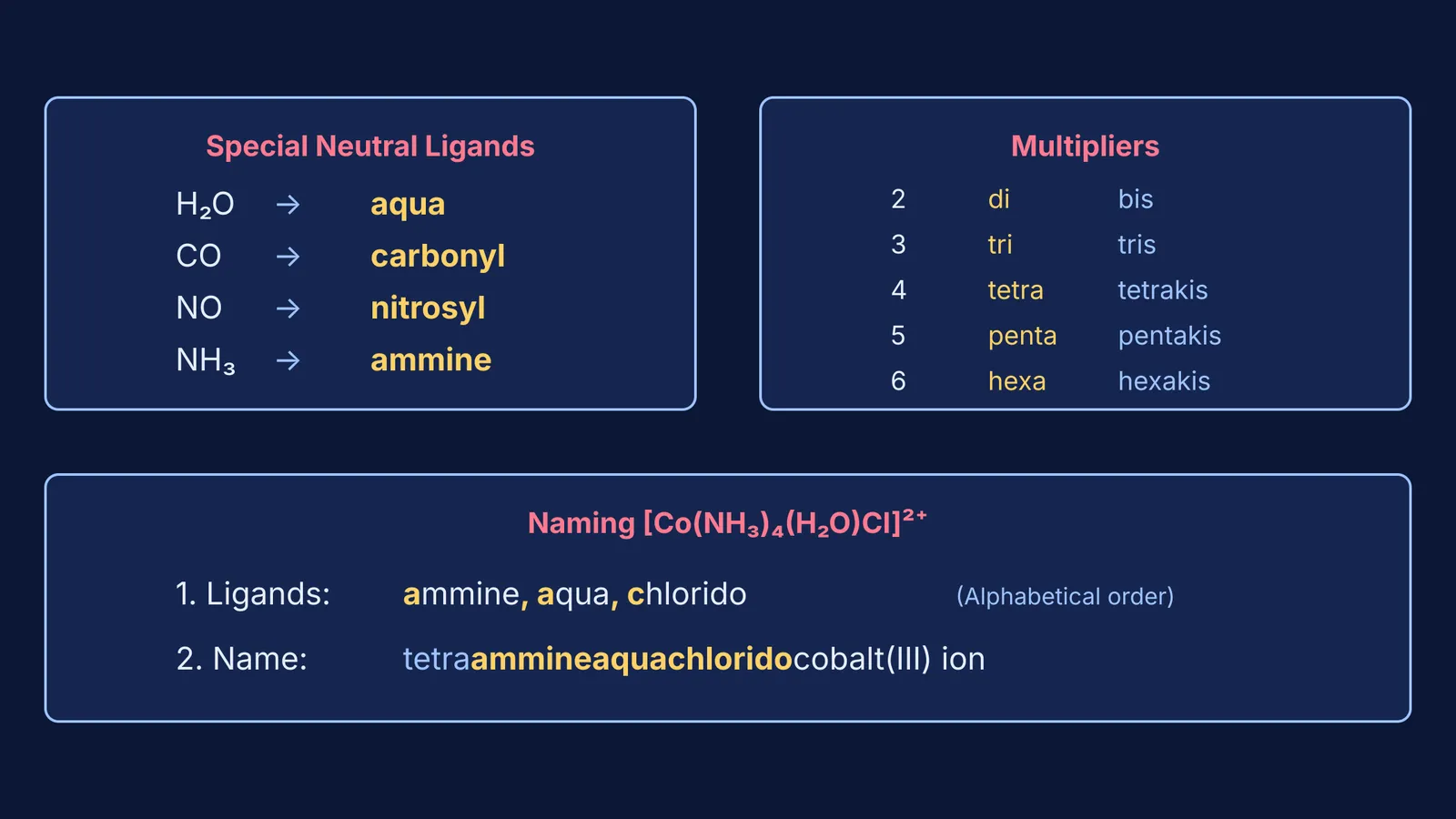
Water (H₂O) is called aqua in modern nomenclature, replacing the older term "aquo". Ammonia (NH₃) becomes ammine, carbon monoxide (CO) is named carbonyl, and nitrogen monoxide (NO) is called nitrosyl. Because these ligands appear so frequently, memorising their special names is the first step in mastering the nomenclature rules.
Why does ammine have two "m"s?
You might notice that ammine (NH₃) has a double "m", while organic amines (like methylamine, CH₃NH₂) only have one. This is a deliberate rule to avoid ambiguity.
The term ammine comes from the historical name for ammonia, which was derived from sal ammoniac (the salt of Amun). Because the word ammonia has two "m"s, its direct coordination derivative kept the double letter. Later, organic chemists shortened the suffix to "-amine" for alkyl derivatives. By keeping the double "m" for the NH₃ ligand, chemists can look at a written name and instantly know whether a complex contains pure ammonia or an organic amine. If you misspell it in an exam, you are technically naming a different class of chemical.
If you are struggling to picture how these molecules arrange themselves in space, the Fermi Simulation Lab lets you interact with 3D geometries, making it easier to see the shapes behind Alfred Werner's coordination theory.
When do you use bis and tris instead of di and tri?
To state how many of a particular ligand are present, we use multiplicative prefixes. For simple ligands, we use the standard set: di, tri, tetra, penta and hexa. For example, six ammine ligands make a hexaammine complex.
However, IUPAC requires an alternative set of prefixes—bis, tris, tetrakis and pentakis—when a ligand's name already contains a numerical prefix. The classic example is ethylenediamine, a bidentate ligand that forms strong bonds through the chelate effect. Because its name already contains "di", calling two of them "diethylenediamine" would sound like a single large molecule with two ethyl groups. Instead, we call it bis(ethylenediamine), placing the ligand name in parentheses to make the boundary clear.
You also use bis and tris for large organic ligands (like triphenylphosphine) or when there is a risk of confusing a single polyatomic ion with multiple simple ions.
How do you name anionic ligands?
In the 2005 IUPAC update, the systematic rule for anionic (negatively charged) ligands is that they must end in the letter "-o". Specifically, the ending "-ide" changes to -ido, "-ate" changes to -ato, and "-ite" changes to -ito.
This means a chloride ion (Cl⁻) becomes a chlorido ligand, cyanide (CN⁻) becomes cyanido, and oxalate (C₂O₄²⁻) becomes oxalato. While you might still see older textbooks using chloro or cyano, chlorido is the current official recommendation.
Mastering these small variations takes practice. If you find yourself forgetting the rules, the Fermi Concept Library breaks down coordination chemistry into manageable steps, keeping all the conventions in one place.
A step-by-step framework for naming complexes
To bring it all together without making a mistake, use a structured approach for every problem.
Find the oxidation state: Deduce the charge of the central metal by balancing the known charges of the ligands against the overall charge of the complex.
Sort the ligands: List the ligands in strict alphabetical order by their names (e.g. ammine before aqua before chlorido). Do not use the multiplicative prefixes when sorting.
Add the prefixes: Apply di, tri, tetra for simple ligands, and bis, tris for complex ones in parentheses.
Name the metal: If the complex is an anion (negatively charged overall), add "-ate" to the metal's root (iron becomes ferrate, copper becomes cuprate). If it is a cation or neutral, keep the normal name. Finish by writing the oxidation state in Roman numerals in parentheses.
For example, take [Co(NH₃)₄(H₂O)Cl]²⁺. The metal is cobalt(III). The ligands are ammine, aqua and chlorido. Alphabetically, it is ammine, then aqua, then chlorido. Adding prefixes gives tetraammine, aqua and chlorido. The final name is tetraammineaquachloridocobalt(III) ion.
Whenever you apply a rule incorrectly, a textbook only prints the final answer, leaving you to guess where you went wrong. Fermi's AI tutor notices where you are stuck—whether you alphabetised by the prefix or forgot the "-ate" ending—and checks your understanding as it guides you to the correct name.


