

On this page
Every morning, millions of students haul heavy backpacks to school. The traditional advice from parents and teachers alike is to "lift with your legs, not your back." But the reason for this golden rule goes far beyond just using stronger muscles—it is a brilliant real-world lesson in the physics of moments, torque, and biological levers.
Why should you lift heavy school bags with your legs?
When a student bends forward at the waist to pick up a backpack, their spine essentially acts as a boom crane. The pivot point (the fulcrum) for this biological lever is located in the lower back, specifically at the lumbosacral joint, known as the L5/S1 vertebral disc. In physics, a moment, or torque, is defined as the turning effect of a force. It is calculated by taking the downward weight of the bag and multiplying it by its horizontal distance from the pivot point.
Because the back muscles (the erector spinae) run parallel and sit very close to the spine, they have an incredibly short internal moment arm. To keep the upper body from toppling forward under the weight of the bag, these muscles must generate a massive internal force to counter the external torque of a bag held far away. Squatting down keeps the bag close to the chest, which drastically shortens the moment arm and eliminates the need for such extreme muscle force.
How does the spine act as a lever?
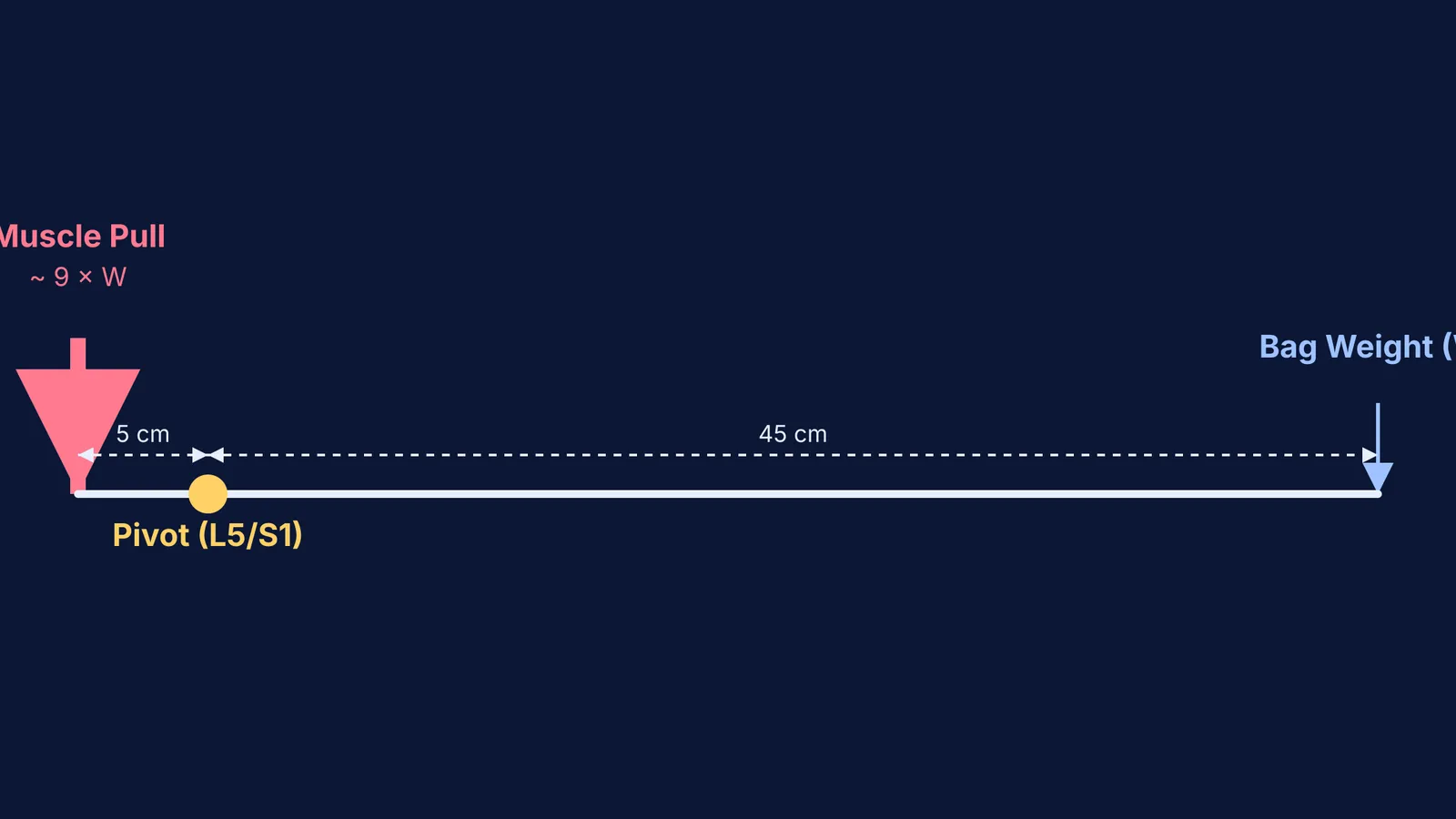
When you lift with straight legs in a "stoop" posture, the load is positioned far away from your body's centre of gravity. Let us say a student lifts a heavy 10 kg bag, holding it 45 cm away from their spinal pivot point. The torque generated by the bag is calculated as 10 kg multiplied by 45 cm.
Because the back muscles are only 5 cm away from the pivot on the opposite side of the lever, they must pull downwards with 90 kg of force just to balance the equation (90 kg × 5 cm = 10 kg × 45 cm). The total compressive force crushing down on the spinal disc is now the 90 kg muscle pull, plus the 10 kg bag, plus the inherent weight of the student's upper body.
This extreme mechanical disadvantage explains why the National Institute for Occupational Safety and Health (NIOSH) sets an action limit of 3,400 Newtons of compressive force on the lower back for safe lifting. A heavy bag lifted poorly can easily approach these limits and cause long-term pain.
This delicate equilibrium is identical to the physics behind finding the mass of a metre scale with the principle of moments. If your child finds it hard to picture how forces multiply along a lever, they can safely explore the changing vectors and moment arms in the Fermi Simulation Lab.
How do compressive and shear forces differ?
The human spine is a robust structure, but it handles different types of forces entirely differently depending on its alignment.
Compressive force presses straight down vertically on the vertebrae. The spinal discs are built like shock absorbers specifically to handle compression, but a massive internal muscle pull increases this compression so rapidly that it can still cause damage.
Shear force occurs when the vertebrae slide horizontally across each other.
Bending completely at the waist alters the angle of the spine, which converts safe vertical compression into dangerous horizontal shear force. The spine is far less equipped to handle shear force, making the ligaments and discs vulnerable to injury. By squatting instead of bending, the trunk remains upright. The resulting force remains purely compressive, and the large gluteus maximus and quadriceps muscles act as the powerful engine for the lift. This leaves the much thinner back muscles to act simply as stabilizers, holding the spine rigid rather than hauling the weight. Understanding how these perpendicular force components interact is a key step in calculating torque as r × F.
A practical checklist for a safer lift
Teaching a student how to lift their school bag properly not only protects their growing back but also reinforces a fundamental physics concept in their daily routine.
Get close to the load: Stand with feet shoulder-width apart, right next to the bag, to minimize the initial distance.
Squat down: Bend the knees and hips entirely, ensuring you keep the back relatively straight and the chest lifted upwards.
Grip and brace: Hold the bag firmly with both hands and immediately bring it as close to the stomach as possible.
Drive upward: Push through the heels, using the powerful leg muscles to stand up while keeping the core tight.
By treating the human body as a living mechanical system, you can lift safely every day and turn a mundane morning chore into a highly effective lesson in active learning.


