

On this page
In short
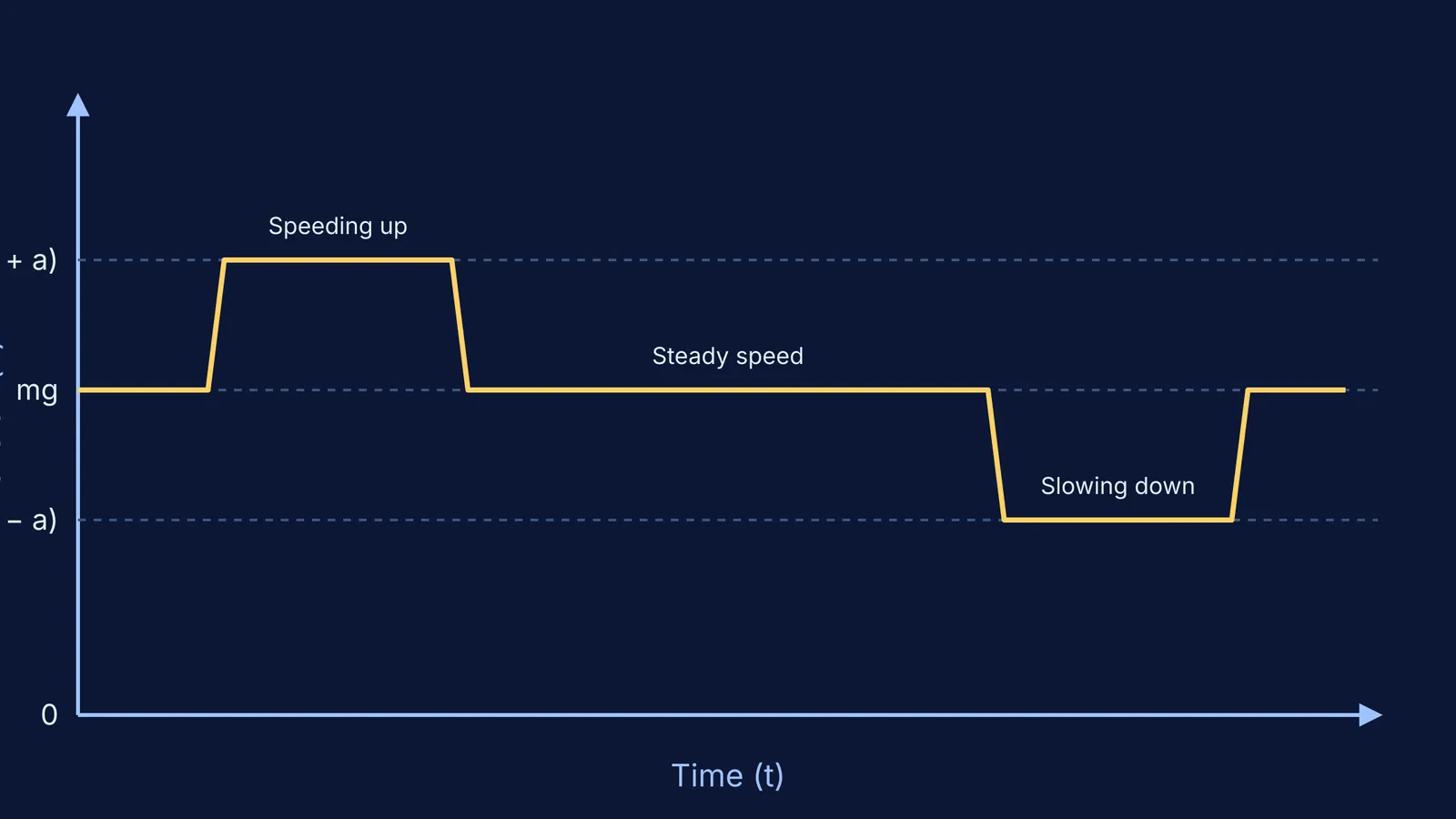
When a lift moves upwards, the cable tension peaks at m(g + a) during acceleration, drops to mg at a steady speed, and falls to m(g − a) when slowing down. The cable must provide extra force to overcome the lift's inertia on top of gravity.
When you step into a lift, you feel a little heavier as it starts moving up and a little lighter as it slows down. This is not an illusion. The cable pulling the lift must provide enough force not only to support its weight, but also to change its speed. Let's trace how the tension changes during a complete journey from the ground floor to the top, and back down again.
What is the tension in a lift cable when speeding up?
To make any mass m accelerate upwards at a rate a, the net force must be ma. Gravity pulls down with a force mg. According to Newton's second law, the cable's tension T must overcome gravity and provide this extra push, which means T = m(g + a) according to OpenStax. This is why tension peaks at the start of the journey.
This is the exact same principle that applies when a monkey climbing a rope speeds up or slows down. The rope must support the monkey's weight and provide the force for acceleration.
What is the tension during steady motion?
Once the lift reaches its cruising speed, it stops accelerating. Even though it is moving upwards rapidly, there is no net force acting on it. The cable only needs to support the weight of the lift, so the tension drops back to exactly mg.
For lifts in tall buildings, this steady motion phase makes up most of the trip. The passengers feel perfectly normal, just as they would standing on solid ground, because the floor is pushing up on them with a force equal to their normal weight.
Why does tension drop when slowing down?
As the lift approaches the top floor, it must slow down. Its acceleration is now directed downwards. Gravity is already pulling down, doing some of the work of slowing the lift. The cable does not need to pull as hard, so the tension falls to m(g − a).
The same thing happens to the normal force from the floor, which is why a person inside feels briefly lighter. For a different look at normal forces, see how a car over a hump experiences a drop in normal force at the peak of the hill.
What happens on the way down?
The physics of a downward journey are the exact mirror image of the trip up. When the lift leaves the top floor and speeds up on its way down, its acceleration is downwards. Because gravity is assisting the motion, the cable tension relaxes to m(g − a). This is why your stomach might drop when a high-speed lift descends.
During the steady downward descent, the tension returns to mg. Finally, when the lift reaches the ground floor and brakes, it must accelerate upwards to cancel out its downward velocity. The cable has to pull hard again, and the tension spikes back up to m(g + a) until the car comes to a complete halt.
What if the cable snaps?
In the extreme, hypothetical scenario of a free fall, the downward acceleration of the lift becomes exactly equal to gravity. Plugging this into the downward acceleration formula gives a tension of m(g − g), which is exactly zero. The lift and everything inside it accelerate downwards at the same rate, resulting in apparent weightlessness. Fortunately, modern passenger lifts have multiple independent cables and mechanical brakes that lock onto the guide rails if they detect a loss of tension, making a true free fall virtually impossible.
How do you draw a tension-time graph for a lift?
If you plot the tension against time for an upward journey, you see three distinct phases. The graph starts with a flat line at mg while the lift is waiting. Then, it jumps up to m(g + a) as the motor hauls the lift up to speed.
During the long middle phase, it settles back to mg. Finally, it dips down to m(g − a) as the brakes apply, before returning to mg when the doors open. A graph for the downward journey would simply swap the peak and the dip.
If you find it tricky to remember whether to add or subtract acceleration in different scenarios, the Fermi Problem Library has worked problems with a step-by-step solver that explains the reasoning rather than printing an answer. This helps you map out the forces properly before you start calculating.
How do you calculate tension in a lift?
Imagine a 500 kg lift accelerating upwards at 2 m/s². Using the `m(g + a)` formula from OpenStax, and taking g as 9.8 m/s²:
Speeding up: T = 500 × (9.8 + 2) = 5,900 N.
Steady speed: T = 500 × 9.8 = 4,900 N.
Slowing down at 2 m/s²: T = 500 × (9.8 − 2) = 3,900 N.
The cable experiences a 2,000 N swing in tension over the course of a single trip. Engineers must account for these dramatic shifts, ensuring that cables and motors are built to withstand the maximum dynamic forces, not just the static weight of the car.


