

On this page
The Liebermann nitroso test is a classic laboratory method used to detect phenol and its derivatives. If you have a colourless organic liquid and suspect it is phenol, this test produces a vivid, unmistakable sequence of colour changes: green, then red, and finally deep blue.
What is the Liebermann nitroso test?
When a phenol is warmed with a small amount of sodium nitrite (NaNO₂) and a few drops of concentrated sulphuric acid (H₂SO₄), the mixture forms a deep green or blue solution. This initial colour is the first step of a sequence that confirms the presence of the phenolic -OH group. The sequence distinguishes phenols from aliphatic alcohols, such as ethanol or propanol, which do not give a positive result.
The test is highly specific to phenols that have a free para-position—the carbon atom exactly opposite the hydroxyl group on the benzene ring. If that position is already occupied by another group (as in p-cresol), the initial nitrosation cannot happen, and the test fails.
Organic chemistry mechanisms can look like a maze of arrows and intermediates. If you find yourself memorising colour changes without understanding why they happen, Fermi's AI tutor can work out what you already know and build a plan for the session, teaching you the steps of electrophilic aromatic substitution without rushing.
The colour sequence of the test
In a practical exam or a multiple-choice question, you are often asked to identify the three stages of the test by their colours. The reaction builds a large, highly conjugated dye molecule called indophenol, which acts as a pH indicator.
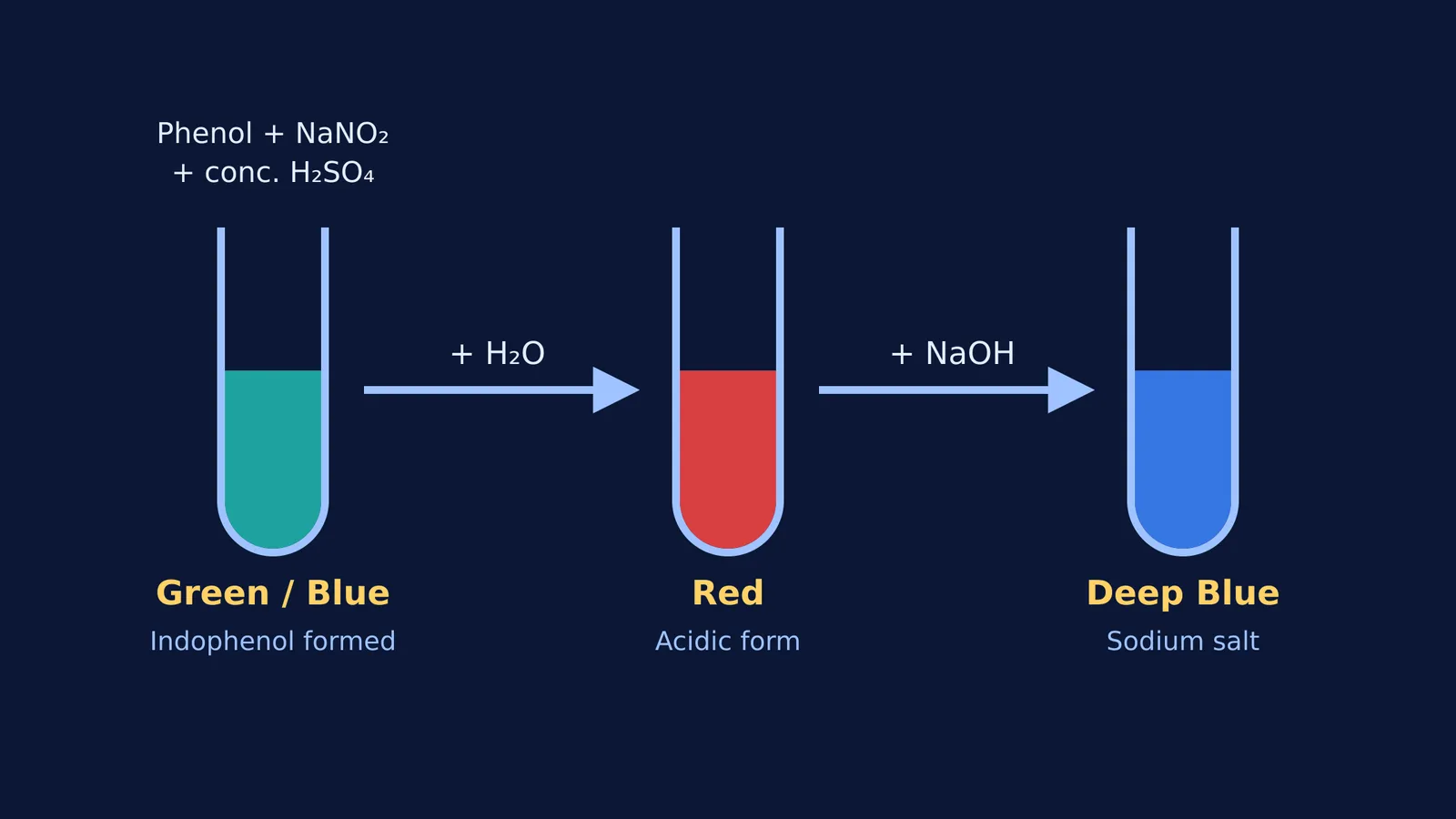
Green or blue: Phenol mixed with NaNO₂ and concentrated H₂SO₄ produces the initial indophenol complex.
Red: Carefully diluting the acidic mixture with water turns it red. This is the acidic form of indophenol.
Deep blue: Adding an excess of sodium hydroxide (NaOH) turns the solution deep blue or violet. The alkali removes a proton from the indophenol, forming its deeply coloured sodium salt.
Mechanism: why does the colour change?
The chemistry behind the Liebermann test happens in three distinct steps:
Nitrosation: First, sodium nitrite and concentrated sulphuric acid react to form nitrous acid (HNO₂). In strong acid, this generates a reactive nitrosonium ion (NO⁺). Because the -OH group strongly activates the benzene ring, the NO⁺ ion attacks the free para-position to form p-nitrosophenol.
Tautomerisation and condensation: The newly formed p-nitrosophenol rearranges (tautomerises) into its more stable isomer, p-quinone monoxime. This oxime then reacts with a second molecule of unreacted phenol. Aided by the concentrated sulphuric acid acting as a dehydrating agent, they condense to form a large molecule called indophenol.
Acid-base shifts: The massive conjugated electron system of indophenol absorbs visible light, creating the colours you see. In concentrated acid it is green or blue; in dilute acid it is red; and as a sodium salt in alkali, it shifts to deep blue.
To see how these ring substitutions fit into the wider picture of organic chemistry, the Fermi Concept Library has every concept in chemistry, each with its own lesson and its place in the map.
Testing for secondary amines
The Liebermann nitroso reaction is not just for phenols; it is also the standard test for secondary amines (both aliphatic and aromatic).
When a secondary amine reacts with nitrous acid, it forms an N-nitrosamine, which separates out as a yellow oil. To confirm what it is, chemists warm the yellow oil with a crystal of pure phenol and a few drops of concentrated sulphuric acid. The acid releases the nitroso group from the amine, allowing it to react with the phenol and produce the exact same green-red-blue indophenol colour sequence. Primary and tertiary amines behave differently with nitrous acid, making this a reliable way to single out secondary amines.
If you are preparing for entrance exams and get stuck on the differences between primary, secondary, and tertiary amine tests, the Fermi Problem Library has worked problems with a step-by-step solver that explains the reasoning rather than printing an answer.
A checklist for the lab
If you are performing this test in a school or university laboratory, follow these steps to ensure it works safely and correctly 1:
Add a small crystal (or a few drops) of the suspected phenol to a clean, dry test tube.
Add a crystal of solid sodium nitrite (NaNO₂).
Very gently heat the mixture, then allow it to cool.
Carefully add a few drops of concentrated sulphuric acid (H₂SO₄). Look for the dark green or blue colour.
Slowly pour the mixture into a beaker containing an excess of distilled water. Watch the colour change to red.
Add dilute sodium hydroxide (NaOH) solution drop by drop until the liquid becomes alkaline. The red will shift back to deep blue.
Phenol's reactivity makes it a central topic in organic chemistry. Once you understand the mechanism behind the Liebermann test, other substitution reactions follow the same logic.


