

On this page
When you draw the Lewis structure of a neutral molecule like water (H₂O), the rules are fairly straightforward: count the electrons, place the bonds, and fill the octets. However, when you face a polyatomic ion, the rules have a crucial twist.
Research shows that ions are where many students get stuck. A study published in the Journal of Chemical Education by Cooper et al. (2010) found that while about 80% of organic chemistry students can construct correct Lewis structures for simple molecules with one carbon atom, the success rate drops to about 30% for species with two or more carbon atoms. The main hurdles are mismanaging the total electron count because of the ion's charge and struggling to balance formal charges correctly.
Here is the five-step method to draw the Lewis structure of any polyatomic ion, whether it is nitrate (NO₃⁻), carbonate (CO₃²⁻), or sulphate (SO₄²⁻).
How to draw the Lewis structure of a polyatomic ion?
Drawing a polyatomic ion uses the same foundational principles as any other electron dot structure, but the process begins and ends with the ion's charge.
Follow this five-step checklist:
Count the total valence electrons: Find the sum of the valence electrons for all atoms, then add or subtract electrons for the overall charge.
Choose the central atom: Place the least electronegative atom in the centre (except hydrogen, which is always on the outside).
Draw single bonds: Connect the outer atoms to the central atom with single lines (each line represents two electrons).
Complete the octets: Distribute the remaining electrons as lone pairs on the outer atoms first, then put any leftovers on the central atom.
Check the formal charges: If the central atom lacks an octet, move lone pairs from the outer atoms to form double or triple bonds. Ensure the sum of all formal charges equals the ion's overall charge.
What happens to the valence electrons when an ion has a charge?
The most common mistake when drawing a polyatomic ion happens in step one. The overall charge of the ion directly changes your total pool of valence electrons.
If you have an anion (a negative charge), you must add that number of electrons to your total. For example, the sulphate ion (SO₄²⁻) has a −2 charge. Sulphur has 6 valence electrons, and each of the four oxygens has 6. Total = 6 + (4 × 6) = 30 electrons. Because the charge is −2, you add 2 more electrons for a total of 32 valence electrons.
If you have a cation (a positive charge), you subtract electrons. The ammonium ion (NH₄⁺) has a +1 charge. Nitrogen provides 5 valence electrons, and the four hydrogens provide 1 each. Total = 5 + (4 × 1) = 9 electrons. Because of the +1 charge, you subtract 1 electron, leaving you with 8 valence electrons.
How do you complete the octet and check formal charge?
Once you have distributed the single bonds, you must place the remaining electrons as lone pairs on the outer atoms until each has a full octet. If you still have electrons left, they go on the central atom.
But simply completing the octet is not the final step. You must verify the oxidation numbers and formal charges. The formal charge helps you decide which Lewis structure is the most stable.
To calculate formal charge: Formal Charge = (Valence Electrons) − (Non-bonding Electrons) − (Number of Bonds)
The most stable structure is the one where:
Formal charges are as close to zero as possible.
Any negative formal charge sits on the most electronegative atom (usually oxygen).
The sum of all formal charges equals the overall charge of the polyatomic ion.
If you are stuck on finding the right resonance structure or balancing these formal charges, the Fermi Concept Library has a lesson on it. The AI tutor notices where a student is stuck and teaches rather than answers, helping you trace the electrons back to their source.
How do you draw the Lewis structure of the nitrate ion (NO₃⁻)?
Let's apply these steps to the nitrate ion (NO₃⁻).
Count valence electrons: Nitrogen has 5. Three oxygens have 3 × 6 = 18. The −1 charge means we add 1 electron.
Total = 5 + 18 + 1 = 24 valence electrons.
Choose the central atom: Nitrogen is less electronegative than oxygen, so N goes in the centre.
Draw single bonds: Connect N to the three O atoms. This uses 3 bonds (6 electrons). We have 18 electrons left (24 − 6 = 18).
Complete the octets: Place 6 electrons (3 lone pairs) on each of the three outer oxygen atoms. This uses all 18 remaining electrons. The oxygen atoms now have full octets, but the central nitrogen only has 6 electrons (from the 3 single bonds).
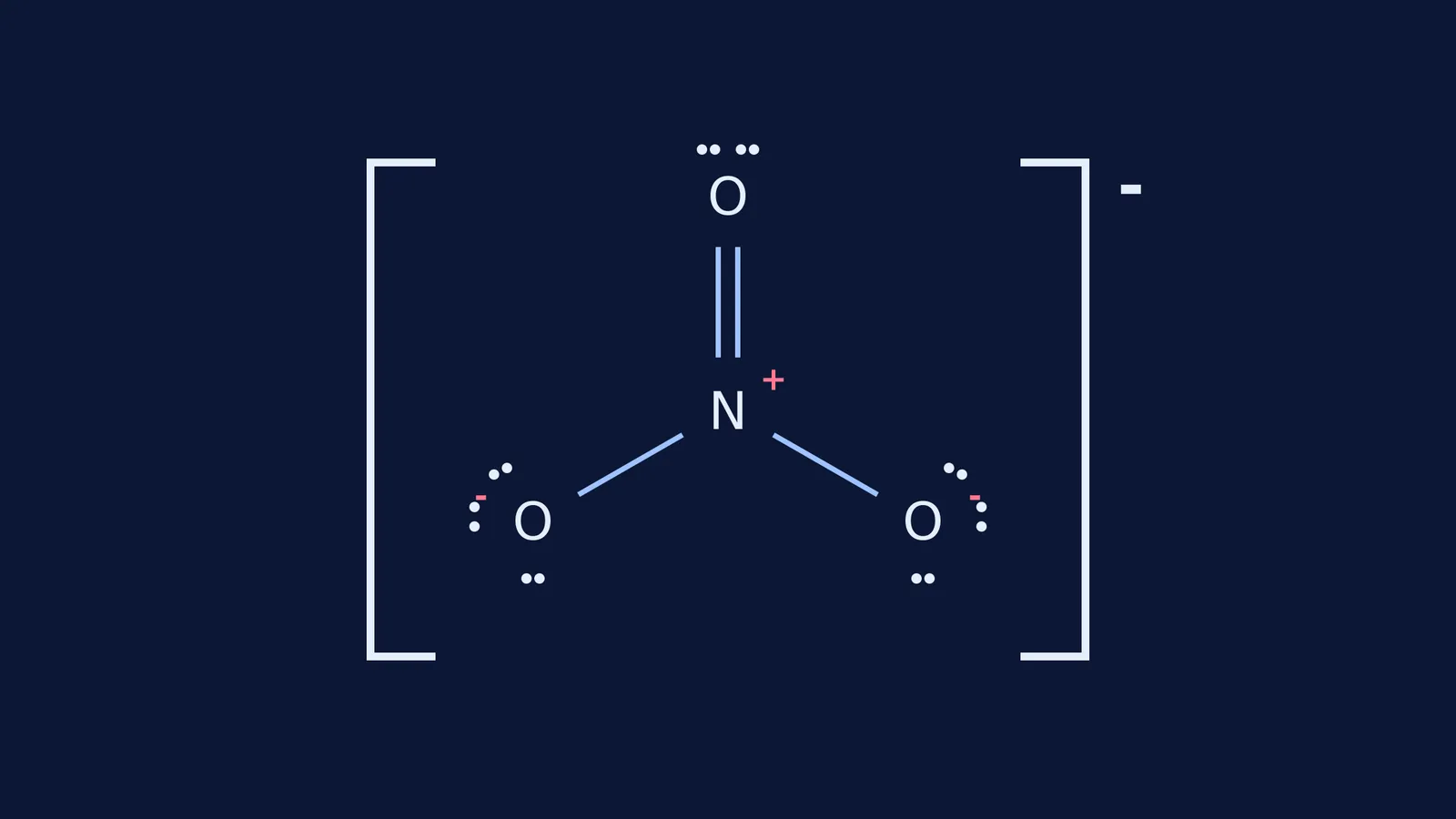
Check formal charges and adjust: Because nitrogen lacks an octet, we must share a lone pair from one of the oxygen atoms to form a double bond.
Now, nitrogen has one double bond and two single bonds (an average bond order of 1.33 due to resonance). Let's check the formal charges:
The double-bonded oxygen: 6 valence − 4 non-bonding − 2 bonds = 0.
The two single-bonded oxygens: 6 valence − 6 non-bonding − 1 bond = −1 each.
The central nitrogen: 5 valence − 0 non-bonding − 4 bonds = +1.
The sum of the formal charges is 0 + (−1) + (−1) + (+1) = −1. This exactly matches the overall charge of the nitrate ion. You finish the drawing by placing square brackets around the entire structure with the −1 charge on the outside.


