

On this page
If you are studying permutations and combinations, you will inevitably meet this question: *In how many ways can 5 letters be posted in 3 letter boxes?*
For many students, the intuitive answer is 5³ (which is 125). But the correct mathematical answer is 3⁵ (which equals 243). A 1997 study published in *Educational Studies in Mathematics* found that the way a combinatorics problem is framed—such as placing objects in boxes instead of picking items from a set—heavily influences the errors students make.
Let us look at why the base and the exponent are placed the way they are, and how to get it right every time.
How do you decide who is doing the choosing?
To solve any arrangement problem where repetition is allowed, you use the Fundamental Principle of Counting. The rule is always:
Total ways = (Choices)^(Items)
The secret is to ask yourself: *Who is doing the choosing?*
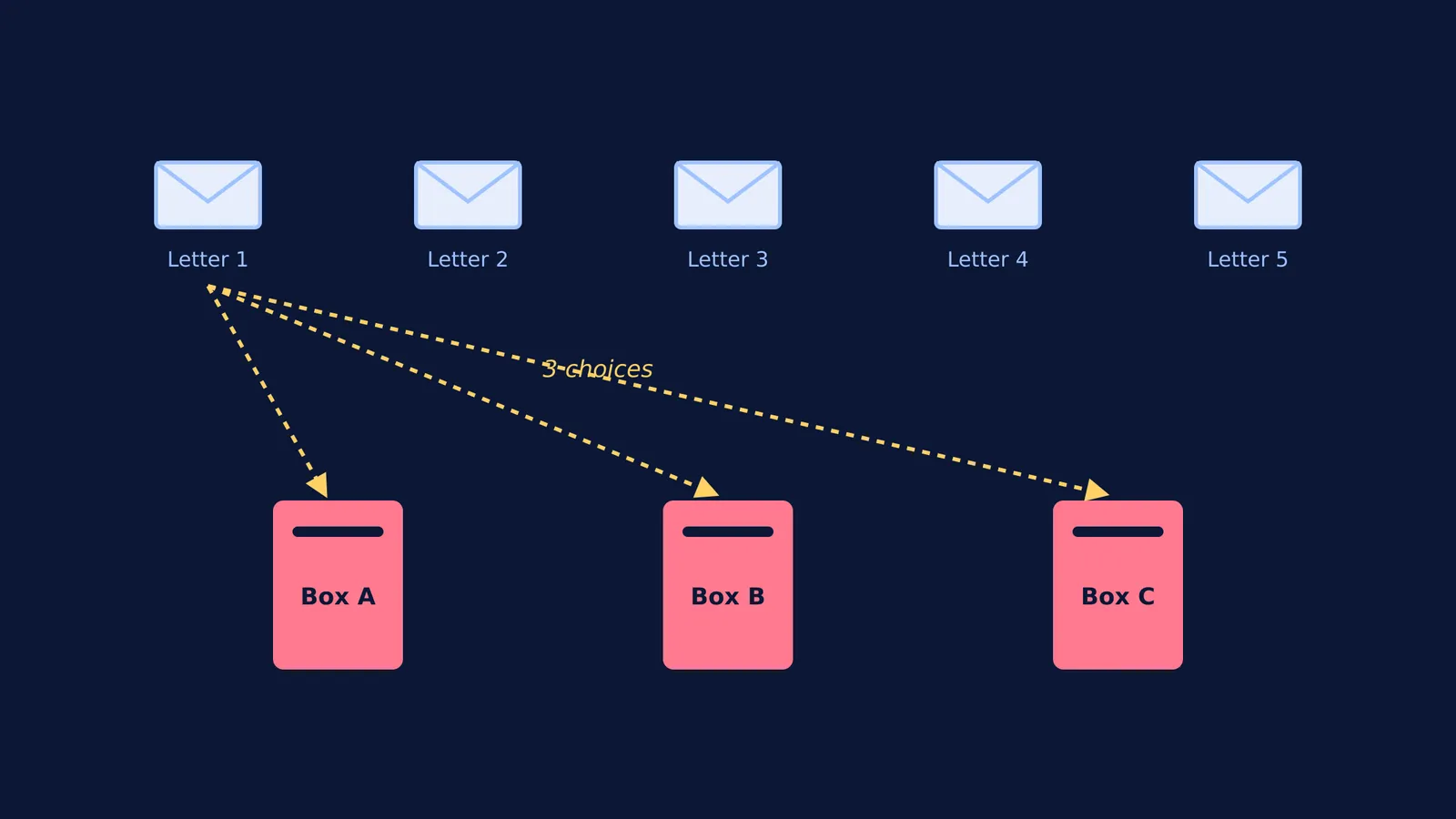
In this scenario, a letter box cannot walk over and choose a letter. Instead, you take the first letter in your hand. You have 3 letter boxes to choose from. You drop it in. Then you take the second letter. You again have 3 boxes to choose from. This continues for all 5 letters.
Because each letter's destination is independent of the others, you multiply the choices together: 3 × 3 × 3 × 3 × 3 = 3⁵
This formula applies because the boxes are distinct (Box A, Box B, Box C) and the letters are distinct (Letter 1, Letter 2, etc.), and a box can hold more than one letter. The NCERT Class 11 Mathematics textbook states that the number of permutations of n different objects where repetition is allowed is n^r. In this problem, the n choices are the 3 boxes, and the r times you choose is 5.
Why is 5³ the wrong answer?
Why do so many students write 5³? It happens when you accidentally swap the items and the choices.
If the answer were 5³, it would mean you have 3 items, and each item has 5 choices. That would describe a completely different problem: *In how many ways can 3 letters be posted in 5 letter boxes?*
When you get stuck on a permutations numerical, guessing the formula often leads to these upside-down errors. The Fermi Problem Library has a step-by-step solver that explains the reasoning rather than printing an answer, so you learn to build the expression from the ground up.
Testing your logic with a smaller number
If you find yourself freezing in an exam and cannot remember whether it should be 3⁵ or 5³, try scaling the problem down to 2 letters and 3 letter boxes.
If the (items)^(choices) logic (2³) were right, there would be 8 ways. If the (choices)^(items) logic (3²) were right, there would be 9 ways.
List them out manually. Let the boxes be A, B and C. The first letter and the second letter could go into:
A and A
A and B
A and C
B and A
B and B
B and C
C and A
C and B
C and C
There are exactly 9 ways. This quick test proves the (choices)^(items) logic, meaning the answer for 5 letters and 3 boxes must be 3⁵.
How do variants like prizes, rings and courses work?
This exact mathematical structure appears in several other classic problems. Once you know to look for the "chooser", they all follow the same 3⁵ logic.
Distributing 5 prizes among 3 students: A student cannot receive a piece of a prize, but one student can receive multiple prizes. The prize does the choosing. You hold up the first prize and have 3 students to give it to. For 5 prizes, it is 3⁵ ways.
Putting 5 rings on 3 fingers: You take the first ring. You have 3 fingers to place it on. You take the second ring, and again have 3 fingers. Each of the 5 rings makes a choice, giving 3⁵ arrangements.
5 students choosing from 3 optional courses: Here, the students are the ones choosing. The first student has 3 courses to pick from. The second student has 3 courses, and so on. The result is still 3⁵.
Whenever you face a problem like this, do not guess the base and the exponent. Picture yourself holding the item and count the choices in front of you.
If you want to read more about specific arrangements, you can revise the bundle method for letters kept together or look at the rules for arranging letters with repeats.


