

On this page
When you hold a boiling tube containing white lead(II) nitrate crystals over a Bunsen flame, a dramatic chemical and physical transformation unfolds within seconds. First comes a sharp, crackling rattle that sounds like popping embers. Moments later, a dense reddish-brown cloud pours from the tube, while a heavy crust clings to the hot glass.
This demonstration, featured in NCERT Class 10 Science Chapter 1 as Activity 1.6, is a standard practical across Indian school curricula. Whether preparing for board examinations or competitive exams like JEE Main and NEET-UG, understanding the underlying thermal decomposition reaction, gas identification tests, and the acoustic physics of decrepitation turns rote memorisation into intuitive chemistry.
What happens during the heating lead nitrate brown fumes reaction?
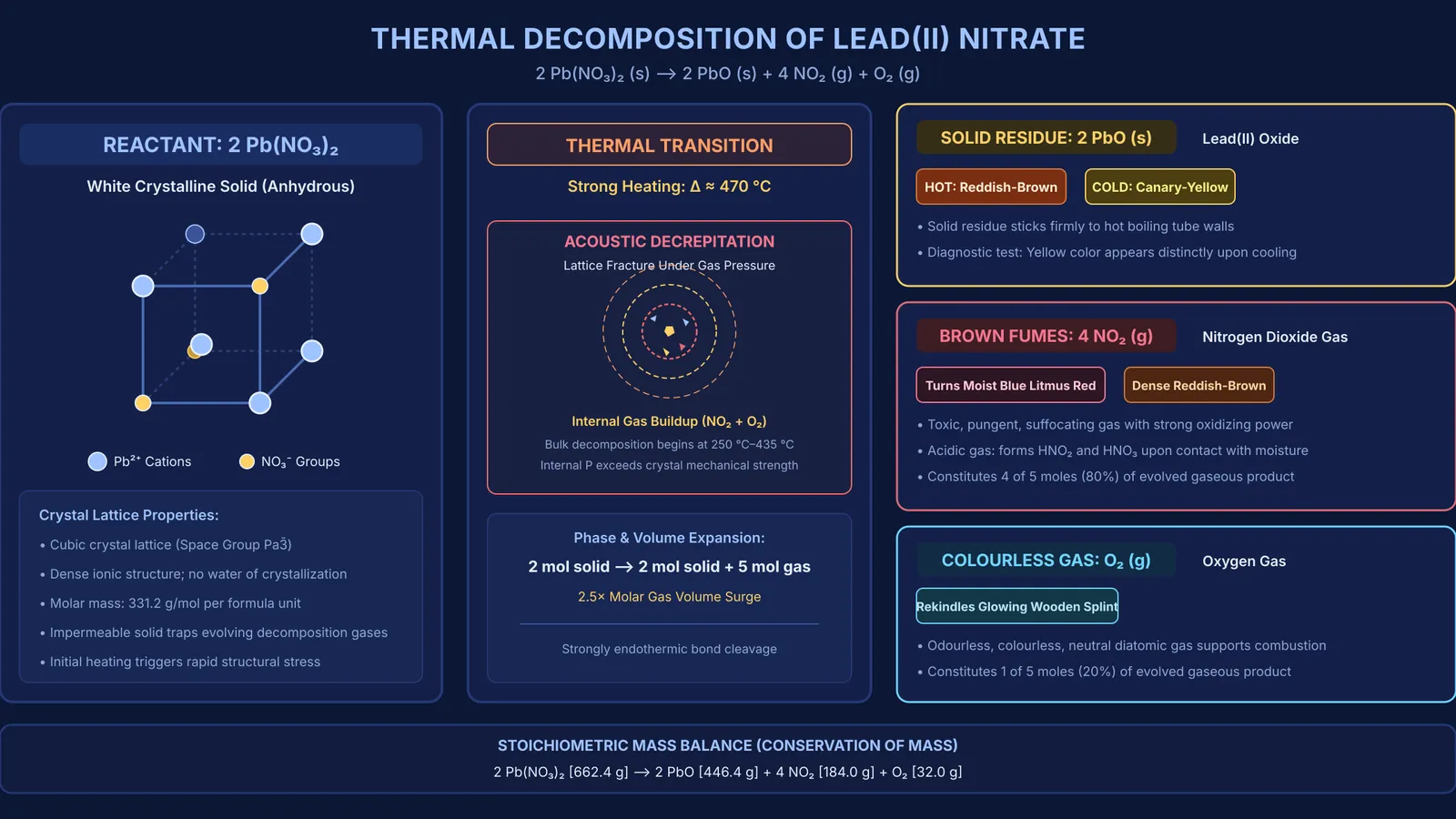
When anhydrous lead(II) nitrate powder is heated strongly, a single solid compound decomposes into three distinct products. According to thermochemical data in the PubChem Compound Summary for CID 24924, lead nitrate decomposes at approximately 470 °C. The reaction is strongly endothermic, drawing energy from the flame to sever the ionic and covalent bonds within the crystal lattice.
The reaction yields products across solid and gas phases:
Solid lead(II) oxide (PbO), which coats the boiling tube.
Nitrogen dioxide (NO₂), a heavy, pungent reddish-brown gas that forms visible fumes.
Oxygen gas (O₂), a colourless, odourless gas evolved simultaneously.
Why does lead nitrate crackle during thermal decomposition?
A striking observation during heating is decrepitation: a sharp crackling noise heard almost immediately. Students often mistake decrepitation for boiling water, but pure lead nitrate crystals are anhydrous and contain no water of crystallisation.
A classic study by F. Vratny and F. Gugliotta in the Journal of Inorganic and Nuclear Chemistry80133-5) established that thermal breakdown initiates within the crystal bulk across temperatures between 250 °C and 435 °C. Lead nitrate crystallises in a dense cubic lattice. As decomposition begins, nitrogen dioxide and oxygen molecules form in microscopic pockets inside the solid.
Because the crystal lattice is non-porous, gas pressure mounts rapidly inside these cavities. When internal stress surpasses the crystal's mechanical strength, the solid fractures abruptly. Microscopic fractures propagate rapidly throughout the crystal lattice, launching tiny fragments against the glass walls and producing the characteristic crackling sound. To see how thermal decomposition fits into broader reaction categories, explore our review of types of chemical reactions in Class 10.
How do you write and balance the lead nitrate reaction equation?
According to the stoichiometric framework taught in NCERT Class 10 Science, balancing this thermal decomposition tests systematic conservation of mass. The unbalanced skeleton equation is:
Pb(NO₃)₂ (s) → PbO (s) + NO₂ (g) + O₂ (g)
To balance the equation, follow these sequential steps:
Nitrogen balance: Two nitrate groups on the left yield two nitrogen atoms, requiring 2 NO₂ on the right: Pb(NO₃)₂ (s) → PbO (s) + 2 NO₂ (g) + O₂ (g).
Oxygen balance: The left has 6 oxygen atoms, whereas the right has 1 (in PbO) + 4 (in 2 NO₂) + 2 (in O₂) = 7 oxygen atoms.
Integer coefficients: Multiply the entire equation by 2 to clear fractional ratios and balance all atoms:
2 Pb(NO₃)₂ (s) → 2 PbO (s) + 4 NO₂ (g) + O₂ (g)
This equation reveals an important molar expansion. Two moles of solid reactant yield two moles of solid lead(II) oxide and five moles of combined gas (four moles of NO₂ and one mole of O₂). This substantial gas expansion explains the rapid pressure surge within the tube.
For step-by-step guidance on balancing multi-product reactions, read our tutorial on balancing chemical equations in Class 10. When working through stoichiometry problems and predicting gas volumes, the Fermi Problem Library provides worked problems with a step-by-step solver that explains the reasoning rather than printing an answer.
What observations appear on board exams and lab practicals?
Examiners frequently test whether students can connect visible observations with chemical identities. Keep this diagnostic checklist in mind:
Initial reactant: White crystalline powder.
Acoustic signal: Rapid decrepitation (crackling noise) as heating begins.
Gas 1 (Brown fumes): Toxic nitrogen dioxide (NO₂), which turns moist blue litmus paper red because it forms an acidic solution with water.
Gas 2 (Colourless gas): Oxygen (O₂), which rekindles a glowing wooden splint placed near the tube mouth.
Solid residue: Lead(II) oxide (PbO), which appears reddish-brown while hot and turns canary-yellow after cooling.
Recognising these specific indicators ensures full marks on practical-oriented questions, as discussed in our guide to the CBSE Class 10 science sample paper. To explore how thermal stability varies across different metal salts, the Fermi Concept Library organises every concept in chemistry with its own lesson and its place in the map.


