

On this page
The last two digits of any whole number are its remainder when you divide it by 100. So "find the last two digits of 3²⁰²⁶" really asks: what is 3²⁰²⁶ mod 100? You only track remainders, and three tools do the work: cyclicity, the binomial theorem and Euler's theorem. The same ideas sit behind remainder and divisibility problems with binomial expansion in JEE maths and the modular patterns in IOQM number theory questions.
How do you find the units digit of a large power?
The units digit is the remainder mod 10, and it repeats in a short cycle:
Ending in 0, 1, 5 or 6: never changes.
Ending in 4 or 9: cycle of 2 (4, 6 and 9, 1).
Ending in 2, 3, 7 or 8: cycle of 4 (2, 4, 8, 6; 3, 9, 7, 1; 7, 9, 3, 1; 8, 4, 2, 6).
Divide the exponent by the cycle length and use the remainder. For 7²⁰²⁶: 2026 = 4 × 506 + 2, so 7²⁰²⁶ ends like 7² = 49. The units digit is 9. If the remainder is 0, take the cycle's last term (for 7, that is 1).
Why 4? Euler's theorem says that if a and n are coprime positive integers, then a^φ(n) ≡ 1 (mod n). Here φ(n), Euler's totient function, counts the positive integers up to n that are coprime to n. Since φ(10) = 4 (from 1, 3, 7, 9), bases ending in 3, 7 or 9 return to 1 within four steps.
How do you find the last two digits of a large number?
Work mod 100. The first method, the binomial shortcut, suits bases near a multiple of 10.
The binomial theorem expands (x + y)ⁿ as the sum of C(n, k) xⁿ⁻ᵏ yᵏ. Write the base as 10m ± 1. Every term from the third onward contains (10m)², a multiple of 100, so only two terms survive: (1 + 10m)ⁿ ≡ 1 + 10mn (mod 100).
11⁵⁶ = (1 + 10)⁵⁶ ≡ 1 + 560 = 561, so the last two digits are 61.
9²⁰²⁶ = (10 − 1)²⁰²⁶ ≡ 1 − 2026 × 10 = −20259. Add 20300 to get 41.
Odd bases often convert: 3²⁰²⁶ = 9¹⁰¹³ = (10 − 1)¹⁰¹³ ≡ −1 + 10130 = 10129, so 29.
Watch the sign: −1 to an even power is +1, to an odd power −1.
How does Euler's theorem shorten the exponent mod 100?
The product formula on the totient function page gives φ(100) = 100 × (1 − 1/2) × (1 − 1/5) = 40. So for any base that is odd and not a multiple of 5, a⁴⁰ ≡ 1 (mod 100), and you can reduce the exponent mod 40.
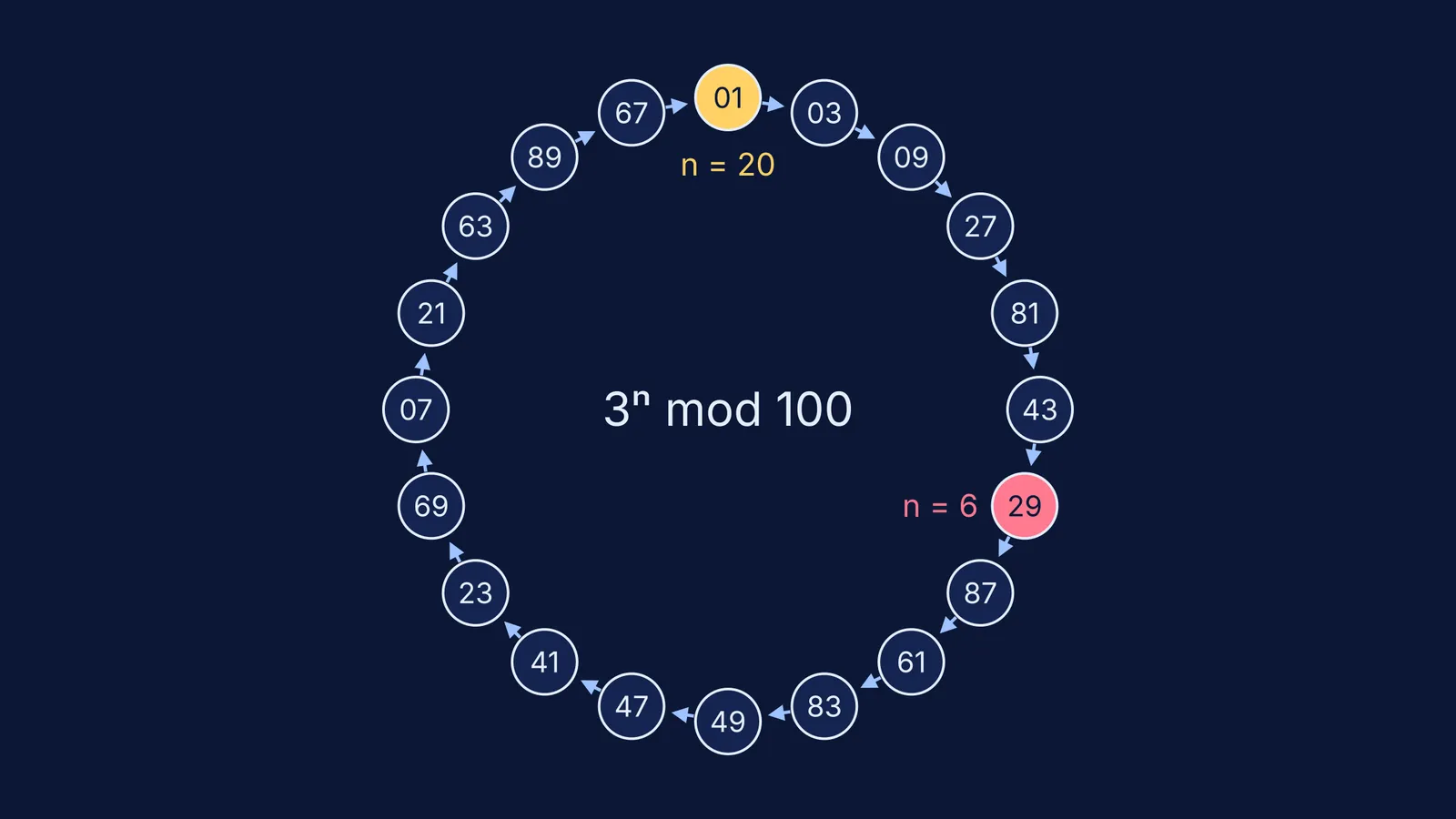
Redo 3²⁰²⁶: 2026 = 40 × 50 + 26, so you need 3²⁶. Square up, keeping two digits: 3⁵ = 243 → 43; 3¹⁰ → 43² = 1849 → 49; 3²⁰ → 49² = 2401 → 01. Then 3²⁶ ≡ 01 × 3⁶ = 729, so the answer is 29 again.
The exponent 40 always works, but the true cycle can be shorter. The Carmichael function λ(n) is the smallest exponent that works for every base coprime to n, and λ(100) = lcm(λ(4), λ(25)) = lcm(2, 20) = 20.
What if the base is even or a multiple of 5?
Euler's theorem needs the base coprime to 100, so split 100 = 4 × 25. Take 2²⁰²⁶.
Mod 4: every power from 2² on is a multiple of 4, so 0.
Mod 25: the prime-power rule φ(pᵏ) = pᵏ⁻¹(p − 1) on the totient function page gives φ(25) = 5 × 4 = 20. Since 2026 = 20 × 101 + 6, 2²⁰²⁶ ≡ 2⁶ = 64 ≡ 14 (mod 25).
Combine: the numbers below 100 that leave 14 mod 25 are 14, 39, 64 and 89. Only 64 is a multiple of 4.
The last two digits are 64. Powers of 5 are quicker: from 5² = 25 on, they all end in 25. The prime factorisation step here is the same one you use for counting the divisors of a number.
Which method should you use in an exam?
Units digit only? Use the cycle of 1, 2 or 4.
Base, or a small power of it, ends in 1 or 9 (3² = 9, 7² = 49)? Binomial, two terms.
Base odd and not a multiple of 5? Reduce the exponent mod 40, or a shorter cycle, then square up.
Base even or a multiple of 5? Split into mod 4 and mod 25.
Check with a second method before you mark the answer.
If you cannot see which step slipped, the Fermi Problem Library has worked problems with a step-by-step solver that explains the reasoning rather than printing an answer. If remainders mod n still feel shaky, the Fermi Concept Library gives every concept in mathematics its own lesson and its place in the map.


