

On this page
In Class 10 mathematics, much like quadratic word problems, questions about the highest common factor (HCF) and lowest common multiple (LCM) often arrive hidden inside word problems. One of the most common formats asks you to find the largest number that divides leaving remainders 6 and 5.
While the calculation itself only requires prime factorisation, spotting the right path can be tricky. A 2026 study in the Bulletin of Education and Research found that using virtual tools and manipulatives enhanced 5th-grade students' math skills and engagement in class when solving prime factorisation, HCF and LCM problems.
If you are facing a blank page, here is how to break down the method.
Why do we subtract the remainders first?
When a question asks for the "largest number that divides," it is looking for a highest common factor. However, you cannot take the HCF of the original numbers because they do not divide perfectly—they leave remainders.
If an unknown number divides a given number A and leaves a remainder of 6, it means A is 6 units larger than a perfect multiple. To find a perfect multiple, you simply subtract the remainder. Once you subtract the respective remainders from all the given numbers, you are left with new numbers that divide perfectly. The largest number that divides these new numbers is their HCF.
How do you find the largest number that divides leaving remainders 6 and 5?
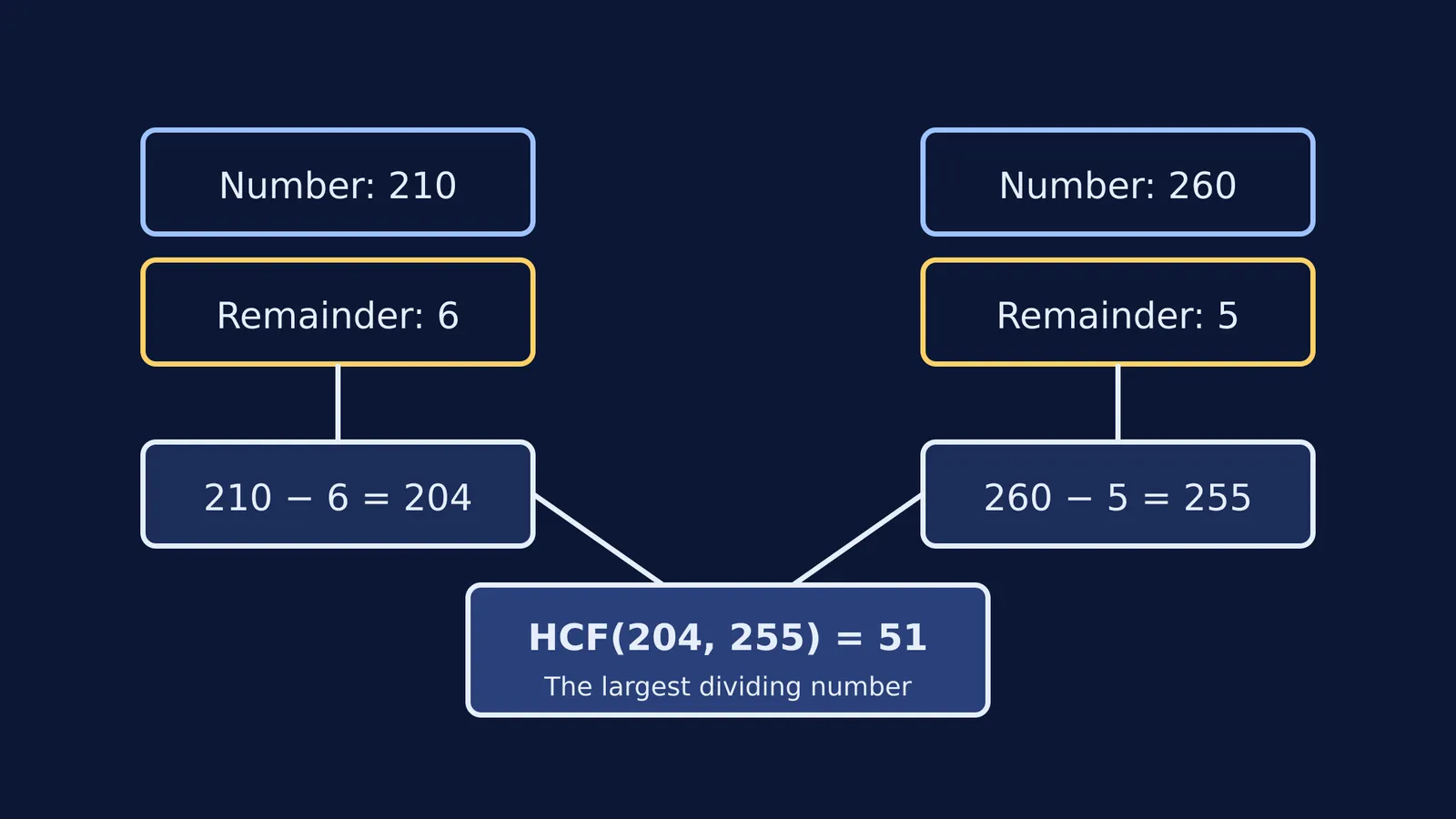
Let us look at a concrete example: find the largest number that divides 210 and 260, leaving remainders 6 and 5 respectively.
Step 1: Subtract the remainders Subtract the specific remainder from each corresponding number:
For 210, the remainder is 6: 210 − 6 = 204
For 260, the remainder is 5: 260 − 5 = 255
Step 2: Find the HCF of the new numbers Now, find the HCF of 204 and 255 using prime factorisation.
204 = 2² × 3 × 17
255 = 3 × 5 × 17
The common prime factors are 3 and 17. Multiply them to get the HCF: 3 × 17 = 51.
Therefore, 51 is the largest number that divides 210 (leaving a remainder of 6) and 260 (leaving a remainder of 5).
What is the difference between smallest and largest number problems?
Students often confuse this problem with its LCM counterpart. The wording tells you which operation to use:
Largest number that divides: This means you are looking for a divisor (a factor). You subtract the remainders first, then find the HCF.
Smallest number divided by: This means you are looking for a dividend (a multiple). You find the LCM of the given numbers first, then add the required remainder at the end.
If you struggle to remember the difference, Fermi's AI tutor can help. Instead of just giving you the final answer, the tutor works out what you already know and builds a plan for the session, teaching you the reasoning step by step so you can spot the pattern yourself.
Setting up a study plan
Mastering real numbers requires practice, just as you would practice finding the sum of all numbers formed from given digits. Create a checklist to tackle these word problems systematically:
Identify if the question asks for a "largest" (HCF) or "smallest" (LCM) value.
Check if the problem states a remainder.
Apply the correct sequence: subtract then HCF, or LCM then add.
Try variations of the problem in the Fermi Problem Library to test your understanding across different numbers.


