

On this page
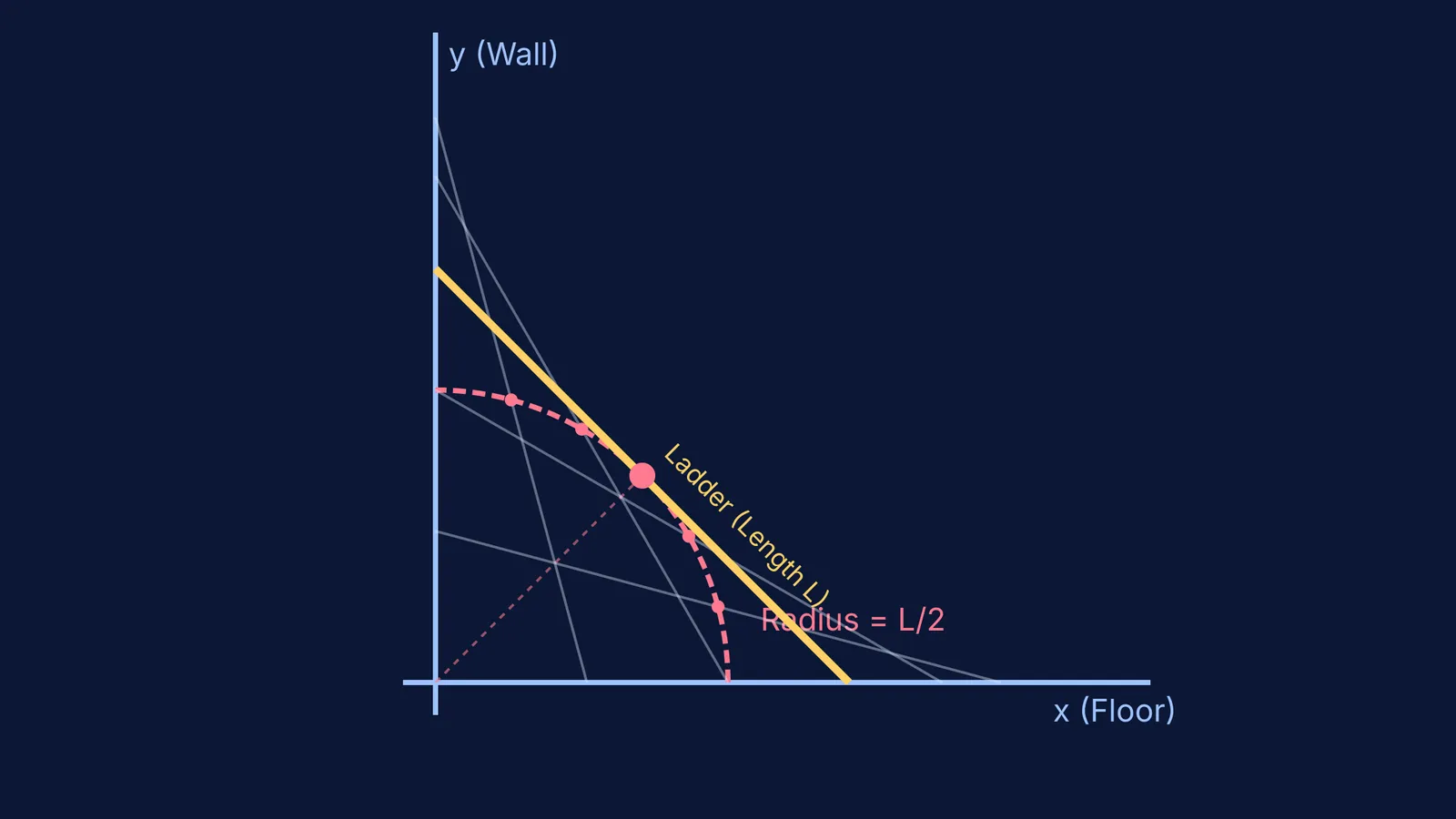
Every locus problem in coordinate geometry asks you to find the path traced by a moving point. The "sliding ladder" is a classic example that appears in physics and mathematics. When a ladder slips down a vertical wall, its ends move in straight lines, but what is the path of its midpoint?
What is the path of the midpoint of a sliding ladder?
If a ladder of length L slides with one end on a vertical wall and the other on a horizontal floor, the path of its midpoint is a circle of radius L/2.
We can prove this using coordinate geometry. Let the wall be the y-axis and the floor be the x-axis. The ends of the ladder touch the axes at points (x, 0) and (0, y). Because the ladder always has a constant length L, the Pythagorean theorem tells us:
x² + y² = L²
Let the midpoint of the ladder be M, with coordinates (X, Y). By the midpoint formula, the coordinates of M are:
X = x / 2 (which means x = 2X)
Y = y / 2 (which means y = 2Y)
Substitute these into the Pythagorean equation:
(2X)² + (2Y)² = L² 4X² + 4Y² = L² X² + Y² = (L/2)²
This is the standard equation of a circle centered at the origin (0, 0) with a radius of L/2. Because the ladder's coordinates (x, y) are always positive, the midpoint is confined to the first quadrant, making the locus exactly a quarter circle.
A worked example with numbers
Let's walk through a numerical example to see this circle in action. Suppose a 10-metre ladder is sliding down a wall. At a certain instant, the bottom of the ladder is 6 metres away from the wall. What is the exact position of the midpoint, and how far is it from the corner?
First, we need to find how high the ladder is on the wall. Using the Pythagorean theorem, the height y is:
y = √(10² - 6²) y = √(100 - 36) y = √64 = 8 metres
This means the ends of the ladder are currently resting at the coordinates (6, 0) on the floor and (0, 8) on the wall.
The coordinates of the midpoint are simply half of these intercept values:
X = 6 / 2 = 3 metres
Y = 8 / 2 = 4 metres
So, the midpoint is at (3, 4). Now, if we calculate the straight-line distance from the corner (the origin at (0, 0)) to this midpoint, we use the distance formula:
Distance = √(3² + 4²) Distance = √(9 + 16) Distance = √25 = 5 metres
This distance is exactly half the length of the 10-metre ladder. No matter where the ladder is along its slide—whether the bottom is 2 metres from the wall or 9 metres—calculating the distance to the midpoint will always yield exactly 5 metres. The midpoint is permanently tethered to this 5-metre radius, tracing a perfect circle.
How does the Trammel of Archimedes work?
This sliding property is the mechanism behind a famous historical drafting tool called the Trammel of Archimedes. The Trammel of Archimedes is a mechanical linkage dating back to Proclus in the 5th century AD that draws perfect ellipses (Wikipedia).
A Trammel consists of two shuttles confined to perpendicular tracks (acting just like the wall and floor) and a rigid rod connecting them (the ladder). When a pen is placed exactly midway between the two shuttles, it traces a perfect circular path.
In modern times, versions of this mechanism became popular in the 1960s as novelty desk toys (Wikipedia). Because the shuttles simply slide back and forth in their tracks, these toys earned the affectionate nickname "do-nothing machines".
What happens to other points on the ladder?
The circle is only traced by the exact midpoint. If you look at any other point on the sliding ladder, its locus is an ellipse.
Suppose a point P divides the ladder into two segments of length a and b, where a + b = L. Let a be the distance from P to the bottom of the ladder, and b be the distance to the top. If the ladder makes an angle θ with the floor, you can use basic trigonometry to find P's coordinates:
x = b cos θ
y = a sin θ
Rearranging these gives cos θ = x / b and sin θ = y / a. Squaring and adding them together, using the identity sin² θ + cos² θ = 1, yields:
x² / b² + y² / a² = 1
This is the standard equation for an ellipse. For more on the geometry of ellipses, you can review how to find latus rectum lengths. The midpoint of the ladder is just the special case where a = b = L/2, turning the ellipse into a circle.
How do you find the locus in exams?
Locus problems test your ability to connect moving parts to a stationary coordinate system. Whether you are finding the circle through three given points or calculating the equation of trajectory of a projectile, the strategy is always to express the moving point (X, Y) in terms of a parameter (like the angle θ or the coordinates x and y) and then eliminate that parameter.
Sometimes the trickiest part of finding a locus is knowing where to start. Fermi's AI tutor can work out what you already know and build a plan for the session, writing on a board and drawing the figure to show you how variables like x and y relate to the constant length L. If coordinate geometry often leaves you wondering which equation to set up first, the Fermi Concept Library maps out the intuition behind loci and conics.


