

On this page
When a ladder rests against a vertical wall, the wall, the level ground, and the ladder itself form a right-angled triangle where the ladder serves as the rigid hypotenuse. In the NCERT Class 10 Mathematics textbook, this physical setup introduces practical applications of the Pythagoras theorem before students advance to more complex heights and distances problems in Class 10. While finding a stationary ladder's vertical height is a direct substitution into the theorem, calculating how far the top slides down when the foot moves outward involves a non-linear quadratic relationship where the horizontal and vertical shifts are never equal.
How do you set up the Pythagoras theorem for a ladder?
Every ladder problem models three physical measurements as the sides of a right triangle:
Hypotenuse (L): The rigid ladder, whose length remains constant throughout any calculation.
Perpendicular (y): The vertical wall height measured from the ground to the top of the ladder.
Base (x): The horizontal distance measured from the wall to the ladder's foot.
By the Pythagoras theorem:
x² + y² = L²
Solving for each unknown gives y = √(L² − x²), x = √(L² − y²), or L = √(x² + y²). When reviewing geometric proofs, the Fermi Concept Library covers every concept in physics, chemistry, biology, mathematics and computing, each with its own lesson and its place in the map.
How do you find the foot distance or wall height?
Most exam questions provide the ladder length and one side, asking you to solve for the missing distance.
A classic question from the NCERT textbook portal (Class 10, Chapter 6, Exercise 6.5) features a 10 m ladder reaching a window 8 m above the ground. To solve this:
Identify knowns: ladder length L = 10 m, height y = 8 m.
Substitute into the theorem: x² + 8² = 10², which simplifies to x² + 64 = 100.
Solve for the base: x² = 100 − 64 = 36, giving x = √36 = 6 m.
Recognising standard Pythagorean triplets—such as 3–4–5 scaled by a factor of two to 6–8–10, or other common triplets like 5–12–13—helps you verify results instantly during timed tests.
How far does the top slide down when the foot moves out?
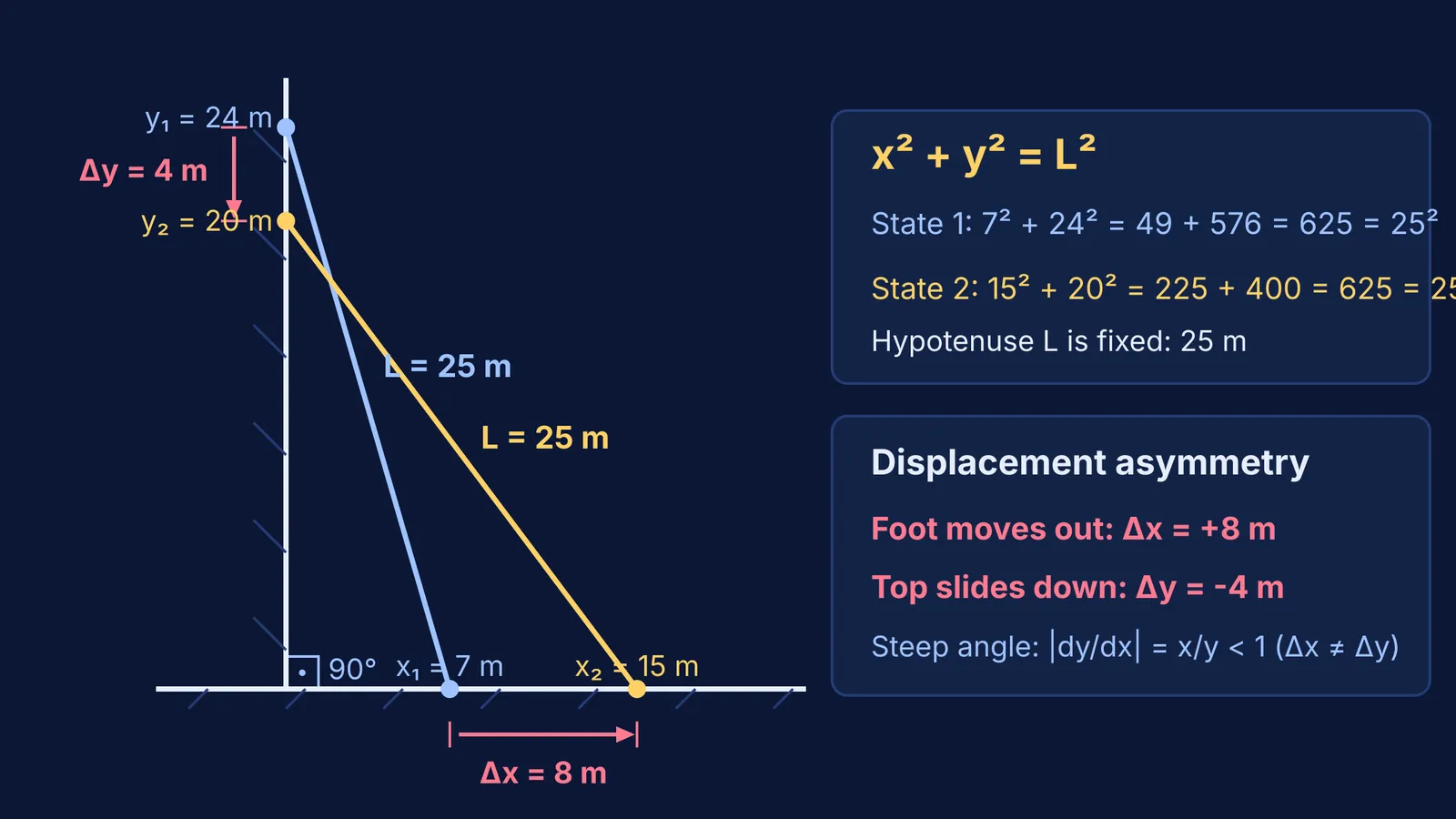
When the foot of the ladder is pulled outward by a distance Δx, students often mistakenly assume the top drops by the exact same amount. Because the formula x² + y² = L² is quadratic rather than linear, the horizontal and vertical shifts are always unequal.
To find the top drop Δy, treat the movement as two separate right triangles sharing the same hypotenuse L:
Initial state: use initial height y₁ and base x₁ to confirm L = √(x₁² + y₁²).
Shifted base: add the outward displacement to find the new base x₂ = x₁ + Δx.
Final height: calculate the new vertical reach y₂ = √(L² − x₂²).
Vertical drop: compute the difference Δy = y₁ − y₂.
For example, in a problem adapted from the NCERT Mathematics textbook, a 25 m ladder rests against a wall and reaches an initial height of y₁ = 24 m. Its initial base is x₁ = √(25² − 24²) = √49 = 7 m. If you pull the foot outward by 8 m, the new base becomes x₂ = 7 + 8 = 15 m.
The new height is y₂ = √(25² − 15²) = √400 = 20 m. The top drops by Δy = 24 − 20 = 4 m. Moving the foot out by a large 8 m causes the top to drop by only 4 m, an asymmetry frequently tested in quadratic word problems.
When solving multi-step geometric shifts like these, the Fermi Problem Library provides worked problems with a step-by-step solver that explains the reasoning rather than printing an answer.
Why is the sliding distance not equal at the top and bottom?
Differentiating x² + y² = L² with respect to x gives 2x + 2y(dy/dx) = 0, which simplifies to dy/dx = −x/y. The drop rate is entirely dependent on the ladder's instantaneous tilt:
Steep ladder (large y, small x): The ratio |dy/dx| = x/y < 1. Shifting the foot outward causes a much smaller drop at the top.
Shallow ladder (small y, large x): The ratio |dy/dx| = x/y > 1. A small pull at the foot makes the top plunge rapidly.
In elementary calculus, assuming the ladder stays pinned to the wall implies an impossible infinite vertical speed as y approaches 0. In reality, as detailed in the American Journal of Physics, M. Freeman and P. Palffy-Muhoray demonstrated that a real ladder loses physical contact with the vertical wall when its top descends to two-thirds of its initial height (which occurs at roughly 48.2° from the vertical when released from rest).
For mechanics problems where static diagrams often hide these changing rates, the Fermi Simulation Lab features interactive simulations for the ideas that are easier to see than to read.
How do safety codes and mechanics apply this geometry?
This exact geometry underpins practical safety out in the real world. Official guidelines from the UK Health and Safety Executive (document LA455) strictly enforce the '1-in-4 rule' for leaning ladders: you must set the base 1 metre away from the wall for every 4 metres of vertical height you intend to reach.
This 1-in-4 ratio produces a safe climbing angle of approximately 75°. By applying Pythagoras, the required ladder length is √(4² + 1²) = √17 ≈ 4.12 m. This arrangement allows the ladder to safely reach 97% of its total length up the wall while maintaining enough friction to prevent the base from slipping, a concept further explored in the physics of torque and equilibrium of leaning ladders.


