

On this page
Trigonometry becomes much easier to grasp when you take it off the page and apply it to the real world. One of the most common applications tested in school is finding the height of a building or the length of a string holding a kite or a balloon. For the CBSE Class 10 Mathematics exams, the chapter "Some Applications of Trigonometry" falls under the Trigonometry unit.
Kite string questions are a staple of these exams. While they might seem like a test of calculation, they are actually testing your ability to translate a real-world picture into a geometric diagram—and then choose the correct mathematical tool to solve it.
What is the angle of elevation?
When you stand on the ground and look up at an object—like a kite flying in the sky—your line of sight forms an angle with the horizontal ground. The angle formed by the line of sight with the horizontal when the object is above the horizontal level is called the angle of elevation.
This is the foundation of Chapter 9 in the official NCERT Class 10 Mathematics textbook. If you draw a vertical line dropping from the kite to the ground, and a horizontal line from your feet to that vertical drop, you create a right-angled triangle.
When should you use sine instead of tangent?
Once you have your right-angled triangle, the biggest hurdle is deciding which trigonometric ratio to use. Students spend so much time calculating the distance to the base of a tower that they often default to using the tangent ratio (tan θ = opposite / adjacent).
However, the tangent ratio only helps when you are dealing with horizontal and vertical distances.
Use tangent (tan) when you know the height and need the distance along the ground, or vice versa.
Use sine (sin) when you know the height and need the length of the diagonal connecting you to the top.
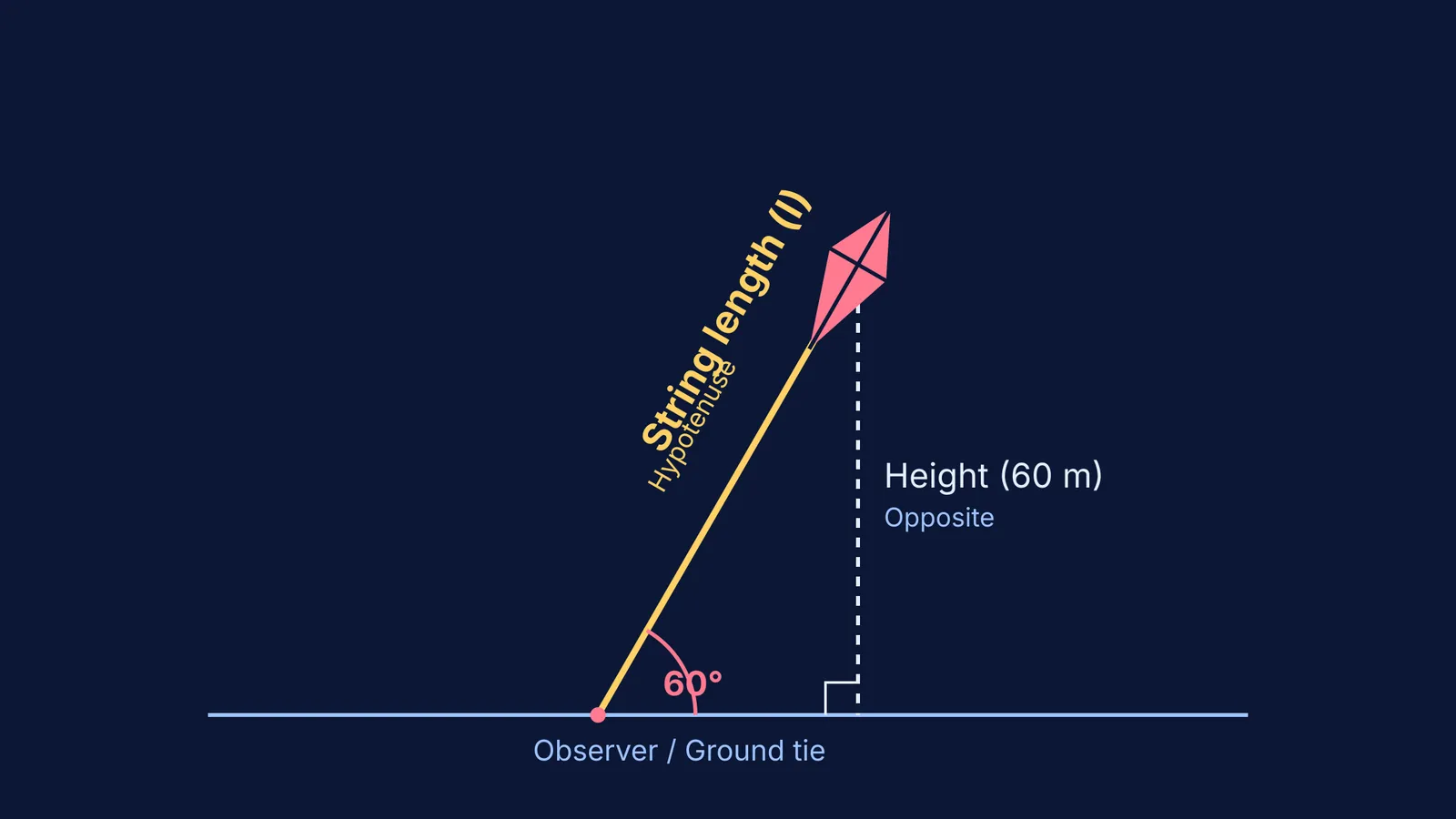
In a kite problem, the vertical height of the kite is the "opposite" side, and the string itself is the diagonal, or the "hypotenuse". Because sine relates the opposite side to the hypotenuse, you must use the sine ratio (sin θ = opposite / hypotenuse) to find the length of a kite string or a ladder leaning against a wall.
If you struggle to recall these relationships during a test, you can review the fundamental ratios in our guide to the Introduction to trigonometry in Class 10.
How to find the length of a kite string?
Let us walk through the classic kite problem (Exercise 9.1, Question 5 from the NCERT textbook).
The problem: A kite is flying at a height of 60 m above the ground. The string attached to the kite is temporarily tied to a point on the ground. The inclination of the string with the ground is 60°. Find the length of the string, assuming that there is no slack.
Step 1: Draw the triangle. Sketch a right-angled triangle. The vertical height (Opposite) is 60 m. The angle at the ground (θ) is 60°. The string is the Hypotenuse (l).
Step 2: Choose the formula. We have the Opposite side and need the Hypotenuse, so we use sine. sin(60°) = Opposite / Hypotenuse
Step 3: Substitute the values. The standard value for sin(60°) is √3/2. √3/2 = 60 / l
Step 4: Solve for the length. l × √3 = 120 l = 120 / √3
To rationalise the denominator, multiply the top and bottom by √3: l = (120 × √3) / 3 = 40√3 metres.
The exact length of the string is 40√3 m (or approximately 69.28 m).
How to avoid common mistakes in trigonometry word problems?
When students struggle with these problems, calculation errors are often not the cause; mistakes frequently happen in the very first step. If the initial diagram is wrong, the correct mathematical answer is impossible.
When practising, try this three-point checklist before writing any equations:
Locate the horizontal: Always draw a clear horizontal line first. Measure the angle of elevation up from this line, never away from the vertical wall or height marker.
Label the observer: If a problem states the observer is 1.5 m tall, draw a rectangle at the base to represent their height, and place the right-angled triangle on top of it.
Check the "ask": Highlight exactly what the question wants. If it asks for the string, label the hypotenuse. If it asks for the distance to the anchor point, label the base.
If you are consistently setting up diagrams incorrectly, the Fermi Concept Library can help. Rather than just giving you the final calculation, Fermi's AI tutor works through the geometry with you, asking you to identify the hypotenuse and the horizontal line before you solve the equation. This ensures you master the setup, which is the most critical part of the problem.
For more advanced applications of these rules, particularly if you are aiming for engineering exams, read our guide on Trigonometric identities and equations: a practice plan for JEE.


