

On this page
When studying human physiology for board exams or NEET, a classic question asks which blood vessel carries the "cleanest" blood. The answer is the renal vein.
Here is why the blood leaving your kidneys has the least urea in the body, and how this system works.
Renal artery and renal vein: which blood is cleaner?
Your kidneys act as the body's primary filtration plants. Their main job is to remove metabolic waste, particularly nitrogen-based waste like urea, from your bloodstream.
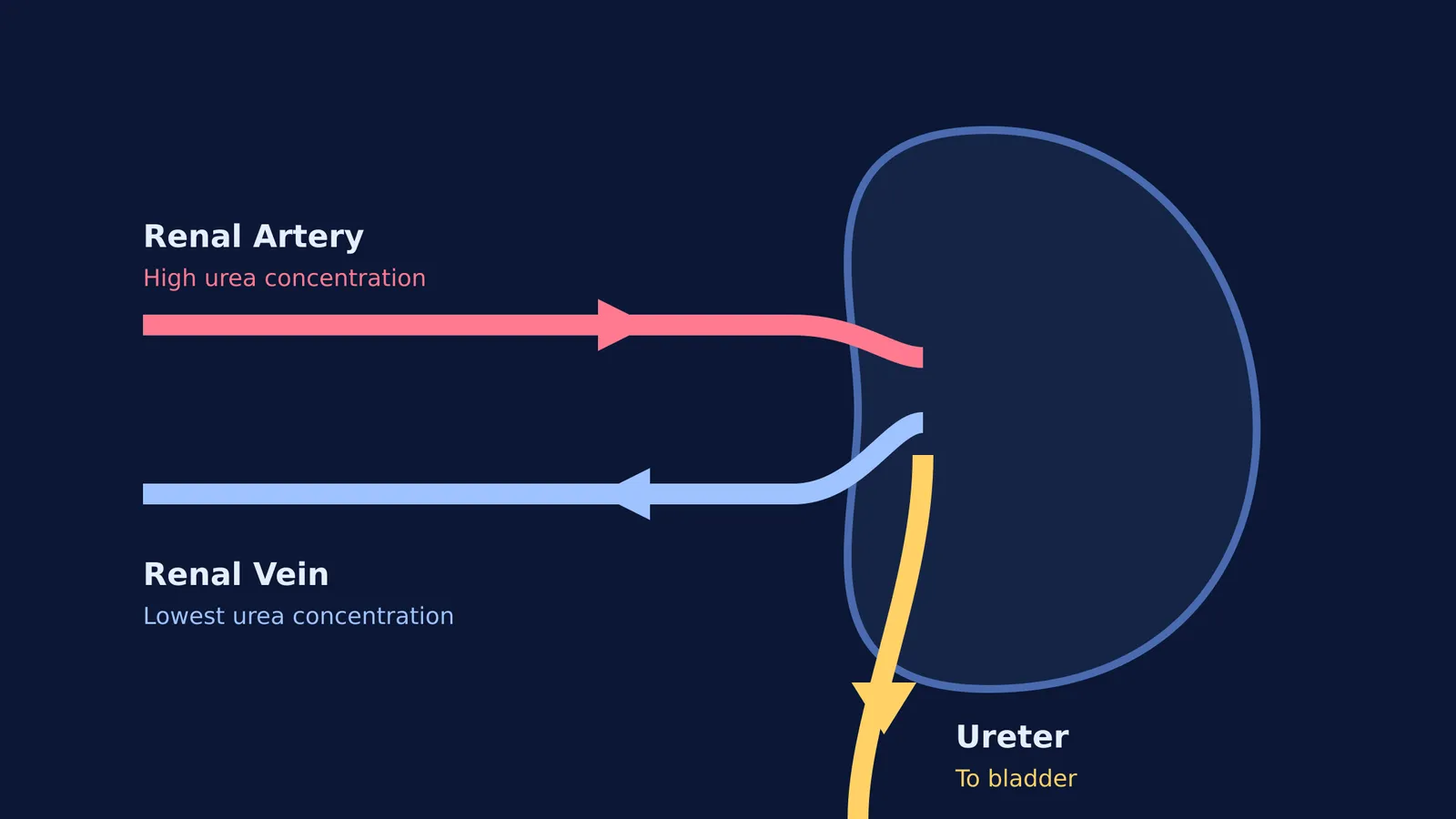
Blood enters the kidney through the renal artery. While this blood is rich in oxygen, it is also loaded with urea that has circulated through the body.
Inside the kidney, microscopic nephrons go to work. The filtration process begins at the renal corpuscle, where blood flows through a small network of capillaries called the glomerulus under high hydrostatic pressure (Wikipedia). This pressure forces water and smaller solutes into the surrounding Bowman's capsule, creating an ultrafiltrate, while retaining large proteins and blood cells. Approximately one-fifth of the blood volume is filtered through the capillary walls during this stage.
Once the ultrafiltrate is collected, it enters the renal tubules for reabsorption and secretion. In the proximal tubule, the majority of essential substances are reabsorbed back into the surrounding capillaries, including 100% of glucose and amino acids, and about 65% of water and sodium (Wikipedia). The filtrate then travels through the loop of Henle, which concentrates the urine by reabsorbing water and ions.
The final stages of processing occur in the distal convoluted tubule and the collecting duct system, where the kidney fine-tunes the balance of electrolytes. Waste products that were not initially filtered are actively secreted from the blood into the tubule. This remaining fluid, now containing concentrated nitrogenous wastes, travels down the ureter to the bladder as urine.
The filtered, "cleaned" blood exits the kidney through the renal vein and returns toward the heart. Because the urea has just been removed by the nephrons, the blood in the renal vein contains the lowest concentration of urea in the entire human body.
Why does the hepatic vein have the most urea?
To fully understand the renal vein's role, you must contrast it with the liver, the body's chemical factory.
When your body breaks down proteins, it produces ammonia, which is highly toxic. If allowed to accumulate in the bloodstream, ammonia can be extremely detrimental. Through a vital biochemical pathway called the urea cycle, the liver converts this dangerous ammonia into urea, a relatively safer and water-soluble compound that can be transported in the blood (Wikipedia).
This process involves a series of enzymatic steps spanning both the mitochondria and the cytosol of liver cells. By safely converting ammonia into urea, the body can transport nitrogenous waste without altering the blood's pH to a dangerous level.
The blood leaving the liver via the hepatic vein carries this newly synthesised urea directly into the main circulation. Therefore, the hepatic vein has the highest concentration of urea in the body.
How do comparison questions appear in exams?
This physiological pathway is a favourite among examiners because it tests your ability to track a substance through multiple organ systems.
Comparison Questions: You will frequently see questions asking you to compare the renal artery and the renal vein. The key distinction to remember:
Renal Artery: High oxygen, high urea.
Renal Vein: Lower oxygen (as the kidney tissue consumed some), but the lowest urea.
Multiple Choice Distractors: A common question asks, "Which of the following blood vessels contains the minimum amount of urea?" Options might include the hepatic vein, renal artery, pulmonary vein, and renal vein. Knowing that the liver produces urea and the kidney removes it makes the renal vein the definitive answer.
How can you master human physiology with Fermi?
Visualising how blood flows and where waste is transferred can be challenging. Fermi's AI tutor helps you trace these physiological pathways step-by-step, helping you understand the "why" behind the facts.
If you struggle with exam questions about nephrons or the urea cycle, the Fermi Concept Library breaks down the excretory system. You can explore the exact structures involved, such as the capsule that filters blood in the kidney and the loop that concentrates urine.
When you are ready to test your knowledge, try the Fermi Problem Library to work through comparison questions on the renal and hepatic systems, getting clear explanations for every step of the reasoning.


