

On this page
When you study organic chemistry for board exams or competitive tests like JEE and NEET, one of the most reliable rules is how carbonyl compounds react with oxygen. While aldehydes readily accept an oxygen atom, ketones refuse to budge unless you force them.
This difference in reactivity is a common testing ground. Let's look at why ketones behave this way, what happens when they finally do oxidise, and how Popoff's rule tells you exactly which products will form.
Why do ketones resist mild oxidising agents?
Aldehydes and ketones both contain a carbonyl group (C=O). The crucial difference lies in what is attached to that carbon. In an aldehyde, the carbonyl carbon is bonded to at least one hydrogen atom. This carbon-hydrogen bond breaks easily during oxidation, allowing the molecule to turn into a carboxylic acid without disrupting its carbon skeleton.
Because of this vulnerable C-H bond, aldehydes react with weak oxidising agents. You see this in the lab when you study Tollens' and Fehling's tests to identify which carbonyl compounds pass them. A mild reagent is enough to oxidise the aldehyde and precipitate a silver mirror or a red copper oxide solid.
Ketones, however, have two alkyl groups attached to the carbonyl carbon. There is no hydrogen atom on the carbonyl carbon to remove. This structural difference makes them highly resistant to mild oxidation. If you add Tollens' reagent to a ketone, nothing happens. The reaction mixture remains completely unchanged because the mild oxidant cannot break a strong carbon-carbon bond.
Why do ketones need strong oxidising agents?
To oxidise a ketone, you must break a carbon-carbon (C-C) bond, which requires powerful oxidising agents at elevated temperatures 1.
Carbon-carbon bonds are strong and stable, so mild reagents simply do not have the energy to cleave them. Instead, you need vigorous conditions. The oxidation of ketones typically involves strong oxidising agents such as concentrated nitric acid (HNO₃), acidic potassium permanganate (KMnO₄/H⁺), or acidic potassium dichromate (K₂Cr₂O₇/H⁺) accompanied by prolonged heating.
Under these harsh conditions, the ketone first tautomerises to form an enol intermediate. The strong oxidising agent then attacks the carbon-carbon double bond of this enol, cleaving the molecule entirely.
When the reaction finally happens, the carbon chain snaps. Because the molecule is split into pieces, the oxidation of ketones produces a mixture of carboxylic acids, each of which has fewer carbon atoms than the original ketone. This is fundamentally different from reduction reactions, where methods like Clemmensen and Wolff-Kishner for reducing a C=O group to CH2 leave the carbon chain intact.
How does the carbon chain break?
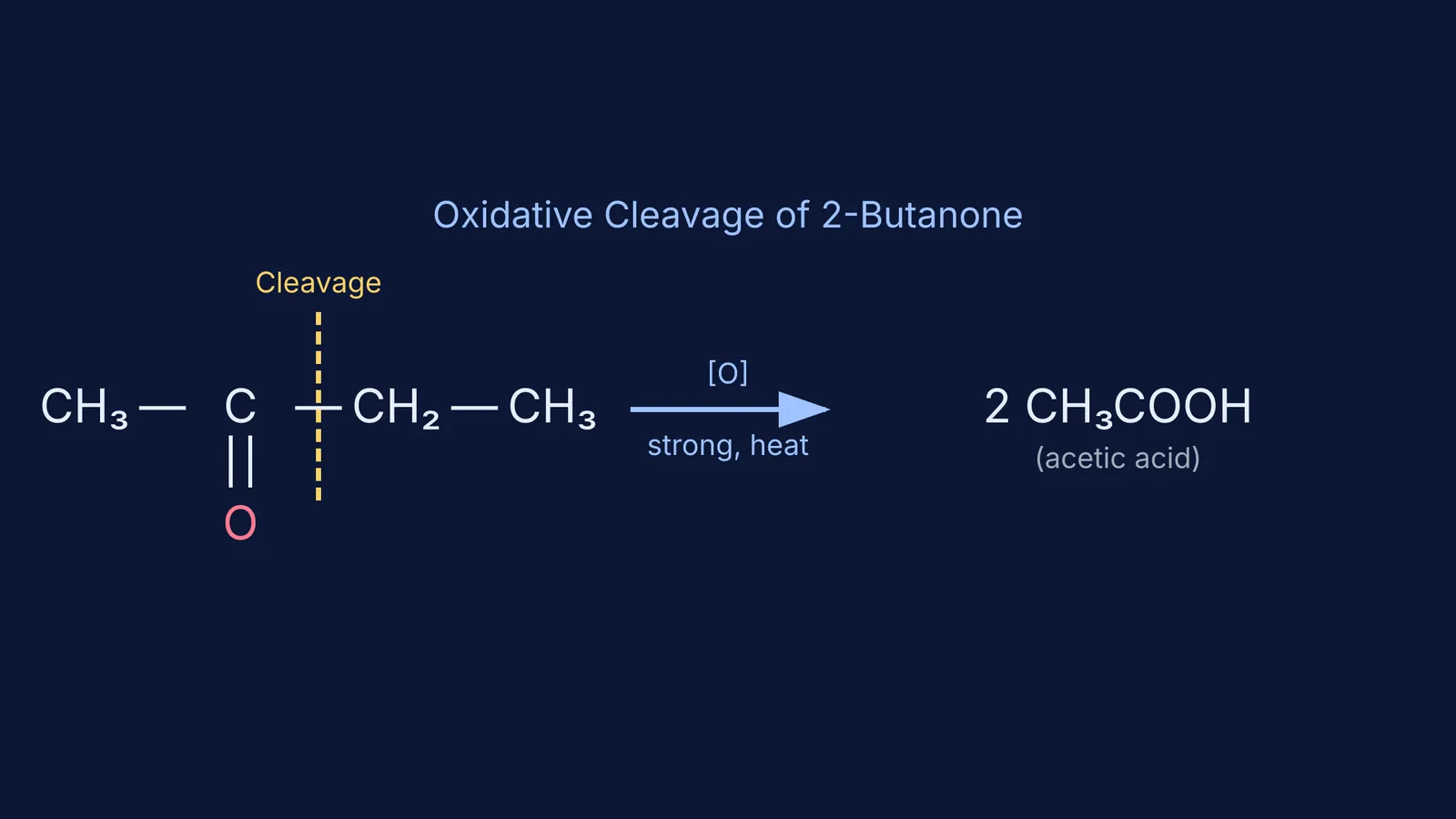
For a symmetrical ketone like propanone (acetone) or pentan-3-one, the cleavage is straightforward. The bond breaks on either side of the carbonyl group, yielding the same set of products. For instance, oxidising propanone gives you a mixture of ethanoic acid and methanoic acid (which can further oxidise to carbon dioxide and water under vigorous conditions).
However, for an unsymmetrical ketone, the carbonyl carbon has a choice: it can stay with the alkyl group on its left, or the one on its right. This is where an empirical guideline known as Popoff's rule comes in.
Consider the oxidation of pentan-2-one (CH₃–CO–CH₂–CH₂–CH₃). The carbonyl group sits between a small methyl group (one carbon) and a larger propyl group (three carbons). According to Popoff's rule, the C=O group remains with the smaller methyl group.
The cleavage occurs between carbon-2 and carbon-3. The CH₃–CO– fragment becomes ethanoic acid (acetic acid, containing two carbons), and the –CH₂–CH₂–CH₃ fragment oxidises to propanoic acid (containing three carbons).
This predictability is incredibly useful when you need to plan a multi-step synthesis. Knowing exactly which carboxylic acids will form allows chemists to work backwards and choose the right unsymmetrical ketone as their starting material.
How can you master organic mechanisms?
Predicting the major product is half the battle; understanding how the electrons move makes the rules impossible to forget. If you find yourself memorising empirical rules without seeing why the bonds break, the Fermi Concept Library can help.
When you bring a tricky organic chemistry topic to Fermi, the AI tutor does not just hand you the final mixture of carboxylic acids. It works out what you already know and builds a plan for the session, teaching through the mechanism step-by-step. The tutor writes out the enol intermediate on the board, showing exactly where the strong oxidant attacks the double bond to cleave the chain.
By seeing the reaction play out, you learn to trust the underlying chemistry rather than just the final rule.


