

On this page
When you switch on an alternating current (AC) in a solenoid with an iron core, a loose metal ring placed on top will suddenly launch into the air. This classic demonstration—following in the footsteps of researchers like Nicholas Callan and the induction coil—is a staple of physics classrooms. But why exactly does it happen?
The answer lies in two fundamental laws of electromagnetism: Faraday’s Law of Induction and Lenz’s Law.
How does a changing magnetic field induce a current?
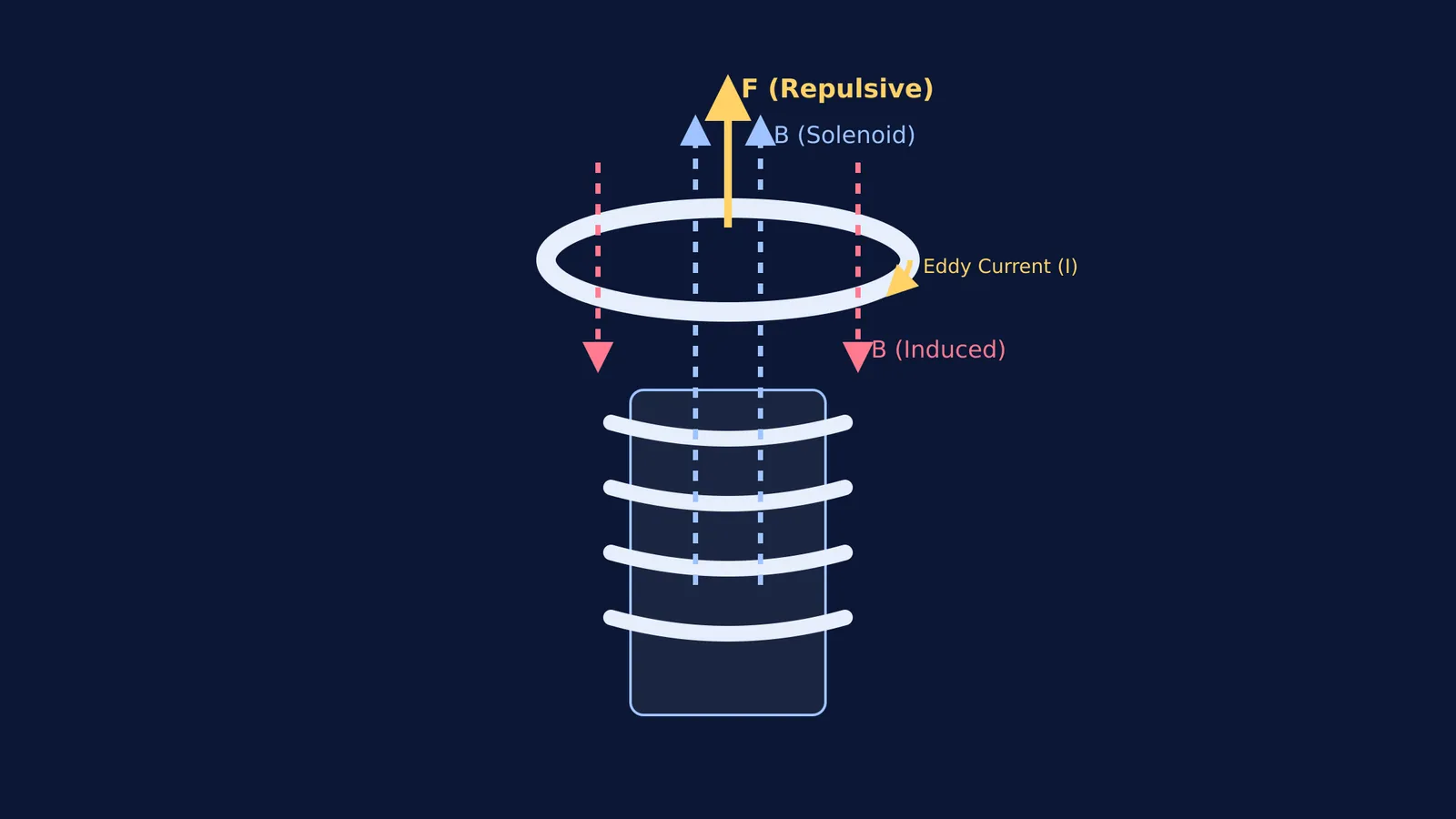
When an alternating current flows through the solenoid, it creates a magnetic field that is constantly changing in magnitude and direction. The iron core acts as a guide, directing this magnetic flux upwards through the centre of the metal ring.
According to Faraday's Law (which also explains the circulating E inside a solenoid), this changing magnetic flux induces an electromotive force (EMF) within the ring. Because the ring—usually made of aluminium or copper—is a good conductor and forms a closed loop, the EMF drives a large current round it. These circulating currents are known as eddy currents.
Why does the ring jump off the solenoid?
The current induced in the ring does not just flow; it creates a magnetic field of its own.
Lenz's Law states that the direction of an induced current will always be such that it creates a magnetic field opposing the change in the original flux. If the solenoid's magnetic field is pointing upwards and increasing, the ring's induced current will circulate in a direction that creates a downward magnetic field.
Because the two magnetic fields oppose each other—like forcing the north poles of two magnets together—they generate a strong repulsive force. This magnetic push is what overcomes gravity and launches the ring into the air.
To see how these opposing fields stack up and change across a cycle, you can explore the Fermi Concept Library, which connects Faraday's and Lenz's laws in an interactive map.
What happens if you cool the ring?
If the ring is dipped in liquid nitrogen before being placed on the core, it jumps much higher. Cooling a metal lowers its electrical resistance, dropping it by a factor of about 2 for an aluminium ring (Harvard Natural Sciences Lecture Demonstrations). With lower resistance, the same induced EMF generates a much larger eddy current. A larger current means a stronger opposing magnetic field, resulting in a more violent repulsion.
How does this apply to Maglev trains?
The jumping ring is a foundational example of electrodynamic suspension (EDS), which is the exact principle used to levitate high-speed trains like the Japanese SCMaglev. In an EDS maglev train, both the track and the train exert a magnetic field.
Instead of a simple AC solenoid, the train uses powerful superconducting magnets. As the train moves forward, its magnetic field sweeps past conducting strips or coils built into the guideway. Just like the ring on the solenoid, the changing magnetic flux induces an electromotive force in the track's coils. This creates an opposing magnetic field that repels the train's magnets, lifting the entire vehicle.
A unique limitation of this system is that it requires speed to work. At slow speeds, the change in magnetic flux is too gradual, meaning the induced current is not large enough to produce a repulsive force capable of supporting the train's weight. Because of this, electrodynamic suspension trains must rely on standard wheels or landing gear until they accelerate to a speed where the magnetic levitation can take over.
Exam checklist: writing the perfect answer
If you are asked to explain the jumping ring in a physics paper (like JEE or board exams), make sure you hit these four points to get full marks:
Identify the cause: State that the AC current creates a changing magnetic flux through the ring.
Name the first law: Cite Faraday's Law to explain that this changing flux induces an EMF and current in the ring.
Name the second law: Cite Lenz's Law to explain that the induced current's magnetic field opposes the solenoid's field.
Conclude with the force: Explain that the opposing fields create the repulsive force that lifts the ring.
This logic works for the jumping ring, but you can also apply it to eddy current brakes and induction cooktops. If you want to practise applying these steps to harder induction questions, the Fermi Problem Library has worked problems with a step-by-step solver that explains the reasoning rather than printing an answer.


