

On this page
Isostructural species are a frequent topic in chemistry exams like JEE Main and NEET. The prefix *iso-* means "same", and *structural* refers to the spatial arrangement of atoms.
So, two molecules or ions are isostructural if they share the exact same 3D shape. Note that this is different from being isoelectronic (having the same number of electrons). Isostructural species can have completely different total electron counts, as long as their central atoms have the same geometry. For a deeper look, read VSEPR and molecular shapes: predict geometry in four steps.
To decide if two species share a shape, you match their hybridization and lone pairs. Here is how to work it out step by step.
How do you find if two species are isostructural?
You do not need to memorize every shape. Instead, the Valence Shell Electron Pair Repulsion (VSEPR) model assumes that electron domains arrange themselves around a central atom to minimize repulsion.
By counting the number of bond pairs and lone pairs around the central atom, you can determine its hybridization and its resulting shape. The steps are straightforward:
Count valence electrons: Identify the central atom and write down its group number to find its valence electrons.
Adjust for charge: If the species is a cation, subtract that number from the valence electrons. If it is an anion, add it.
Count bonding and lone pairs: Each surrounding atom forms a single bond. Count how many electrons are used up. The remaining valence electrons form lone pairs (divide by two).
Find hybridization and shape: Add the number of bonds and lone pairs to get the electron domains.
2 domains = sp (Linear)
3 domains = sp² (Trigonal planar if 0 lone pairs; Bent if 1)
4 domains = sp³ (Tetrahedral if 0 lone pairs; Trigonal pyramidal if 1; Bent if 2)
If both species end up with the same final shape (e.g., both are tetrahedral, or both are trigonal planar), they are isostructural. As discussed in Dipole moments and molecular polarity: predicting from shape, the resulting symmetry from these shapes also dictates whether the molecule is polar or non-polar.
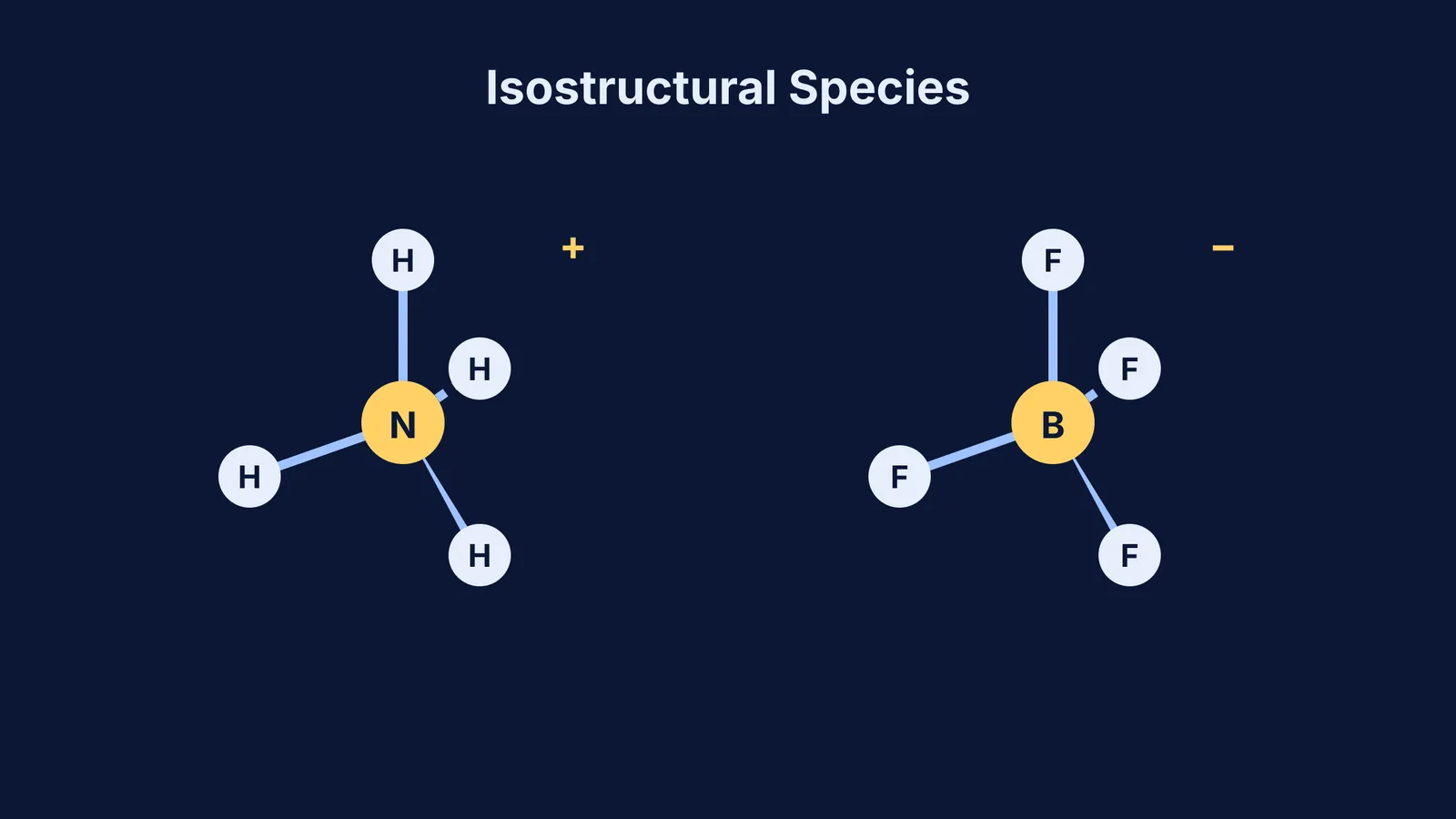
Are NH₄⁺ and BF₄⁻ isostructural?
Let us test the ammonium ion (NH₄⁺) and the tetrafluoroborate ion (BF₄⁻).
For NH₄⁺:
The central nitrogen (N) atom is in Group 15, so it has 5 valence electrons.
The +1 charge means we remove one electron, leaving 4 available.
Nitrogen bonds with 4 hydrogen atoms, using all 4 electrons. There are 0 lone pairs.
With 4 bonding pairs and 0 lone pairs, the steric number is 4. The shape is tetrahedral.
For BF₄⁻:
The central boron (B) atom is in Group 13, so it has 3 valence electrons.
The −1 charge means we add one electron, giving 4 available.
Boron bonds with 4 fluorine atoms, using all 4 electrons. There are 0 lone pairs.
With 4 bonding pairs and 0 lone pairs, the steric number is 4. The shape is tetrahedral.
Because both NH₄⁺ and BF₄⁻ have a tetrahedral shape, they are isostructural.
If you struggle to picture these arrangements, the Fermi Concept Library maps out every concept in chemistry, each with its own lesson.
Are CO₃²⁻ and NO₃⁻ isostructural?
Let us test carbonate (CO₃²⁻) and nitrate (NO₃⁻).
For CO₃²⁻:
Carbon has 4 valence electrons.
The −2 charge brings the total to 6 electrons.
Oxygen atoms form double bonds, but for VSEPR, each oxygen counts as one domain. Carbon uses all 6 electrons to bond with 3 oxygens.
There are 3 bonding domains and 0 lone pairs. The hybridization is sp² and the shape is trigonal planar.
For NO₃⁻:
Nitrogen has 5 valence electrons.
The −1 charge brings the total to 6 electrons.
Nitrogen bonds with 3 oxygens, using all 6 electrons.
There are 3 bonding domains and 0 lone pairs. The hybridization is sp² and the shape is trigonal planar.
Both CO₃²⁻ and NO₃⁻ are trigonal planar, so they are isostructural.
How do you check for isostructural species in exams?
When you spot a "which of the following pairs are isostructural?" multiple-choice question on an exam, use this checklist:
Same central atom group and same charge? They likely have the same shape.
Different central atoms? Calculate the bond pairs and lone pairs for each.
Beware of lone pairs: Ammonia (NH₃) and boron trifluoride (BF₃) both have 3 surrounding atoms. But NH₃ has 1 lone pair (sp³, trigonal pyramidal), while BF₃ has 0 lone pairs (sp², trigonal planar). They are *not* isostructural. If there are lone pairs involved, as discussed in Interhalogen compounds: shapes of ClF3, BrF5 and IF7 for JEE, the shape will deviate from the regular geometry.
If you are losing marks on these types of questions, the Fermi Problem Library offers worked problems with a step-by-step solver that explains the reasoning rather than printing an answer.


