

On this page
What are the five aromatic isomers of C7H8O?
Calculating the degree of unsaturation (double bond equivalent, DBE) for the formula C7H8O gives: 7 + 1 − (8 / 2) = 4. An aromatic benzene ring accounts for all 4 units through three conjugated double bonds and one ring closure. That leaves one carbon atom, two hydrogen atoms, and one oxygen atom to position around the ring.
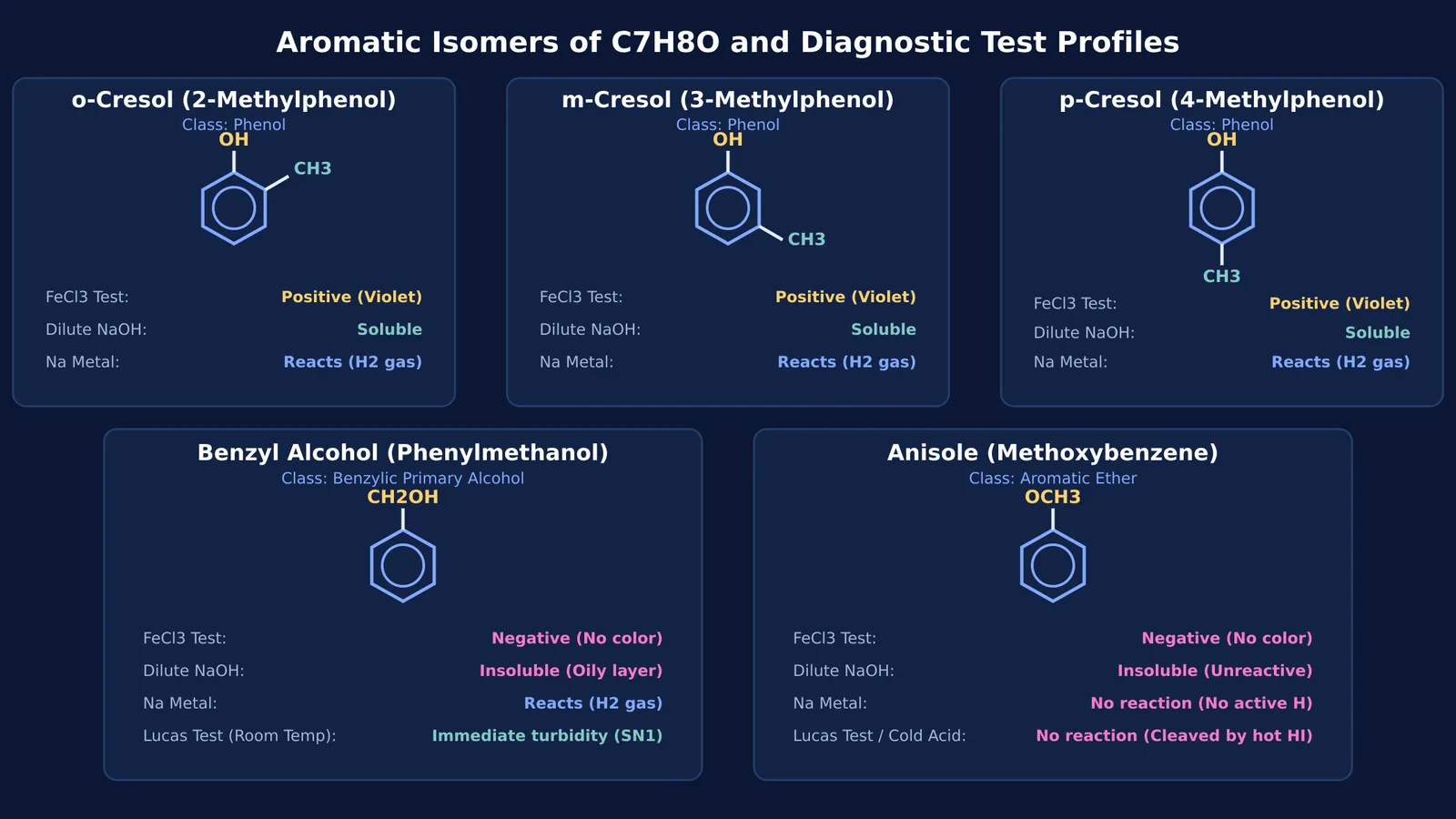
This yields five constitutional isomers across three functional classes:
Three cresols (monomethyl phenols): The hydroxyl group (−OH) binds directly to the benzene ring, with a methyl group (−CH3) at the ortho, meta, or para position. PubChem records show that ortho-cresol (CID 7237) boils at 191 °C with a pKa of 10.28, meta-cresol (CID 342) boils at 202.2 °C with a pKa of 10.09, and para-cresol (CID 2879) boils at 201.9 °C with a pKa of 10.14.
One primary aromatic alcohol: In benzyl alcohol (phenylmethanol, C6H5CH2OH), the −OH attaches to a benzylic sp³ hybridised carbon. According to PubChem CID 244, it boils at 205.3 °C with a pKa of 15.40 at 25 °C.
One aromatic ether: In anisole (methoxybenzene, C6H5OCH3), oxygen bridges the phenyl ring and a methyl group. As catalogued in PubChem CID 7519, it boils at 154 °C.
Just as when identifying structural isomers of C4H10O, organising isomers by functional class prevents missing structures that span different functional groups.
Which C7H8O isomers react with sodium metal, NaOH, and neutral FeCl3?
The chemical behaviour of these five isomers depends on whether the oxygen atom carries an active proton and whether that proton sits on an aromatic or aliphatic carbon:
Reaction with dry sodium metal: Sodium reacts with compounds containing acidic hydrogen attached to oxygen. Four isomers—ortho-cresol, meta-cresol, para-cresol, and benzyl alcohol—readily liberate hydrogen gas (2 R−OH + 2 Na → 2 R−ONa + H₂). Anisole is an ether lacking an O−H bond, so it does not react.
Solubility in aqueous sodium hydroxide (NaOH): Cresols are phenols with pKa values near 10.1 to 10.3 (PubChem CID 7237), making them sufficiently acidic to dissolve in dilute aqueous base as water-soluble sodium cresylates. Benzyl alcohol, with a pKa of 15.40 (PubChem CID 244), is too weakly acidic to deprotonate in dilute aqueous base and remains an insoluble oily layer. Anisole also does not dissolve.
Neutral ferric chloride (FeCl3) test: According to the standard ferric chloride test, neutral FeCl3 identifies phenolic groups. All three cresols yield an intense violet coordination complex ([Fe(OC6H4CH3)6]³⁻). Benzyl alcohol and anisole give no colour change.
Because cresols have strongly activated rings, they also mirror phenol during electrophilic substitution in bromination of phenol, forming polybrominated precipitates with bromine water.
Why does benzyl alcohol give immediate turbidity in the Lucas test?
Class 12 textbooks state that primary aliphatic alcohols do not react with Lucas reagent (concentrated hydrochloric acid and anhydrous zinc chloride) at room temperature. Yet benzyl alcohol produces immediate white turbidity under the same conditions.
The difference stems from carbocation stability. When the hydroxyl group of benzyl alcohol protonates and leaves as water, it forms a benzyl carbocation (C6H5CH2⁺). This carbocation is stabilised by resonance delocalisation across the aromatic ring, enabling a rapid SN1 reaction. Chloride ion attacks the carbocation to form benzyl chloride, which is insoluble in the aqueous reagent and separates as an instant cloudy suspension.
Cresols cannot undergo this substitution because partial double-bond character in the aryl carbon-oxygen bond prevents carbocation formation. Anisole also resists Lucas reagent, though heating it with concentrated hydroiodic acid cleaves the ether bond, a reaction key to synthesising alkyl aryl ethers via Williamson ether synthesis.
When you encounter unexpected reaction pathways in organic problems, the Fermi Problem Library provides worked problems with a step-by-step solver that explains the reasoning rather than printing an answer. For structured review of reaction mechanisms and functional groups, the Fermi Concept Library covers every concept in chemistry, each with its own lesson and its place in the map.
How do you systematically identify an unknown C7H8O isomer?
When an exam question presents an unknown aromatic compound with formula C7H8O, follow this three-step elimination roadmap:
Test with sodium metal: If no hydrogen gas bubbles form, the substance is anisole. If effervescence occurs, it is either a cresol or benzyl alcohol.
Shake with aqueous NaOH: If the compound dissolves and forms a violet complex with neutral FeCl3, it is a cresol. If it remains insoluble and gives no color with FeCl3, it is benzyl alcohol.
Confirm benzyl alcohol: Adding Lucas reagent produces immediate white turbidity at room temperature.
To differentiate the three cresols, test their bromination products:
Meta-cresol has three positions activated by both substituents, producing a tribromo derivative with excess bromine water.
Ortho-cresol and para-cresol each produce dibromo derivatives because one active ring position is occupied by the methyl group. Para-cresol yields the symmetrical 2,6-dibromo product, identifiable by its melting point.


