

On this page
How many carboxylic acids have the formula C4H8O2?
With a degree of unsaturation of one, every C4H8O2 isomer contains exactly one double bond or ring. For carboxylic acids, that unsaturation resides in the carboxyl group (–COOH). Subtracting –COOH leaves a three-carbon saturated alkyl chain, –C3H7.
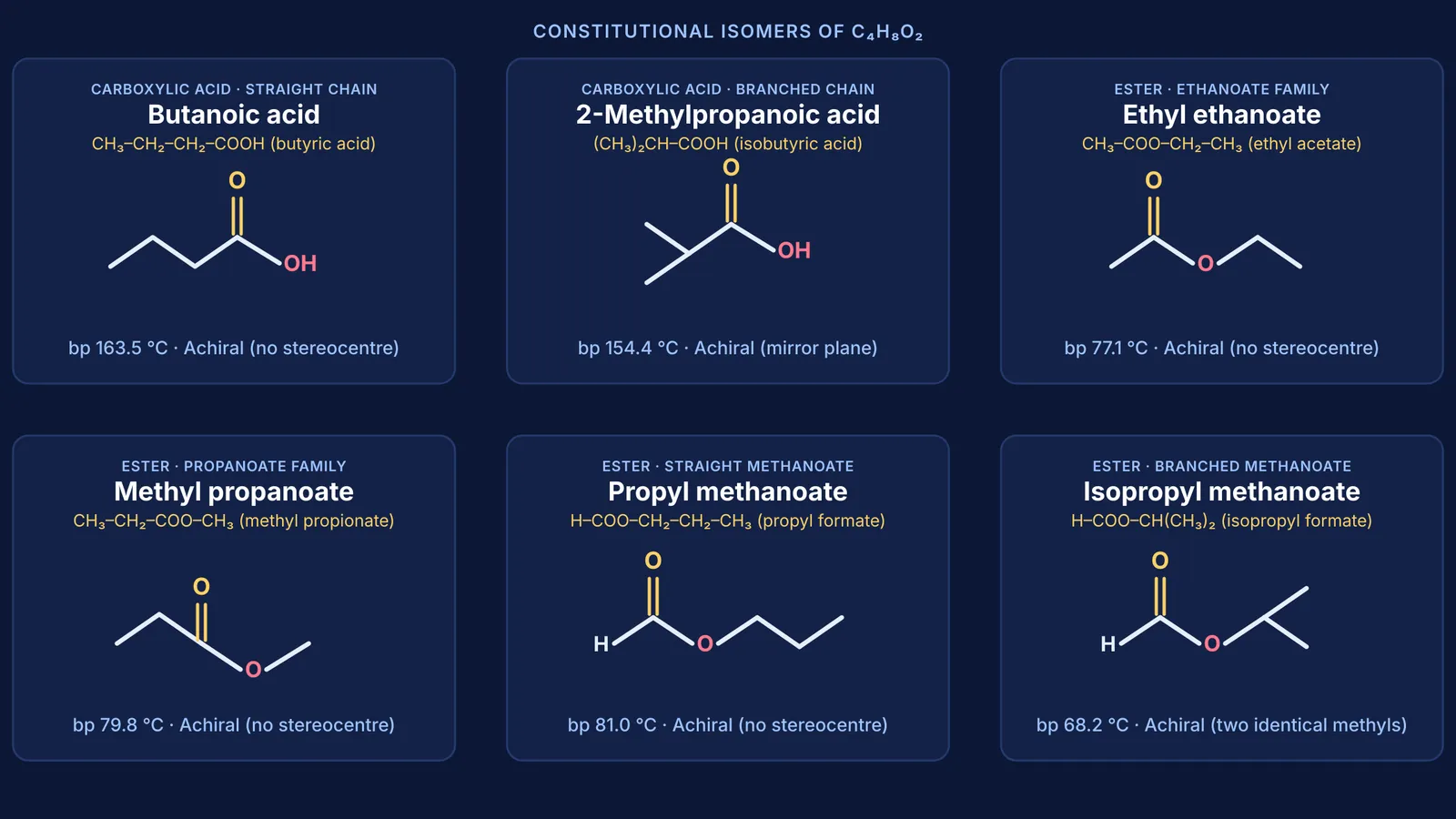
Because a propyl fragment has two distinct constitutional attachments, there are exactly two carboxylic acids with formula C4H8O2:
Butanoic acid: A straight chain with the structure CH3–CH2–CH2–COOH, historically named butyric acid and catalogued as PubChem CID 264.
2-Methylpropanoic acid: A branched chain with the structure (CH3)2CH–COOH, known as isobutyric acid and indexed as PubChem CID 6590.
Under IUPAC Organic Nomenclature Recommendations, numbering starts at the carbonyl carbon as C1. These two compounds share the –COOH functional group but differ in carbon branching, making them chain isomers, just like the straight and branched alkanes introduced in structural isomers in Class 10.
How do you name the four esters of C4H8O2?
Esters share the general formula R–COO–R' and act as functional isomers of carboxylic acids. Systematic IUPAC rules name the alkoxy group R' first as a separate word, followed by the acyl parent chain R–CO– ending in "-oate". Because R' must carry at least one carbon, the remaining three carbons divide across the ester bridge in three ways:
Acyl group with zero carbons (R = H, methanoates): The three remaining carbons form either a straight chain in propyl methanoate (propyl formate, PubChem CID 8073), H–COO–CH2–CH2–CH3, or a branched group in isopropyl methanoate (1-methylethyl methanoate, PubChem CID 12257), H–COO–CH(CH3)2.
Acyl group with one carbon (R = –CH3, ethanoates): The alkoxy side takes two carbons as an ethyl group, producing ethyl ethanoate (ethyl acetate, PubChem CID 8857), CH3–COO–CH2–CH3.
Acyl group with two carbons (R = –CH2–CH3, propanoates): The alkoxy side takes the final carbon as a methyl group, producing methyl propanoate (methyl propionate, PubChem CID 11124), CH3–CH2–COO–CH3.
These four esters are metamers of one another because their carbon counts differ on either side of the divalent –COO– bridge. They form through the acid-catalysed equilibrium explored in Fischer esterification mechanism.
Are any carboxylic acids or esters of C4H8O2 chiral?
A classic trap on competitive exams asks which C4H8O2 acid or ester rotates plane-polarised light. The answer is none: all six isomers are achiral and optically inactive.
By IUPAC Stereochemistry Recommendations, a tetrahedral carbon is a stereocentre only when bonded to four chemically distinct groups, ensuring the molecule lacks an internal symmetry plane (σ). In all six isomers, every saturated carbon fails this condition:
Butanoic acid: Carbon-2 and carbon-3 are –CH2– methylene units, while carbon-4 is a –CH3 methyl group, each carrying multiple identical hydrogen atoms.
2-Methylpropanoic acid: Carbon-2 is bonded to –COOH and –H, but its other two ligands are identical methyl groups (–CH3), creating a mirror plane through the central C–H bond.
Esters: In propyl methanoate, ethyl ethanoate, and methyl propanoate, every sp³ carbon is either –CH2– or –CH3. In isopropyl methanoate, the central alkoxy carbon is attached to –H, –OOCH, and two identical methyl groups.
While C4H8O2 forms chiral isomers among hydroxy-carbonyls like 2-hydroxybutanal, none of its acids or esters possesses a stereocentre, as explained in counting stereoisomers from chiral centres.
How do physical properties separate acids from esters?
Despite sharing an identical molecular mass of 88.11 g/mol recorded across their PubChem records, the physical properties of these isomers diverge because of intermolecular forces. Carboxylic acids form strong, cyclic hydrogen-bonded dimers, driving their boiling points far higher than those of esters.
As documented in the NIST Chemistry WebBook for butanoic acid, butanoic acid boils at approximately 163 °C, while branched 2-methylpropanoic acid boils at 154 °C. In comparison, esters lack hydroxyl protons and cannot form hydrogen bonds among themselves. Data from the NIST Chemistry WebBook for ethyl acetate show that ethyl ethanoate boils at 77.1 °C, methyl propanoate boils at 80 °C, propyl methanoate boils at 81 °C, and isopropyl methanoate boils at 68 °C.
In the laboratory, two standard tests distinguish these functional families:
Sodium bicarbonate test: Carboxylic acids liberate carbon dioxide gas with brisk effervescence upon adding aqueous NaHCO3, while esters remain completely unreactive.
Tollens' test: Propyl methanoate and isopropyl methanoate retain an aldehydic hydrogen (H–C=O) and reduce Tollens' reagent to a silver mirror, whereas ethyl ethanoate and methyl propanoate do not.
When you practice sorting constitutional isomers and IUPAC names, the Fermi Problem Library has worked problems with a step-by-step solver that explains the reasoning rather than printing an answer. To explore how functional groups fit into broader reaction pathways, the Fermi Concept Library arranges every concept in physics, chemistry, biology, mathematics and computing, each with its own lesson and its place in the map.


