

On this page
When you see the formula C₃H₆O₂ in a chemistry problem, the question usually asks you to find its structural isomers. Because it contains two oxygen atoms, the most familiar answers are carboxylic acids and esters. But the full list of open-chain isomers also includes compounds with both a hydroxyl group and a carbonyl group.
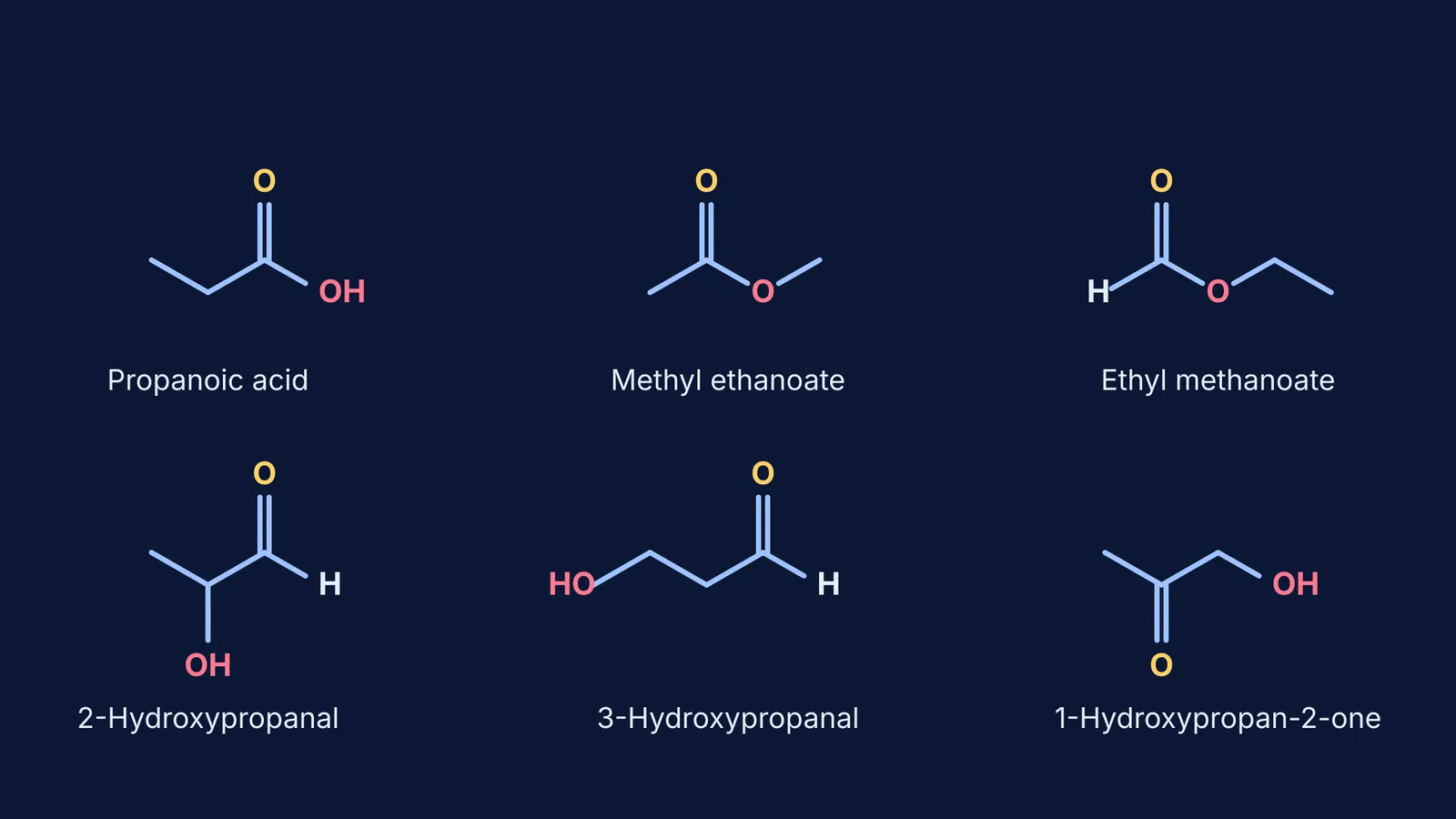
Here is the systematic way to identify all six stable acyclic isomers of C₃H₆O₂, complete with their IUPAC names and structures.
What is the degree of unsaturation for C3H6O2?
Before drawing any structures, you need to know what kinds of bonds are possible. The first step is to calculate the degree of unsaturation, also known as the double bond equivalent (DBE).
The degree of unsaturation for C₃H₆O₂ is 1. A DBE of 1 means that every isomer must contain exactly one double bond (such as C=O or C=C) or one ring. For standard exam questions, we focus on the stable acyclic (open-chain) isomers, much like when drawing structural isomers in Class 10. This means we will be drawing structures that contain exactly one double bond. Given the two oxygen atoms, this double bond is almost always a carbonyl group (C=O), which provides the foundation for our six isomers.
What are the acid and ester isomers of C3H6O2?
If both oxygen atoms are part of the same functional group, the molecule is either a carboxylic acid or an ester. Just as you separate C4H10O isomers into alcohols and ethers, you must split C₃H₆O₂ into its distinct functional families to ensure you count them all.
There is only one carboxylic acid with three carbons.
Propanoic acid (also called propionic acid): The IUPAC name for this three-carbon acid is propanoic acid, with the structure CH₃CH₂COOH. It is an oily liquid that occurs naturally and acts as a preservative.
If the compound is an ester, the oxygen bridge splits the three carbons into two parts. You can have a methyl group on one side and an ethyl group on the other, giving two possible arrangements:
Methyl ethanoate (common name methyl acetate): The structure is CH₃COOCH₃. The carbonyl group is attached to a single methyl carbon.
Ethyl methanoate (common name ethyl formate): The structure is HCOOCH₂CH₃. The carbonyl group is attached only to a hydrogen atom, while the ester oxygen connects to an ethyl chain.
What are the hydroxy carbonyl isomers of C3H6O2?
If the two oxygen atoms are in separate functional groups, you must draw a molecule with one hydroxyl group (–OH) and one carbonyl group (C=O). These are called hydroxy carbonyls, and they can be either aldehydes or ketones.
There are two hydroxy aldehydes:
2-Hydroxypropanal (lactaldehyde): The hydroxyl group is on the second carbon, giving the structure CH₃CH(OH)CHO. Notice that the second carbon is a chiral centre, meaning this compound exists as two enantiomers (read more on counting stereoisomers from chiral centres), though they count as one structural isomer.
3-Hydroxypropanal: The hydroxyl group is on the third carbon, giving HOCH₂CH₂CHO, a compound also known as reuterin in microbiology.
There is only one hydroxy ketone:
1-Hydroxypropan-2-one (hydroxyacetone): The carbonyl group must be on the central carbon to form a ketone, forcing the hydroxyl group to sit on an end carbon. This simplest alpha-hydroxyketone has the structure CH₃COCH₂OH.
How do you systematically count isomers in exams?
When counting structural isomers, you should never guess. Use this step-by-step checklist to ensure you find every valid compound without drawing duplicates:
Calculate the DBE: Confirm how many rings or double bonds you have to work with.
List possible functional groups: For C₃H₆O₂ with one double bond, write down "acid, ester, hydroxy aldehyde, hydroxy ketone".
Draw the carbon skeletons: Sketch the straight chain of three carbons, then map where the double-bonded oxygen and single-bonded oxygen can attach.
Move the functional groups: Shift the –OH group along the chain to find position isomers, checking that you have not drawn the same molecule backwards.
Name every structure: Assigning IUPAC names ensures that any duplicate drawings will be revealed instantly.
If you often miss isomers or draw duplicates by accident, the Fermi Concept Library maps out how functional groups relate to each other so you can see the complete picture. When you are practising these structural derivations, Fermi's AI tutor works alongside you. If you drop a hydrogen when drawing a structure or lose track of a chiral centre, the tutor notices where you are stuck and explains the bonding rules before you move on, rather than just printing the final answer.
By learning to read the degree of unsaturation and checking every combination of functional groups logically, you can tackle any isomer question with total confidence.


