

On this page
The chemical formula C₂H₄O₂ is a classic example of functional isomerism. Functional isomerism occurs when compounds share the exact same molecular formula but possess completely different functional groups. Because functional groups act as the reactive centres of molecules, functional isomers do not just look different on paper—they exhibit entirely different physical properties, boiling points, and chemical reactivities.
In the case of C₂H₄O₂, the allocation of two oxygen atoms allows for the formation of a carboxyl group (−COOH), an ester linkage (−COO−), or a combination of a hydroxyl (−OH) and an aldehyde (−CHO) group. Understanding these structures is critical because they dictate how each compound reacts in the laboratory.
What are the isomers of C₂H₄O₂?
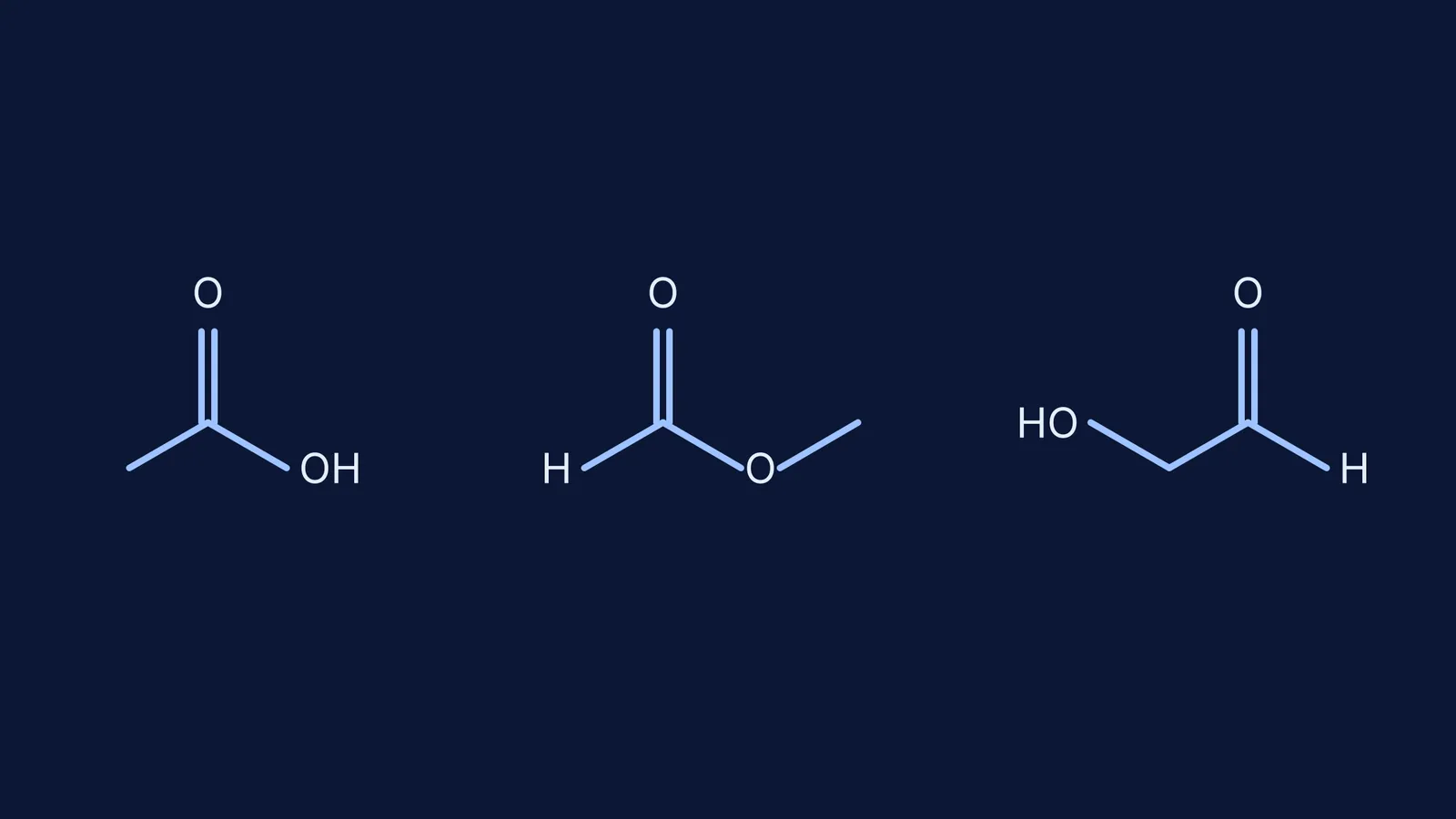
The three main structural isomers have distinct properties and applications:
Ethanoic acid (acetic acid): A carboxylic acid with the formula CH₃COOH. It is an acidic, colourless liquid and the active component of vinegar.
Methyl methanoate (methyl formate): The methyl ester of formic acid (HCOOCH₃). It is a colourless liquid characterised by its ethereal odour and high vapour pressure.
Hydroxyethanal (glycolaldehyde): The smallest possible molecule that contains both an aldehyde group and a hydroxyl group (HOCH₂CHO).
Because these molecules possess different functional groups, they behave entirely differently during chemical analysis. When you use the Fermi Concept Library to explore organic chemistry, seeing these structural differences side by side makes predicting their reactivity much easier.
Related: Ethanol and ethanoic acid: Class 10 properties and reactions
How to test for ethanoic acid (acetic acid)?
The simplest way to identify the carboxylic acid isomer is the sodium bicarbonate test.
The procedure: Add an aqueous solution of sodium bicarbonate (NaHCO₃) to the sample.
The result: A positive test produces brisk effervescence as carbon dioxide (CO₂) gas evolves.
The reaction is a straightforward acid-base neutralisation. Because carboxylic acids are stronger acids than carbonic acid, they successfully displace CO₂ from bicarbonates. The other two isomers (the ester and the aldehyde) are essentially neutral in water and lack an acidic proton, meaning they are not sufficiently acidic to react with NaHCO₃. This rapid bubbling is the universal first check for any unknown organic acid.
Is there a chemical test for methyl methanoate?
Yes, you can identify methyl methanoate using tests specific to esters. In its structure, the acidic hydrogen of formic acid has been replaced by a methyl group. This seemingly small structural change completely removes the molecule's ability to act as a traditional acid. While its distinct fruity or ethereal smell is a strong qualitative indicator, the hydroxamic acid test is a definitive chemical method.
The procedure: React the sample with hydroxylamine hydrochloride in a strong base, and then add a solution of ferric chloride (FeCl₃).
The result: A deep violet or reddish-purple color confirms the presence of an ester.
The chemistry behind this test involves two steps. First, the ester reacts with hydroxylamine to form a hydroxamic acid intermediate. Second, the addition of ferric ions (Fe³⁺) creates a brightly coloured, highly stable coordination complex.
Esters can also undergo alkaline saponification, where they are heated with a strong base like sodium hydroxide to yield a salt and an alcohol. If you struggle to track the movement of electrons during hydrolysis or esterification, practising with the Fermi Problem Library allows you to step through the reaction mechanisms logically, rather than merely memorising them.
Related: Fischer esterification: mechanism and how to push the equilibrium
How does hydroxyethanal react with Tollens' reagent?
Hydroxyethanal is uniquely interesting because it conforms to the general carbohydrate formula, Cₙ(H₂O)ₙ, and is considered the simplest possible sugar (a diose). Because it contains an aldehyde group (−CHO), it acts as a strong reducing agent. This makes it responsive to standard aldehyde tests that both ethanoic acid and methyl methanoate will confidently fail.
The procedure: Add the sample to Tollens' reagent—a freshly prepared solution of silver nitrate, ammonium hydroxide, and sodium hydroxide—and warm the vessel gently in a water bath.
The result: The aldehyde reduces the aqueous silver ions (Ag⁺) to elemental silver (Ag⁰), precipitating as a brilliant "silver mirror" on the inside of the glass test tube.
Alternatively, heating the sample with Fehling's solution (a deep blue mixture containing copper(II) sulfate and potassium sodium tartrate) will yield a brick-red precipitate of copper(I) oxide (Cu₂O). The blue Cu²⁺ ions are successfully reduced to red Cu⁺ ions by the aldehyde group.
Related: Reducing and non-reducing sugars: why sucrose fails Tollens' test
Lab Identification Checklist
If you are handed an unmarked vial containing one of these C₂H₄O₂ isomers, you can determine its precise identity in three quick steps:
Add NaHCO₃: If it fizzes immediately, you have ethanoic acid.
Add Tollens' reagent: If a silver mirror forms upon gentle heating, you have hydroxyethanal.
Perform the hydroxamic acid test: If the solution turns deep purple, you have methyl methanoate.


