

On this page
Have you ever wondered what happens when you mix two different acids that happen to have the exact same pH? You might expect a complex reaction or a shift in acidity depending on their volumes, but the result is surprisingly simple. The pH does not change at all. These are called isohydric solutions, and their properties make calculating acid dilutions much easier.
What is an isohydric solution?
Isohydric solutions are two or more solutions of different solutes that have the exact same concentration of a common ion. Most typically, this common ion is the hydrogen ion (H⁺). Because they share the exact same [H⁺] concentration, they also have the exact same pH value.
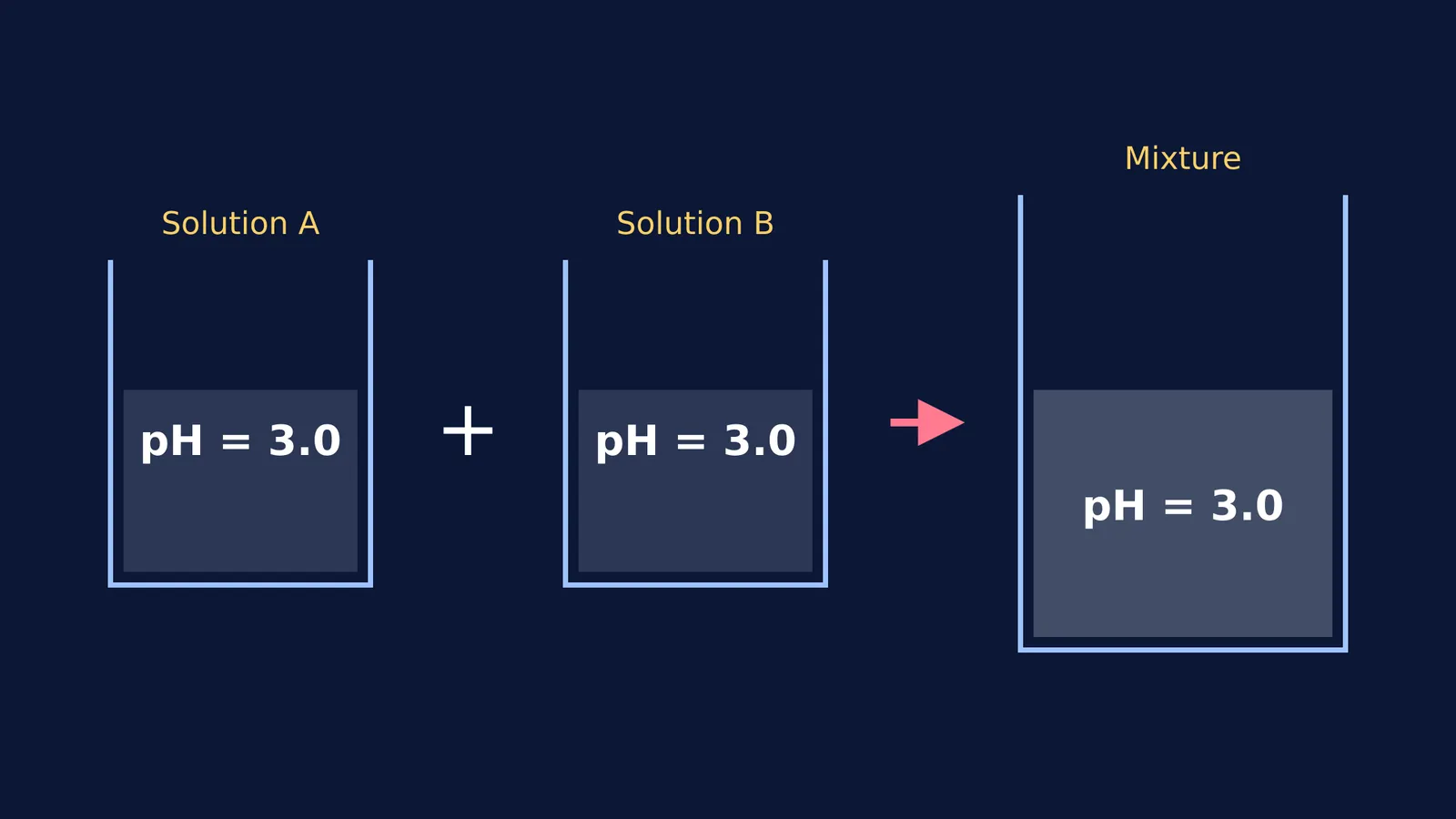
This means if you take a beaker of acetic acid at a pH of 3.0 and another beaker of formic acid at a pH of 3.0, these two solutions are isohydric to each other. Even though acetic acid and formic acid have different acid dissociation constants (Ka) and must therefore have different total concentrations to reach that pH of 3.0, the actual amount of free hydrogen ions in the water is identical in both beakers.
Understanding this concept is crucial for students tackling complex equilibrium problems, as it simplifies situations that look mathematically intimidating.
Why does the pH remain unchanged on mixing?
When you mix two isohydric solutions, the pH of the resulting mixture remains exactly the same as the original solutions.
This happens because of the common ion effect. The dissociation of a weak acid in water is an equilibrium process that is driven by how many H⁺ ions are already present in the solution. Because both solutions already contain the exact same concentration of hydrogen ions before they meet, neither acid feels a "push" or "pull" to dissociate more or less when they are poured together. The degree of dissociation (α) for each acid in the mixture stays exactly as it was in its separate container.
In a sense, the acids cannot tell that they have been mixed. The environment they experience—the surrounding concentration of H⁺—has not changed, so their equilibrium position does not shift.
How does the common ion effect control the equilibrium?
To understand this deeply, look at the equilibrium expression for a generic weak acid, HA. The dissociation reaction is HA ⇌ H⁺ + A⁻, and the equilibrium constant is Ka = ([H⁺][A⁻]) / [HA].
When you mix two isohydric acids, say HA₁ and HA₂, they both contribute to the total [H⁺] in the new mixture. However, because the [H⁺] of the individual solutions was exactly the same, the concentration of [H⁺] in the final blended volume remains unchanged. The ratio of [A⁻] to [HA] for the first acid is locked by its Ka and the common [H⁺]. Since neither Ka nor [H⁺] has changed, the ratio remains constant. The equilibrium does not shift forward or backward.
How to calculate the dilution for isohydric acids?
A common exam problem asks you to find the concentration or dilution needed to make two weak acids isohydric. We can find this by equating their hydrogen ion concentrations.
For a weak acid HA₁ with dissociation constant K₁ and concentration C₁, the hydrogen ion concentration is roughly √(K₁ × C₁). For a second weak acid HA₂ with constant K₂ and concentration C₂, its hydrogen ion concentration is √(K₂ × C₂).
If they are isohydric, we set them equal: √(K₁ × C₁) = √(K₂ × C₂)
Squaring both sides gives the standard isohydric formula: K₁ × C₁ = K₂ × C₂
If you need help checking your reasoning on dilution calculations, the Fermi Problem Library has worked problems with a step-by-step solver that explains the reasoning rather than printing an answer.
Where does the isohydric principle apply in nature?
This mathematical curiosity is actually what keeps you alive. In human blood, a mixture of carbonic acid and bicarbonate is present in the plasma to maintain the pH between 7.35 and 7.45. However, blood also contains phosphate buffers and protein buffers.
The isohydric principle is the phenomenon whereby multiple acid and base pairs in a solution will be in equilibrium with one another, tied together by their common hydrogen ion. This means if a metabolic change shifts the balance of the bicarbonate system, it instantly shifts the phosphate and protein systems too. Clinicians only need to measure one buffer pair (usually CO₂ and bicarbonate) to know the state of all the others, because the shared H⁺ pool forces them to move together.
How is this used in laboratory practice?
In a laboratory, chemists and biologists frequently rely on this principle when designing complex experiments. When researchers need to create a buffer solution for delicate enzyme assays or cell cultures, they often need to mix multiple buffer components to achieve a broader buffering capacity.
By ensuring that the different buffer solutions are isohydric before mixing them, the researcher guarantees that the final mixture will be immediately ready for use at the target pH. They do not have to spend extra time carefully titrating the final mixture with strong acids or bases to correct sudden pH swings that might otherwise occur upon mixing.
What are the common exceptions?
The rule that mixing isohydric solutions does not change the pH is strictly limited to systems where only acid-base equilibria are involved and the solutes do not interact directly. The pH might change if:
Mixing the two solutions triggers a new chemical reaction, such as forming a complex ion.
A solid precipitate forms, removing ions from the solution.
An oxidation-reduction reaction occurs between the components.
The solutions are extremely concentrated, changing the activity coefficients of the ions.
When you are preparing for exams, you might also need to practice mixing and diluting solutions or finding the pH of a very dilute acid where water's own dissociation matters. And remember that true neutrality is a moving target—you can read how the neutral pH changes with temperature to see why pH 7 isn't always neutral.


