

On this page
If you are working through the Class 10 Mathematics syllabus, you will come across a classic problem in the Arithmetic Progressions chapter: check whether 301 is a term of the list of numbers 5, 11, 17, 23.
This question tests a key idea in sequences. While you can calculate a theoretical position for any number, the sequence itself only exists at whole-number counting steps. You cannot have a "two-and-a-half-th" term.
Is 301 a term of the AP check?
Let's break down the sequence to see how the numbers grow. The list of numbers is 5, 11, 17, 23, and so on.
First, we find the common difference (d) by subtracting the first term (a) from the second: 11 − 5 = 6 17 − 11 = 6 23 − 17 = 6
Since the difference is a constant 6 every time, this is an arithmetic progression with a = 5 and d = 6.
To check if 301 is a term, we use the formula for the nth term of an AP: aₙ = a + (n − 1)d
We want to know if there is a valid position n where the term value aₙ equals 301.
How do you know if a number is a term at all?
The position of a term in any sequence must be a counting number—a positive integer like 1, 2, 3, or 50.
If we substitute 301 into our formula and solve for n, the result will tell us exactly where 301 would sit. If n works out to be a neat integer, the number is in the sequence. If n contains a fraction or a decimal, the number falls between two valid terms and is not part of the progression.
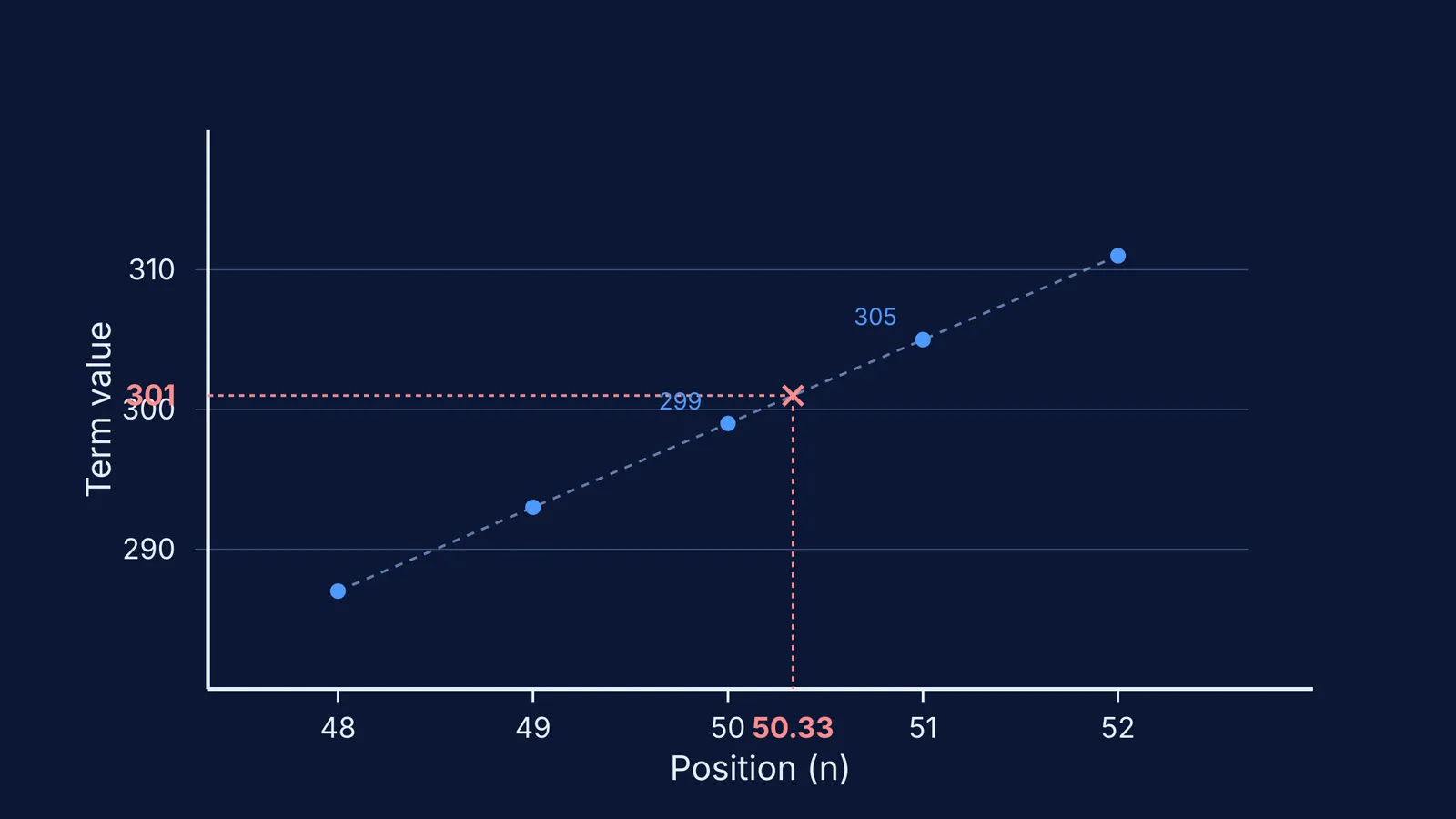
A sequence like an arithmetic progression is essentially a function where the domain is restricted to the natural numbers. While a continuous line graph of a similar equation would pass straight through the non-integer point, an arithmetic progression is more like a series of isolated stepping stones. If you try to step onto a value that does not belong, your foot lands in the empty space between two valid stones. Understanding this difference between continuous lines and discrete points is a crucial step in mastering algebra and sequences.
What is the exact position of 301?
Let's put our values into the formula and solve for n: 301 = 5 + (n − 1)6
Subtract 5 from both sides: 301 − 5 = (n − 1)6 296 = 6(n − 1)
When you reach this stage, you might be tempted to reach for a calculator and find n − 1 = 49.33. While this is mathematically correct, working with fractions is often safer in exam conditions. Fractions preserve the exact value and make it immediately obvious whether a number divides neatly.
Divide both sides by 6: 296 / 6 = n − 1 148 / 3 = n − 1
Add 1 to both sides: n = 148/3 + 1 n = (148 + 3) / 3 n = 151 / 3
Since 151 / 3 simplifies to 50.33, n is not a positive integer. Therefore, 301 is not a term of the given list of numbers.
If we calculate the nearby valid terms, the 50th term is 299 (5 + 49 × 6) and the 51st term is 305 (5 + 50 × 6). The number 301 simply gets skipped over as the sequence jumps by 6.
Mastering sequences and progressions
Understanding how formulas connect to the real shape of a sequence helps you spot mistakes early. If you need to quickly check another sequence or find three terms that add up to a specific number, read our guide on choosing a − d, a, a + d for three numbers in AP or GP or how to use the subtraction trick for recovering aₙ from a formula for Sₙ.
For a complete map of sequences, series and every other mathematics topic, explore the Fermi Concept Library. It covers every concept in physics, chemistry, biology, mathematics and computing, each with its own lesson and its place in the map. As you work through the ideas, Fermi's AI tutor can explain the reasoning, write on a board, draw the figure, and check your understanding as it goes.


